

By Moktan Sir | Geopolitical Analysis | 29 October 2026
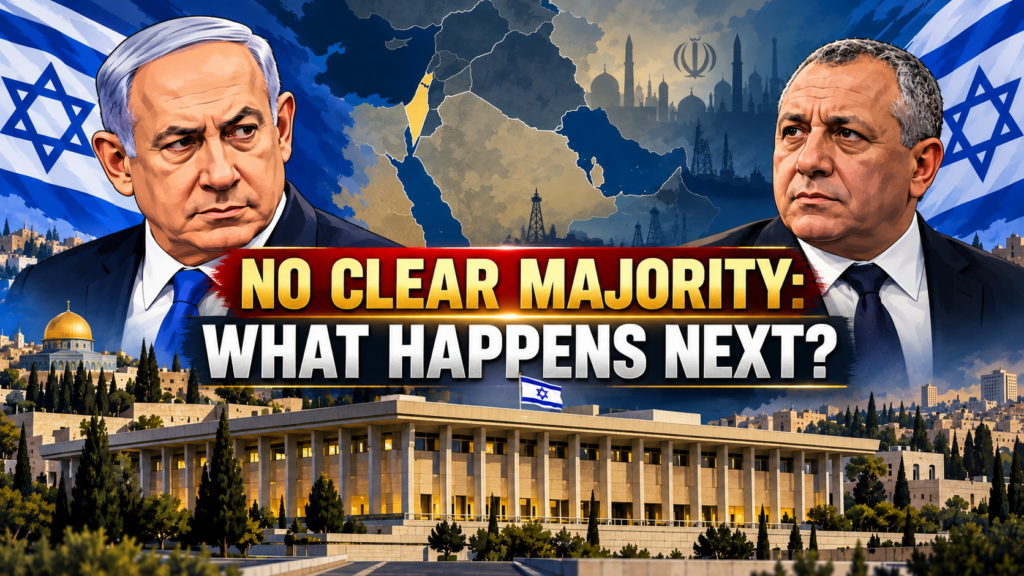
Israel has voted, but the election has not delivered a clear path to government. With Benjamin Netanyahu’s bloc and the opposition led by Gadi Eisenkot both short of a parliamentary majority, coalition negotiations could determine the country’s political direction and influence its relations with Iran, the Palestinians, the United States, Europe and India.
Introduction: An Election Without a Clear Winner
Elections are supposed to provide political clarity. Israel’s latest parliamentary election has produced a more complicated result. The election held on 27 October 2026 has left Israel facing a difficult question: who can assemble enough parliamentary support to govern?
According to the partial results reported on 28 October, Prime Minister Benjamin Netanyahu’s right-wing and religious bloc is projected to win approximately 53 seats in the 120-member Knesset. The opposition bloc led by former military chief Gadi Eisenkot is projected to secure around 48 seats, while Arab-led parties could collectively win approximately 19 seats. The final distribution may change as counting continues. Neither main bloc has reached the 61 seats required for a parliamentary majority.
The result creates a political contest in which parliamentary arithmetic, ideological differences and negotiations between parties may matter as much as the number of seats won by the largest party. The implications extend well beyond Israel’s borders. The government that eventually emerges will influence decisions on national security, the conflict with Iran, the future of Gaza, relations with Washington and Israel’s wider diplomatic position.
However, one distinction is important: a hung parliament does not automatically mean political paralysis, a change of prime minister or a new election. Those outcomes depend on what happens during the coalition-building process.
Understanding Israel’s Hung Parliament
Israel operates under a parliamentary system with proportional representation. Voters elect political parties to the Knesset, which has 120 seats. A government needs parliamentary support from at least 61 members to secure a majority.
Because Israeli politics is divided among several parties with different ideological, religious and security priorities, governments are generally formed through coalitions. This system gives smaller parties considerable influence. A party with only a handful of seats may become decisive when the larger blocs cannot govern independently. The current election illustrates this problem.
Netanyahu’s Likud-led bloc has not secured enough seats to govern on its own. Eisenkot’s opposition bloc faces the same difficulty. Arab-led parties, meanwhile, may hold enough seats to influence which side can assemble a viable government.
The outcome therefore depends on more than the identity of the largest party. It depends on which candidate can persuade enough lawmakers to support a government.
Under Israel’s constitutional process, President Isaac Herzog consults the elected parties before assigning a member of the Knesset the task of forming a government. The designated candidate normally has 28 days, with a possible 14-day extension, to complete the task. If the process fails, further attempts or another election may follow under the applicable rules.
The country’s political future will consequently be determined over the coming weeks rather than by the election-night figures alone.
Scenario One: Netanyahu Forms Another Government
The first possibility is that Netanyahu remains prime minister by assembling a coalition or obtaining additional parliamentary support. His political bloc has approximately 53 seats in the reported partial count. It therefore needs support from at least eight additional lawmakers to reach the 61-seat threshold.
The challenge is finding partners willing to join or support his government. Political disagreements over security, religious policy, military service and the direction of the country could make negotiations difficult.
Netanyahu could attempt to attract support from opposition lawmakers, negotiate with smaller parties or explore a broader political arrangement. However, public commitments made during the campaign may limit his options. If Netanyahu forms a government, continuity in several areas of Israeli policy would be possible.
Consequences for Iran
A Netanyahu-led government would likely maintain a strong emphasis on confronting perceived Iranian security threats. The precise approach would depend on intelligence assessments, military developments, American policy and the condition of regional diplomacy.
The election result alone cannot establish whether Israel would undertake further military action against Iran. Such decisions depend on circumstances beyond parliamentary seat totals. Nevertheless, the formation of a government committed to Netanyahu’s existing security approach could reduce uncertainty about the broad direction of Israeli policy.
Consequences for Gaza
A government led by Netanyahu could continue to face difficult choices over security arrangements, humanitarian access, negotiations concerning hostages where relevant, reconstruction and the future political administration of Gaza. Its ability to pursue particular policies would depend on the demands of coalition partners, international pressure and developments on the ground.
Consequences for the United States
Washington would continue to face the task of balancing its security partnership with Israel against wider regional priorities. The United States could seek to influence decisions concerning Iran, Gaza and regional diplomacy through military cooperation, negotiations and diplomatic pressure. The extent of that influence would depend on the priorities of both governments.
A Netanyahu victory in coalition negotiations would therefore represent political continuity, but it would not guarantee that every existing policy remained unchanged.
Scenario Two: Gadi Eisenkot Builds an Alternative Government
The second possibility is that Eisenkot succeeds in forming a government without Netanyahu. His opposition bloc has approximately 48 seats in the partial count. Together with the roughly 19 seats projected for Arab-led parties, the two groups would have a theoretical total of 67 seats. Numerically, this would be enough to cross the parliamentary majority threshold.
Politically, however, the calculation is much more complicated. The opposition includes parties with different views on national security, religion, economic policy and the Palestinian question. Arab-led parties also have their own priorities and conditions for cooperation.
Some opposition leaders have expressed reservations about working with Arab parties, while the parties themselves may prefer supporting an arrangement from outside the government rather than taking cabinet positions. Consequently, the combined seat total should not be mistaken for an established coalition.
If Eisenkot succeeds, the new government could attempt to change the tone of Israel’s domestic and foreign policy. Possible areas of change include:
- A review of national security decision-making and the political accountability surrounding the 7 October 2023 attacks.
- A different approach to relations with the United States and European governments.
- New discussions about the future administration of Gaza and the management of regional conflicts.
- Changes in domestic policy concerning military service, religious exemptions and relations between different communities.
The extent of these changes would depend on the coalition agreement. An opposition government would still have to manage Israel’s security concerns, parliamentary divisions and the expectations of its own supporters. A change of prime minister would not automatically produce a peace agreement with the Palestinians or end the confrontation with Iran.
Scenario Three: A National Unity Government
A third possibility is a national unity government involving parties from opposing political camps. Such an arrangement could be designed to provide greater parliamentary stability during a period of regional uncertainty.
A unity government might agree on certain national priorities while postponing or compromising on more divisive domestic issues. Its members could also negotiate arrangements for the distribution of cabinet positions and responsibilities. However, the political obstacles are substantial.
Eisenkot’s opposition has campaigned against Netanyahu’s leadership, while Netanyahu has called for a strong right-wing government. A coalition that brings the two sides together would require significant political compromises.
The parties would also need to address questions concerning accountability for the 2023 security failures, the conduct of military operations, relations with religious parties and the future of the Palestinian territories.
A unity government could provide a framework for cooperation, but its stability would depend on whether its members could agree on the most important questions facing the country. For international partners, such a government could create opportunities for negotiations. It would not necessarily produce agreement on every regional issue.
Scenario Four: Another Election
If coalition negotiations fail, Israel may have to return to the polls. The country has experienced repeated elections and prolonged coalition negotiations in recent years. The current result raises the possibility of another period of political uncertainty.
A fresh election would allow parties to seek a new mandate. It could also deepen political divisions if voters return a similarly fragmented parliament. There would be costs to such an outcome. Government formation could be delayed, political parties might concentrate on domestic competition, and difficult decisions could become more complicated.
Importantly, an election deadlock would not leave Israel without a government. The outgoing government can continue in a caretaker capacity until a successor takes office, although the political circumstances may affect its freedom of action in practice.
This is particularly relevant for foreign policy. A caretaker administration retains substantial executive responsibilities, including national security and diplomacy. Political uncertainty therefore does not automatically suspend military or diplomatic decisions.
For regional governments, the question would be whether Israel’s political transition changes its decisions or merely delays the formation of a new coalition.
Iran: The Most Immediate Geopolitical Concern
Israel’s political future cannot be separated from its confrontation with Iran. The two countries have been involved in a prolonged strategic rivalry, with disputes concerning Iran’s nuclear programme, regional armed groups, missile capabilities and Israel’s security.
The government that emerges from the election will have to decide how to balance military deterrence, intelligence operations, diplomatic engagement and cooperation with Washington.
A Netanyahu-led government could maintain the security approach associated with his leadership. An Eisenkot-led government could review elements of that approach, although it would still have to respond to Israel’s security assessments. Neither scenario establishes that a new war will occur or that tensions will decline.
Three developments deserve particular attention. First, whether Israel and Iran continue direct military confrontation or return to a period of deterrence. Second, whether Washington supports additional pressure on Tehran or pursues negotiations aimed at reducing the risk of escalation. Third, whether regional governments can prevent a bilateral confrontation from expanding into a wider conflict.
The consequences could extend beyond the two countries. A serious escalation could affect Gulf security, commercial shipping, energy markets and the security of American personnel in the region.
For countries dependent on imported energy, including India, the economic consequences could be significant. The election does not determine these outcomes. It determines who will make decisions on Israel’s side of this strategic contest.
Gaza and the Future of the Palestinian Question
The election also matters for the future of Gaza and the wider Israeli-Palestinian conflict. The central questions include security arrangements, humanitarian assistance, reconstruction, political representation and the long-term status of the Palestinian territories.
An Israeli government must address domestic security concerns while managing international demands concerning civilian protection and humanitarian access. A change of leadership could affect the methods used to pursue these objectives. It would not, by itself, resolve the fundamental disagreements over Palestinian statehood, Israeli security and the political future of Gaza. The composition of the coalition will matter.
Parties that favour a harder security approach may oppose concessions they consider dangerous. Other parties may support greater diplomatic engagement or a different arrangement for Gaza’s future. International actors, including the United States, Egypt, Qatar and European governments, could seek to influence the process through diplomacy and negotiations.
The central question is whether the next Israeli government can establish a workable policy that addresses security, humanitarian needs and the prospects for a political settlement. A hung parliament may complicate that task, especially if coalition partners disagree on the objectives and acceptable compromises.
The United States: An Ally With Its Own Strategic Priorities
The United States remains a central partner in Israel’s security and diplomacy. Washington’s priorities extend beyond the formation of an Israeli government. They include regional stability, the security of American personnel, relations with Gulf states, the risk of a wider conflict and the management of tensions involving Iran.
The outcome of the Israeli coalition negotiations could affect how the two countries coordinate their policies. If Netanyahu remains prime minister, the established relationship would continue, although disagreements over specific policies could persist. If Eisenkot forms a government, Washington would have a new Israeli leadership team with which to negotiate. This could alter diplomatic priorities and the tone of bilateral relations. A unity government could create another set of possibilities, depending on the parties involved.
However, American support for Israel is shaped by long-standing strategic and political relationships. A change of government in Jerusalem would not automatically end that partnership. The wider question is how Washington balances its relationship with Israel against its interests in avoiding a regional war and maintaining relations with other Middle Eastern governments.
Europe: Security, Diplomacy and International Law
European governments will be watching both Israel’s political transition and its effect on regional policy. The European Union and individual European states have interests in preventing wider conflict, protecting civilians, maintaining access for humanitarian assistance and supporting diplomatic efforts.
Differences may arise over the use of military force, settlement policy, humanitarian obligations and the prospects for a negotiated settlement. A change in Israel’s leadership could create opportunities for renewed diplomatic engagement. Alternatively, a prolonged political deadlock could make negotiations more difficult if the government lacks a clear political mandate or coalition partners disagree on policy.
Europe’s response will also depend on developments on the ground rather than the election result alone. For European policymakers, the practical test will be whether Israel’s next government is willing and able to engage in diplomacy on the issues that affect regional stability.
India: The Economic and Diplomatic Stakes
For India, Israel’s election has implications that reach beyond bilateral relations. India maintains important relationships with Israel, the United States, the Gulf states and Iran. These relationships involve security cooperation, energy supplies, trade, technology and regional connectivity. A prolonged crisis in West Asia could create difficulties in several areas.
Energy security
India imports a substantial share of its crude oil requirements. Any disruption to energy production or shipping in the Gulf could raise costs and increase uncertainty in global oil markets. The Strait of Hormuz is particularly important because of its role in international energy transportation. If military escalation threatens shipping through this route, India could face higher import costs and pressure on its trade balance.
Trade and connectivity
Regional instability could affect shipping routes, transport costs and investment plans. Projects intended to improve connectivity between India, the Middle East and Europe depend on a sufficiently stable regional environment. Political uncertainty in Israel is only one factor among many, but a wider conflict could make such projects harder to implement.
Strategic diplomacy
India has to maintain working relations with Israel while also preserving ties with Arab partners and Iran. A change in Israeli leadership could alter the diplomatic atmosphere, but India’s broader approach would still be shaped by its national interests.
Indian citizens in the region
Any wider military escalation could create risks for Indian citizens living and working in the Middle East. Depending on the location and severity of the conflict, the Indian government might need to provide updated travel advice, consular assistance or evacuation support. The election itself does not create these risks. The relevant factor is whether the political transition is accompanied by changes in regional security.
The Global Economic Consequences
Political uncertainty in Israel matters to the global economy primarily through its possible effect on regional security. The most important transmission channels are energy prices, shipping, insurance costs, investor confidence and government spending on security.
A serious escalation involving Iran could threaten commercial shipping and increase the cost of transporting oil and other goods. Higher energy prices could then place pressure on inflation, transport and industrial production in countries that depend on imported fuel.
Financial markets may also react to uncertainty about the duration and geographical spread of a conflict. However, it would be inaccurate to conclude that Israel’s hung parliament will automatically cause an oil-price shock or a global economic crisis.
The outcome depends on the next government’s decisions, the response of Iran and other regional actors, the position taken by the United States and the resilience of international energy supplies. The election is a political event with potential economic consequences. Those consequences will become clearer only as the regional situation develops.
What the World Should Watch Next
The following developments will help determine whether the political deadlock leads to continuity, a change of direction or another election.
First: The final seat count. The official results will establish the exact distribution of seats and clarify the starting position for coalition negotiations.
Second: President Isaac Herzog’s consultations. His decision about whom to nominate to form a government will be an important procedural step, although the nominee must still assemble sufficient parliamentary support.
Third: Negotiations with Arab-led parties. Their role could prove decisive if the opposition seeks to build an alternative to Netanyahu. The central issue will be whether a workable agreement can be reached.
Fourth: The position of smaller parties. Their demands on security, religious policy, military service and domestic priorities could determine which coalition arrangements are possible.
Fifth: The response from Washington. Statements and diplomatic contacts from the Trump administration could provide clues about American priorities, particularly concerning Iran and Gaza.
Sixth: Developments on the ground. Military actions, ceasefire negotiations, humanitarian conditions and regional diplomacy will remain important regardless of who ultimately forms the Israeli government.
These indicators will provide a more reliable basis for assessing Israel’s direction than speculation based on partial results.
Conclusion: The Election Has Opened a Negotiation, Not Settled Israel’s Future
Israel’s election has produced a parliament in which neither of the two principal blocs appears to have an independent path to a majority. Netanyahu’s bloc has approximately 53 seats in the reported partial count, while Eisenkot’s opposition bloc has around 48. Arab-led parties could collectively hold approximately 19 seats, giving them potential influence over the coalition negotiations.
The immediate contest is therefore about parliamentary support. The larger question concerns the policies of the government that eventually emerges. A Netanyahu-led coalition could preserve broad continuity in Israel’s existing security approach. An Eisenkot-led government could review important policy choices. A national unity arrangement could bring opposing camps together, while failed negotiations could lead to another election.
Each scenario would carry different implications for Israeli domestic politics and its relations with Iran, the Palestinians, the United States, Europe and India. Yet none of these outcomes is predetermined by the election figures alone.
The wider geopolitical consequences will depend on decisions taken after the election: whether Israel prioritises military pressure or diplomacy in particular circumstances, how Washington responds, whether regional governments can contain escalation, and whether the next government can maintain sufficient political support to carry out its policies.
The most important question is no longer simply who won the most seats. It is who can form a government, what that government will stand for, and how its decisions will affect a region already facing serious security and diplomatic challenges.