

By Suman Moktan
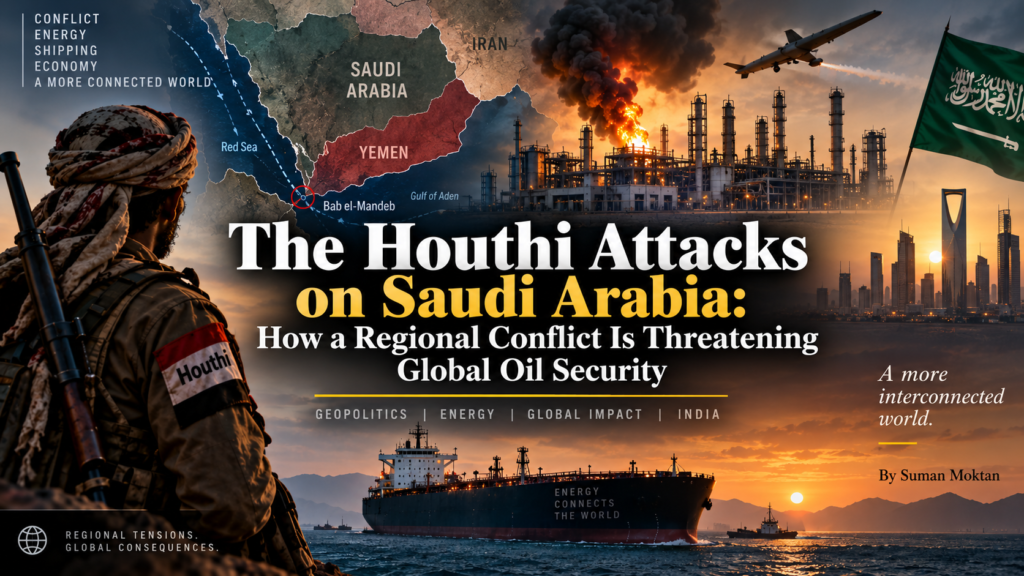
The Middle East is changing with Houthi attacks, what once appeared to be a regional conflict is now creating concerns far beyond the borders of Yemen and Saudi Arabia.
As Saudi Arabia is one of the world’s major oil producers and a drone attack at the oil facility or a threatened shipping route may not appear to be local security incident, the consequences can extend to international markets. The recent conflict between Saudi Arabia and Yemen’s Houthi movement has increased concerns about oil infrastructure and shipping security. At the same time, other attacks in the region have been attributed to different Iran-aligned groups. Understanding who carried out an attack is essential to understanding the conflict.
This is not simply a story between Saudi Arabia and the Houthis. It is also a story about geography, energy security, military strategy and the economic consequences of regional instability.
1. The Latest Escalation: What Has Happened?
The latest escalation has involved renewed Houthi attacks against Saudi Arabia, alongside Saudi military operations in Yemen. On September 15, Saudi authorities reported that Houthi missile and drone attacks on Khamis Mushait, Abha and Taif injured 13 civilians and damaged residential properties and vehicles. On September 17, Saudi civil defence reported that debris from an intercepted Houthi drone killed one person and injured two others in Taif province. The Houthis denied Saudi allegations concerning an attempted attack on Mecca.
These incidents demonstrate the risks faced by civilians as the conflict intensifies. They also raise concerns about the possibility of further escalation between Saudi Arabia and Houthi forces. However, the security situation cannot be understood through Houthi attacks alone. Other armed groups operating in the region have been linked to separate incidents, including an attack on Saudi Arabia’s oil transportation infrastructure.
2. The Important Distinction: Who Is Responsible for the Attacks?
One of the most important challenges in covering the current crisis is identifying the parties responsible for individual attacks. The Houthis are a Yemen-based armed movement with links to Iran. They have their own leadership, military capabilities and political objectives.
A separate drone attack on Saudi Arabia’s East-West Pipeline was attributed by Saudi and Iraqi authorities to drones originating from Iraq, where Iran-aligned militias operate. No group had claimed responsibility in the reporting available at the time.
The pipeline incident should therefore be treated separately from attacks directly attributed to Houthi forces. This distinction matters for several reasons. Identifying the alleged attacker helps establish responsibility, informs diplomatic responses and prevents different armed groups from being treated as a single organisation.
Iran’s relationship with regional armed groups does not mean that every attack carried out by those groups can automatically be attributed to Iran or the Houthis. Reliable reporting must distinguish between confirmed facts, official allegations and information that remains unverified.
3. Saudi Arabia’s Oil Infrastructure: Why the East-West Pipeline Matters
Saudi Arabia’s oil industry depends on an extensive network of production facilities, processing plants, pipelines and export terminals. Among these, the East-West Pipeline is particularly important because it connects oil-producing areas in eastern Saudi Arabia with the Red Sea port of Yanbu. The approximately 1,200-kilometre pipeline provides an alternative route for transporting crude oil without relying entirely on the Strait of Hormuz.
Its strategic importance has increased amid disruptions to shipping through the Strait of Hormuz. Reuters reported that the pipeline had been carrying approximately 4–5 million barrels of oil per day before the recent attack. On September 11, Saudi Arabia temporarily shut down the pipeline following aerial attacks. Subsequent reporting attributed the attack’s origin to Iraq, while responsibility for the strike remained unresolved. The incident exposed the vulnerability of infrastructure designed to provide an alternative export route.
Why does pipeline damage matter?
When an important pipeline is damaged, the consequences may include:
- Disruption to crude oil transportation
- Delays in restoring normal operations
- Increased pressure on alternative export routes
- Greater uncertainty in international energy markets
The scale of the disruption depends on the damage, repair time and the availability of other transportation options. Reuters reported on September 18 that Saudi Arabia was working to restore part of the pipeline’s capacity, while concerns about regional supply disruptions continued.
4. How Regional Conflict Affects Global Oil Markets
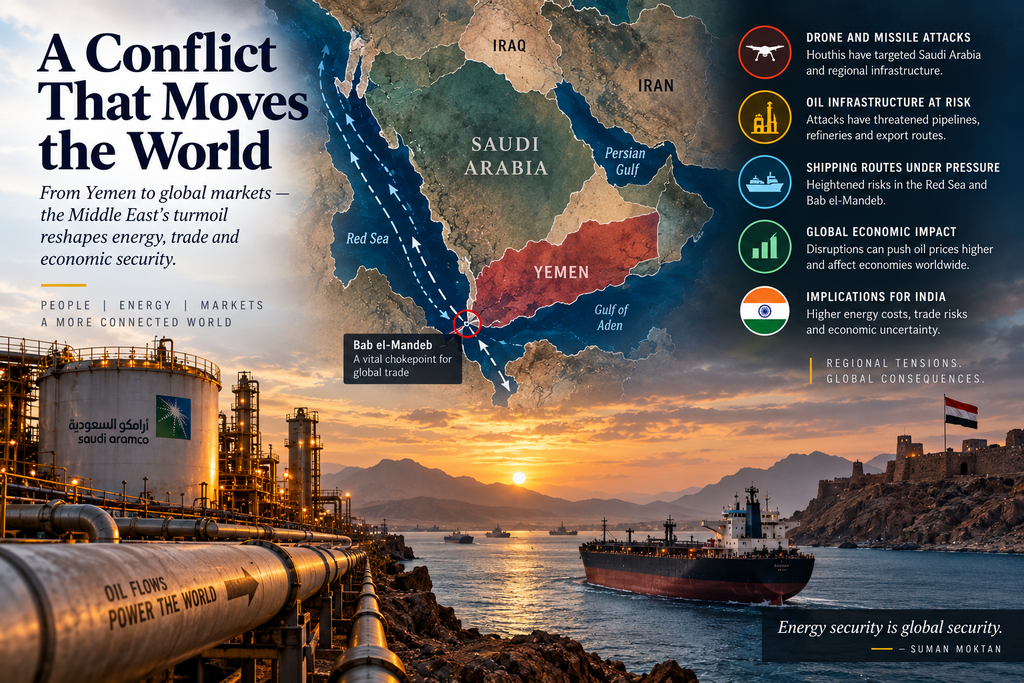
Oil is traded in an interconnected international market. Events in one major producing region can influence prices in countries that are not directly involved in the conflict. When an attack threatens oil production or transportation, traders assess whether supplies could become restricted. This assessment can affect prices even before a major shortage occurs.
The recent escalation has contributed to volatility in energy markets. Reuters reported that Brent crude was trading around $104 per barrel on September 18, after earlier price increases associated with concerns about supply disruptions. It is important, however, to avoid reducing every price movement to a single attack. Oil prices are influenced by several factors, including global demand, production levels, shipping conditions, market expectations and geopolitical developments. The longer a major disruption continues, the greater the potential pressure on international energy supplies.
5. The Red Sea and Bab el-Mandeb: A Strategic Maritime Route
The geography of Yemen helps explain why the conflict has international consequences. Yemen is located near the southern entrance to the Red Sea. The Bab el-Mandeb Strait connects the Red Sea with the Gulf of Aden, making it an important passage for maritime trade. The route links the Indian Ocean region with the Red Sea and the Suez Canal, which provides a shorter maritime connection between Asia and Europe.
When ships face security threats, shipping companies may choose longer alternative routes. This can increase voyage duration, fuel consumption, insurance costs and operating expenses. The effect extends beyond shipping companies. Businesses that depend on international transportation may face higher costs, while delays can affect supply chains. The Houthi advance and the wider regional conflict have increased concerns about the security of maritime routes around the Red Sea and Bab el-Mandeb.
6. What Does This Mean for India?
India’s economy is closely connected to international energy markets because the country imports a substantial share of its crude oil requirements. A prolonged disruption in oil transportation or a sustained increase in international crude prices could create pressure on India’s import bill and operating costs. The possible effects include higher costs for shipping, transport and energy-intensive businesses. These pressures may also influence the prices of goods and services.
However, the effect on Indian consumers is not automatic. Domestic fuel prices depend on factors such as international crude prices, currency movements, taxation, government policies and the pricing decisions of oil marketing companies. A responsible analysis should therefore distinguish between potential economic risks and confirmed effects on Indian households. For India, the conflict is relevant because energy security depends on reliable international supply chains and stable global markets.
7. The Humanitarian Consequences
The strategic and economic dimensions of the conflict should not obscure its humanitarian consequences. Yemen has experienced years of war, political instability and displacement. Renewed fighting creates additional risks for civilians and places further pressure on essential services.
Recent reporting described substantial displacement as the conflict intensified. The Associated Press reported that more than 125,000 people had fled their homes amid the latest escalation. Civilian protection, access to healthcare and humanitarian assistance remain important considerations in assessing the consequences of military operations.
The impact of the conflict cannot be measured only through oil prices or military developments. It must also be understood through the experiences of people living in affected communities.
8. What Should the International Community Watch?
The direction of the crisis will depend on developments across several connected areas.
Security: Whether attacks on Saudi territory and military operations in Yemen continue to intensify.
Energy infrastructure: Whether Saudi Arabia can restore damaged pipeline capacity and maintain reliable export routes.
Maritime trade: Whether vessels can operate safely through the Red Sea and Bab el-Mandeb.
Diplomacy: Whether regional and international actors can support measures to reduce escalation.
Humanitarian conditions: Whether displaced civilians can access protection and essential assistance.
These developments are interconnected. Continued military escalation could increase risks to infrastructure and shipping, while diplomatic progress could reduce pressure on regional energy routes.
Conclusion: A Regional Conflict With Global Consequences
The latest Houthi attacks on Saudi Arabia have renewed attention to the security challenges facing the Gulf region and Yemen. The consequences extend beyond the immediate exchange of military attacks. They include risks to civilians, pressure on oil transportation infrastructure and uncertainty in international energy markets.
At the same time, the separate attack on Saudi Arabia’s East-West Pipeline illustrates why accurate attribution matters. Although the Houthis and other Iran-aligned groups are part of the wider regional security picture, responsibility for individual attacks must be assessed on the available evidence.
For India and other energy-importing countries, the developments highlight the connection between regional stability, maritime security and energy costs. The Middle East is changing, but the outcome of this crisis remains uncertain. Its long-term consequences will depend on how the parties involved respond, whether diplomatic channels remain open and whether critical energy and shipping routes can be protected.
A conflict that begins in one region can create consequences across the global economy. Understanding those consequences requires accurate reporting, careful attribution and attention to the people affected by the fighting.
Editorial note: This article reflects reporting available on September 18, 2026. Responsibility for individual attacks should be attributed according to credible evidence, and developing claims should be identified as such.