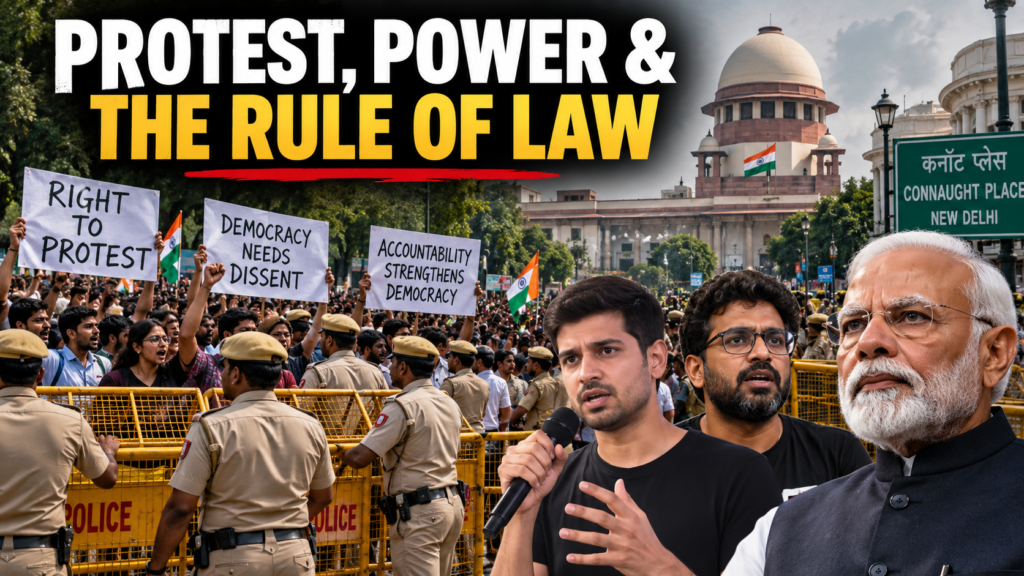

The right to protest is a pillar of democracy. But who protects the rights of ordinary citizens when demonstrations disrupt public life, political language becomes abusive, and the administration finds itself caught between protesters and the courts?
India is a country where people have the freedom to question their government, criticise political leaders and take their grievances to the streets. These freedoms are essential to democracy. No elected government should expect citizens to remain silent when they disagree with its policies.
Yet recent developments surrounding the CJP protests have raised questions that deserve serious public discussion. The controversy is not simply about whether people should be allowed to protest against the government. It concerns the limits of public demonstrations, the language used against elected leaders, the responsibility of protest organisers, the authority of the police and the role of the judiciary.
Watching these developments, I have been asking myself a question: Can a democracy protect the right to protest while ensuring that the law remains effective and public administration can perform its duties? The answer requires a careful look at the Constitution, the conduct of political movements and the responsibilities of every institution involved.
When Political Criticism Turns Personal
One incident that caught my attention was the strong language used against Prime Minister Narendra Modi during the CJP controversy. Following his release from detention on October 11, 2026, CJP founder Abhijeet Dipke described Modi as an embarrassment to India and called him a “coward and bully” in a post on X, according to media reports.
Dhruv Rathee also attracted attention during the wider controversy surrounding the CJP protests. However, the specific “coward and bully” remark was attributed in reports to Dipke, and the two should not be confused. This incident raises an important question about political communication in India.
Can anyone criticise the Prime Minister? Certainly. Can citizens question his decisions, challenge government policies and demand accountability? Absolutely. An elected leader is accountable to the people and cannot claim immunity from public criticism. But there is a difference between criticising a leader’s decisions and using personal insults to make a political point.
Calling a Prime Minister a coward may generate headlines and attract attention on social media. It does not, by itself, establish that a government decision was wrong or that an allegation is true. Those questions must be answered through facts and evidence.
At the same time, we should not confuse offensive language with a criminal offence. The Constitution protects freedom of expression, including strong criticism of political leaders. Whether particular speech violates the law depends on its content and circumstances.
My concern is therefore not that the Prime Minister should be protected from criticism. It is that political debate should retain some connection with facts, arguments and accountability. Public figures have influence. They should use it responsibly.
The Prime Minister Is Elected, Not Beyond Question
In a democracy, an elected Prime Minister must remain open to criticism. Winning an election does not mean that every government decision becomes correct or that opponents must agree with the ruling party. The public has the right to ask difficult questions about employment, education, economic policy, public services and the functioning of government institutions.
The same principle applies to political opponents. They must be free to disagree with the Prime Minister without being treated as enemies of the nation merely because they oppose the government. However, democratic debate also requires intellectual honesty. If someone accuses a leader of corruption, electoral manipulation or deliberate wrongdoing, the allegation should be examined on the available evidence. Political slogans may express anger, but slogans alone cannot establish facts.
There is also a difference between criticising a government and rejecting the democratic process through which it came to power. An elected government can be challenged through elections, public debate, peaceful demonstrations and legal proceedings. That is how democratic accountability should work. The principle must remain consistent: the Prime Minister is not above the law, and neither are those who oppose him.
Does the Right to Protest Mean Anywhere, Anytime?
This is one of the most important questions raised by public demonstrations. A procession may be peaceful in its intention but still affect thousands of people. A gathering on a busy road can delay ambulances, interrupt public transport, prevent employees from reaching work and cause financial losses to small businesses.
Consider an ordinary citizen travelling to a hospital, a student appearing for an examination or a shopkeeper trying to open a shop. These people may have no connection with the protest. Their rights and needs matter too. Article 19(1)(b) of the Constitution guarantees citizens the right to assemble peaceably and without arms. Article 19(3) allows reasonable restrictions on that right in the interests of the sovereignty and integrity of India and public order. This means that the right to assemble is protected, but it is not unlimited.
The police and other competent authorities may regulate processions, routes, timings and locations in accordance with applicable law. They may impose reasonable conditions to protect public safety and prevent serious disruption. However, restrictions must have a lawful basis. Authorities cannot deny permission simply because they dislike a protester’s political opinion or want to avoid criticism of the government. The law must protect both sides.
Protest organisers should respect lawful conditions, plan their routes responsibly and consider the effect of their actions on the public. The administration should explain its restrictions and offer reasonable alternatives where possible. A peaceful protest should not be unnecessarily obstructed. Equally, the public should not be expected to surrender access to essential services whenever a group decides to assemble.
The right to protest is a constitutional freedom, not an unrestricted right to occupy any public space at any time.
The CJP Protests and the Challenge Before the Administration
The recent CJP demonstrations in Delhi provide a practical example of this tension. The protests included demands for the resignation of Chief Election Commissioner Gyanesh Kumar amid allegations concerning the Election Commission’s functioning and electoral rolls. The allegations and the merits of the protesters’ demands must be assessed separately from questions about how the demonstrations were organised.
During the October 10 protests, restrictions and detentions became the subject of legal proceedings. The Supreme Court intervened over issues including alleged illegal detentions and the need to maintain the movement of people and the functioning of public services. The Delhi High Court later declined to stop the proposed CJP protest at Connaught Place on October 16, 2026, while recording the Delhi Police’s assurance that the gathering would be regulated according to law. These developments show that the dispute is more complicated than a simple contest between protesters and the police.
The administration must consider public order and safety. Protesters must be allowed to exercise their constitutional rights. Courts must examine whether restrictions and police actions comply with the law. The difficulty arises when these responsibilities appear to pull in different directions.
If the police impose restrictions, protesters may allege that their freedom is being suppressed. If the authorities fail to manage a large gathering, ordinary citizens may face serious disruption. If individuals are detained unlawfully, they are entitled to seek judicial relief. No institution can resolve these problems by ignoring the others.
The answer must come through lawful planning, clear communication, proportionate police action and compliance with judicial orders.
Why Does the Administration Sometimes Appear Helpless?
From the outside, it can appear that the administration is left with very little room to act. Police officers must maintain order, prevent violence, regulate traffic and protect public property. They must also respect fundamental rights and comply with judicial directions.
If they act firmly, they may face allegations of excessive force or suppression of dissent. If they allow a gathering to proceed without sufficient safeguards, they may be criticised for failing to protect public order. The pressure can be especially difficult when a demonstration attracts national attention, and every police action is immediately discussed on social media. But it would be wrong to conclude that the police should have unlimited power.
The police are not expected to prevent all inconvenience or silence every protest. Their duty is to enforce the law, protect people and maintain order through lawful and proportionate measures. At the same time, lawful authority must be meaningful in practice. If a valid restriction is imposed, officials should be able to enforce it fairly. If a protester violates an applicable law, the allegation should be investigated and dealt with through due process. The administration should neither surrender its responsibilities nor exceed its legal powers.
This is where planning becomes important. Authorities should identify suitable protest locations, establish clear procedures for permissions, communicate restrictions in advance and create arrangements for emergency access. Protest organisers should have a designated channel for communication with the police. Officers should document decisions and explain the legal basis for significant restrictions. These steps can reduce confrontation and make it easier to protect both public order and democratic freedoms.
When the Courts Intervene, Is It a Defeat for the Police?
Judicial intervention is sometimes presented in political discussions as a victory for protesters and a defeat for the administration. That is an oversimplification. The judiciary has a constitutional responsibility to protect fundamental rights and examine the legality of government action.
If a person is unlawfully detained, the courts can provide a remedy. If an administrative restriction violates constitutional protections, the courts can examine and set it aside. If public order requires reasonable regulation, courts can also recognise the authority of the administration to impose lawful conditions. The result depends on the facts and the law.
In the CJP controversy, the Supreme Court’s intervention over detentions and public services demonstrated the need to protect constitutional freedoms while ensuring that ordinary life continues. The Delhi High Court’s decision not to stop the October 16 demonstration did not mean that the protesters received unlimited freedom to act without regulation. The police were still responsible for managing the gathering according to the law.
This distinction is important because a judicial order must be read in its actual terms. It should not be treated as a blanket endorsement of every action taken by one side. The administration must comply with valid court orders, even when doing so is difficult. If an order is unclear, officials may seek clarification or use the legal remedies available to them.
Similarly, protesters must respect applicable legal requirements and any lawful conditions governing their activities. The judiciary is not an enemy of the administration. It is a constitutional safeguard against unlawful action. Effective administration and judicial review can coexist.
The Rights of Ordinary Citizens Must Not Be Forgotten
Political movements naturally focus on their demands. Governments focus on order and security. Courts focus on the legal questions placed before them. But who speaks for the citizen who simply wants to go to work, reach a hospital or open a shop? This question deserves greater attention.
A protest can have a legitimate political purpose and still impose costs on people who have no involvement in the dispute. A road closure may affect a patient. A transport disruption may affect a daily wage worker. A sudden restriction may create difficulties for traders and residents. These effects should not automatically be used as an excuse to ban demonstrations. Public protest is sometimes inconvenient by its nature. The aim should be to manage that inconvenience fairly and prevent unnecessary harm.
Organisers should consider the location, timing, duration and likely size of their gatherings. The administration should provide reasonable routes and access arrangements wherever possible. Emergency vehicles must be able to pass. Essential public services should continue. Restrictions should be proportionate to the actual risks. A democratic society must protect the right to raise political demands while respecting the lives of people who are not part of the movement.
The Same Law Must Apply to the Government and Its Opponents
One of the most damaging things in a democracy is the perception that the law changes according to political affiliation. If a group supporting the ruling party receives permission to hold a procession while an opposition group is refused without a valid reason, public trust suffers. If one group is allowed to block a public road while another is penalised for comparable conduct, people may reasonably question the fairness of enforcement. The same standards must apply to everyone.
The government must respect the Constitution and judicial orders. Protest organisers must obey applicable laws. Police officers must act impartially. Courts must decide disputes on the basis of law and evidence. Political loyalty should not determine how the law is enforced.
Nor should a protester’s popularity, social media following or ability to mobilise public opinion place that person beyond legal accountability. Democracy cannot function properly if one side believes that its political purpose gives it special privileges. The rule of law means that power, influence and public pressure do not replace legal standards.
Freedom of Expression Also Requires Responsibility
Social media has changed political communication. A statement can reach millions of people within minutes. A sharp insult may receive more attention than a detailed explanation of a government policy. This creates a problem for public debate.
When personal attacks become the main form of political communication, the actual issues can disappear. Questions about electoral rolls, public administration, employment or education may receive less attention than arguments about who insulted whom. Citizens should be free to criticise public figures, including the Prime Minister. Strong language alone does not automatically make a statement unlawful. However, public figures should understand that their words can influence how people view institutions and political opponents.
Responsible expression does not mean avoiding difficult questions. It means making serious arguments with evidence, distinguishing fact from allegation and correcting mistakes when they occur. This standard should apply equally to political commentators, protesters, government supporters and public officials. The Prime Minister must be open to criticism. His critics should also be willing to explain the basis of their claims. That is not a demand for silence. It is a demand for meaningful debate.
My View: Democracy Must Protect Dissent Without Weakening the Law
My concern about the CJP protests is not that people are questioning the government or criticising the Prime Minister. Such criticism is a legitimate part of democratic life. My concern is whether we sometimes focus so heavily on the rights of protesters that we pay insufficient attention to the responsibilities accompanying those rights, the needs of ordinary citizens and the lawful duties of the administration.
A democracy cannot function through fear of criticism. But neither can it function if every lawful restriction is treated as an attack on freedom. The police must be allowed to perform their duties within the law. Courts must remain free to examine police and administrative action. Protest organisers must be able to express their grievances peacefully. Citizens who disagree with the movement must retain their own rights.
The government, too, must remember that electoral victory is not a licence to disregard constitutional protections. These principles must apply regardless of which party is in power. If the police act unlawfully, they must be held accountable. If a protester violates the law, the allegation must be dealt with fairly. If a court issues an order, the administration must comply. If a government policy deserves criticism, citizens must be free to challenge it. No side should receive a special exemption.
Conclusion: The Real Test of Democracy
The CJP controversy raises questions that extend beyond one protest or one political leader. How do we protect the right to assemble while keeping public roads accessible? How do we allow sharp criticism of the Prime Minister without reducing political debate to personal abuse? How do we ensure that police officers can maintain order without violating fundamental rights? And how do we preserve public confidence when disputes reach the courts? These questions have no simple answer, but the guiding principle is clear.
India must protect peaceful dissent. The administration must act lawfully and effectively. The judiciary must safeguard constitutional rights. Protest organisers must respect the rights of others. Political leaders must remain accountable to the people. The Prime Minister is not above criticism. Protesters are not above the law. The police are not above judicial review. And the courts must remain within their constitutional role.
Democracy does not require everyone to agree. It requires disagreement to take place within a system of rights, responsibilities and lawful accountability. The strength of a democracy is measured by how well it protects the right to question power while ensuring that the law remains fair, effective and equal for everyone. That is the balance India must preserve.