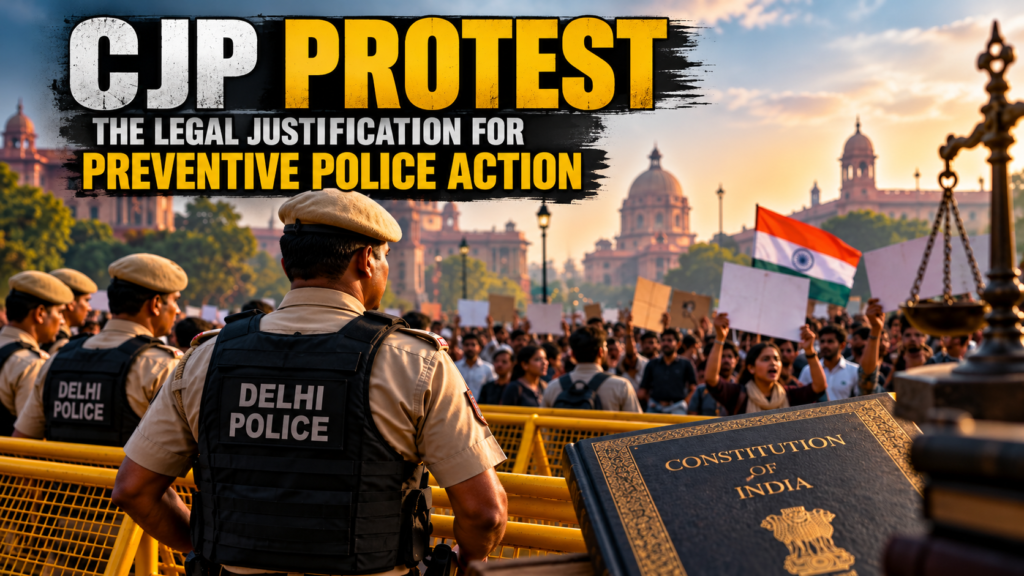

Introduction: When Protest Meets Public Order
Democracy gives citizens the right to question the government, challenge public institutions and protest against decisions they consider unjust. These freedoms are essential to a constitutional democracy. But democracy also requires public order, respect for the law and protection of the rights of other citizens.
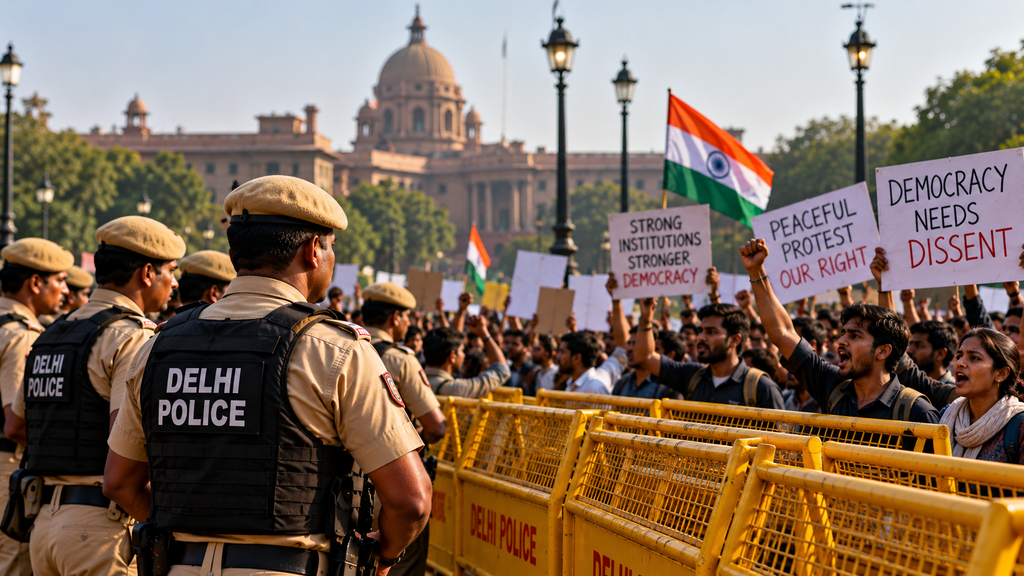
The recent protests organised by the Cockroach Janta Party (CJP) in Delhi have brought this balance into focus. The demonstrations were directed against Chief Election Commissioner Gyanesh Kumar over alleged irregularities in the Election Commission’s Special Intensive Revision (SIR) of electoral rolls. The controversy intensified when Delhi Police detained CJP founder Abhijeet Dipke and co-convenors Ashutosh Ranka and Saurav Das at Indira Gandhi International Airport on 10 October 2026, ahead of their planned protest.
Delhi Police subsequently stated that the three leaders had been placed under preventive arrest under Sections 126 and 170 of the Bharatiya Nagarik Suraksha Sanhita, 2023 (BNSS). They were produced before an Executive Magistrate the following day and released on a bond relating to the maintenance of peace and good behaviour.
The episode raises an important question: Can the police lawfully intervene before a protest takes place if they believe it may lead to a breach of public peace?
The answer under Indian law is yes, provided the statutory conditions are satisfied. Preventive policing is a recognised legal power. However, it must be exercised on reasonable grounds, for a legitimate purpose and in accordance with constitutional safeguards.
The legal defence of police action must therefore rest on the law and the facts, rather than on political preferences or an assumption that every protest is a threat to public order.
The Constitution Protects Protest, but Allows Reasonable Restrictions
The CJP protest has brought renewed attention to the constitutional right to protest in India, which derives primarily from Article 19 of the Constitution. Article 19(1)(a) guarantees freedom of speech and expression, while Article 19(1)(b) guarantees the right to assemble peacefully and without arms. These provisions protect citizens who organise demonstrations, raise slogans, criticise public officials and demand accountability from constitutional institutions.
However, these freedoms are subject to the restrictions expressly permitted by the Constitution. Article 19(2) allows reasonable restrictions on freedom of speech on specified grounds, including public order. Article 19(3) permits reasonable restrictions on peaceful assembly in the interests of public order and the sovereignty and integrity of India. In the context of the CJP protest, this distinction matters. The Constitution protects peaceful dissent, but it does not create an unrestricted right to hold a demonstration anywhere, at any time, regardless of lawful restrictions or the rights of others.
A protest may affect traffic, access to public buildings, emergency services and the movement of ordinary citizens. Authorities can regulate gatherings, including the CJP protest, to address genuine risks to public order. They must, however, justify their restrictions under the law. The principle is clear: public order and civil liberty must be protected together.
Why Preventive Policing Is Necessary
The police’s primary responsibility is to prevent crime, protect life and property, and maintain public peace. Waiting until violence occurs can sometimes make effective intervention impossible. Consider a situation in which the police receive credible information that a proposed gathering will involve forced entry into a restricted area, violent confrontation or the deliberate obstruction of essential public services.
If the information is sufficiently specific and the legal conditions are met, preventive measures may be necessary before the threatened offence occurs. The police are not required to remain passive until the first stone is thrown or the first person is injured. This is the practical justification for preventive policing. Its purpose is to prevent a foreseeable offence, not to punish a person for expressing an unpopular opinion.
In a crowded capital city, where demonstrations may take place near government offices, transport hubs and sensitive public installations, the authorities have legitimate reasons to assess risks and make security arrangements. Nevertheless, an assessment of risk must be based on relevant information. A political slogan, criticism of the Election Commission or the announcement of a peaceful demonstration cannot, by itself, establish that a cognisable offence is about to occur.
Preventive action is justified when the law’s requirements are met, not merely because the police would prefer that a demonstration did not take place.
Section 170 of the BNSS: The Legal Basis for Preventive Arrest
Section 170 of the Bharatiya Nagarik Suraksha Sanhita, 2023, deals specifically with arrest to prevent the commission of cognisable offences. It authorises a police officer who knows of a design to commit a cognisable offence to arrest the person planning it, without a warrant or prior order from a Magistrate, if the officer considers that the commission of the offence cannot otherwise be prevented. The provision also limits custody under this power to 24 hours unless further detention is required or authorised under another applicable legal provision.
Three elements are particularly important.
First, the police must have knowledge of a design to commit a cognisable offence. A general fear that a large crowd might become difficult to manage is not, on its own, enough.
Second, the arrest must be necessary to prevent that offence. If a less restrictive and effective measure can prevent the threatened offence, the statutory necessity requirement becomes important.
Third, the power cannot be used as a substitute for ordinary criminal investigation or as a means of silencing political opposition.
Applied to the CJP episode, Section 170 provides a statutory basis for preventive arrest if Delhi Police possessed the required information and reasonably concluded that the threatened cognisable offence could not otherwise be prevented.
The police have publicly stated that they invoked this provision. Whether every condition was satisfied in the individual cases is a separate legal question that must be assessed from the grounds, records and circumstances of the arrests. The existence of a statutory power establishes that preventive arrest is legally possible. It does not automatically prove that every exercise of that power is lawful.
Section 126 of the BNSS: Security for Keeping the Peace
Section 126 of the BNSS deals with security for keeping the peace in other cases. In the context of the CJP protest, where public order and the prevention of potential disturbances became important issues, this provision deserves particular attention. Where an Executive Magistrate receives information that a person is likely to commit a breach of the peace, disturb public tranquillity or do an act likely to occasion such a breach, the Magistrate may initiate proceedings in accordance with the section and require the person to show cause why a bond, with or without sureties, should not be executed for keeping the peace.
The provision is preventive in nature. Its object is to secure future peace rather than to impose punishment for an offence that has already been committed. This is relevant to the CJP protest because police reported that Sections 126 and 170 of the BNSS were invoked and that the leaders were subsequently brought before an Executive Magistrate.
The two provisions perform different functions. Section 170 authorises a qualifying preventive arrest by police, while Section 126 provides a legal process for requiring security for keeping the peace through a Magistrate. The procedural requirements of the BNSS must be followed. The use of Section 126 does not independently validate an arrest under Section 170, and the police cannot bypass the safeguards governing proceedings before the Magistrate.
A lawful preventive process must be supported by the necessary information, the applicable procedure and a genuine need to prevent a breach of the peace. Therefore, any legal assessment of the CJP protest must consider whether the authorities acted within these statutory limits while balancing public order with the constitutional right to peaceful assembly.Section 163 of the BNSS: Preventing Immediate Danger and Disorder
Section 163 of the BNSS gives an Executive Magistrate powers to issue orders in urgent cases of nuisance or apprehended danger. Where the statutory conditions are met, a Magistrate may issue a written order directing a person to abstain from a particular act or take certain action to prevent obstruction, annoyance, injury, danger to human life or safety, disturbance of public tranquillity, a riot or an affray. The power is intended for urgent situations. The order must be supported by the material facts required by law, and its scope must be appropriate to the danger being addressed.
Where a valid order restricts a particular gathering or activity, the police may enforce it through lawful means. Disobedience of a lawful order may also attract consequences under the applicable criminal law, depending on the facts and statutory requirements. However, Section 163 must not be treated as a blanket power to prohibit every demonstration. A restriction must have a lawful basis and cannot simply be imposed because the views expressed by protesters are unwelcome.
In the CJP matter, the reported denial of permission to demonstrate at Jantar Mantar and the wider security restrictions form part of the background. Any assessment of their legality must examine the actual orders, their scope, the reasons recorded and the conduct of the people concerned.
The Police Have a Duty to Prevent Cognisable Offences
Section 168 of the BNSS places a duty on every police officer to intervene, to the best of the officer’s ability, to prevent the commission of any cognisable offence. In the context of the CJP protest, this duty forms an important part of the legal framework governing preventive policing and the maintenance of public order.
Police officers must assess threats, gather relevant information, coordinate deployments and take lawful steps to prevent violence. Where a genuine threat exists, failing to act may expose the public to avoidable danger. At the same time, Section 168 does not provide an independent licence to arrest anyone whom the police consider troublesome. The specific legal requirements governing an arrest or other restriction on liberty must still be satisfied.
The CJP protest illustrates the need to balance the police duty to prevent crime with citizens’ constitutional freedoms. The distinction is between a duty to prevent crime and an unrestricted power to curtail freedom. A responsible police force must fulfil its preventive responsibilities without exceeding the authority granted by law.
Why the Police May Regulate a Protest
A protest is a public activity. Its location, timing, size and manner can affect the rights of people who are not participating in it. In the context of the CJP protest, authorities may regulate demonstrations where there are legitimate concerns involving public safety, access to essential facilities, traffic or a credible risk of disorder.
In Himat Lal K. Shah v. Commissioner of Police, Ahmedabad (1973), the Supreme Court recognised that the State can regulate public meetings on streets, while making clear that such regulatory authority cannot be arbitrary.
In Mazdoor Kisan Shakti Sangathan v. Union of India (2018), the Supreme Court considered restrictions on demonstrations in the Jantar Mantar area of Delhi. The judgment recognised the importance of peaceful demonstrations while addressing the need to balance protesters’ rights with the interests of residents and the wider public.
These decisions provide a useful legal framework for understanding the CJP protest. Public authorities may regulate the exercise of fundamental rights, but regulation must not become an unreasonable or blanket denial of those rights.
If organisers seek to march beyond an authorised area, enter a restricted zone or disregard a valid order, police may take appropriate lawful action. However, the legality of that action depends on the circumstances and the legal power used. The mere fact that the CJP protest is politically controversial, critical of the government or directed against a constitutional authority is not sufficient justification for arrest. Any restriction must be supported by law and the relevant facts.
The CJP Arrests: What Can Be Legally Defended?
Delhi Police stated that the three leaders of the CJP (Cockroach Janta Party) were placed under preventive arrest on 10 October under Sections 126 and 170 of the BNSS. They were produced before an Executive Magistrate on 11 October and released on a bond relating to peace and good behaviour. The CJP protest raises important questions about the legal basis of preventive policing and the constitutional balance between public order and the right to peaceful assembly.
The police position can be defended in principle on the following grounds.
First, prevention is a legitimate police function. The law allows preventive action where the required conditions exist. Police need not wait for a cognisable offence to be completed if a lawful preventive intervention is necessary to stop it.
Second, public order is a legitimate constitutional concern. Articles 19(2) and 19(3) permit reasonable restrictions on specified grounds, including public order. In the context of the CJP protest, authorities may consider credible risks associated with a proposed demonstration, provided their decisions are based on relevant facts and lawful grounds.
Third, preventive proceedings are recognised by law. Sections 126 and 170 of the BNSS provide distinct mechanisms relating to the prevention of breaches of peace and cognisable offences. These provisions can support preventive action when their respective statutory requirements are satisfied.
Fourth, judicial or magisterial scrutiny remains available. Bringing a person before the competent Magistrate allows the legal basis for further proceedings or security requirements to be examined. Preventive powers do not place police decisions beyond scrutiny.
These points explain why preventive police action during the CJP protest may be legally justified in appropriate circumstances. They do not establish, without examining the underlying evidence and procedural records, that every aspect of the arrests was lawful. That distinction is essential to a credible legal argument.An Important Qualification: The Leaders Were Released
A fair account must include what happened after the arrests. The three CJP leaders were released by an Executive Magistrate on 11 October after being produced before the court. Reports described their release on a bond relating to the maintenance of peace and good behaviour for one year.
The Indian Express also reported that, according to the leaders’ lawyer, the police could not establish grounds for further detention. Their release does not, by itself, establish that the initial preventive arrest was unlawful. The initial arrest and continued custody are separate questions, and the legal grounds must be assessed at the relevant stages.
Equally, the fact that the police invoked a statutory provision does not settle the question in their favour. The police must be able to demonstrate compliance with the law when their action is challenged. A sound defence of police conduct should therefore recognise the outcome of the proceedings rather than ignore it. The law gives police preventive powers, while requiring them to justify their use.
Constitutional Safeguards Must Be Respected
Article 21 of the Constitution provides that no person shall be deprived of life or personal liberty except according to the procedure established by law. Article 22 provides important protections for arrested persons, including the right to be informed of the grounds of arrest, the right to consult and be defended by a lawyer of their choice, and production before a Magistrate within 24 hours, subject to the constitutional provisions and exceptions applicable to the case.
In the context of the CJP protest, these constitutional safeguards are particularly important when examining the legal basis of preventive police action. The BNSS also contains safeguards governing arrest, information to relatives or nominated persons, and custody. These protections are not obstacles to effective policing; they are essential elements of lawful policing.
The Supreme Court’s decision in Joginder Kumar v. State of Uttar Pradesh (1994) emphasised the distinction between the existence of a power to arrest and the justification for exercising it. This principle remains relevant to the CJP protest and to preventive policing generally: a power conferred by law must be exercised for a proper purpose and on grounds that can withstand legal scrutiny.
If officers use preventive powers to punish peaceful dissent, intimidate political opponents or detain people without satisfying the applicable legal requirements, their actions may be challenged and could attract appropriate legal consequences. Conversely, if officers act on credible information, satisfy the statutory conditions and comply with the required safeguards, preventive intervention may be a legitimate part of maintaining public order.
Ultimately, the legal assessment of the CJP protest must rest not merely on the powers available to the police, but also on the facts, the necessity of the intervention, compliance with procedure and respect for constitutional rights.
Police Neutrality Is the Real Test
The police must remain neutral in political disputes. Their responsibility is to enforce the law, protect the public and preserve the conditions in which democratic activity can take place. That means police must protect a peaceful demonstration even when its message is strongly critical of those in power. It also means they may intervene when there are legally sufficient grounds to prevent violence or another cognisable offence.
Neither political popularity nor political unpopularity should determine whether police action is lawful. A consistent standard is the best protection against accusations of selective enforcement. Similar circumstances should be assessed using the same legal principles, regardless of the organisation involved or the target of its protest.
Police officers should document the information supporting preventive action, record the grounds required by law, use proportionate measures and comply with judicial or magisterial directions. These practices protect the public, the institution and the officers themselves.
Conclusion: A Strong Police Force Must Also Be a Lawful Police Force
The CJP protest presents a wider question about how India should balance democratic dissent with public order. The Constitution protects peaceful protest. The BNSS empowers the police and Magistrates to take preventive steps when the legal requirements are met. Neither principle cancels the other.
The legal justification for preventive police action is straightforward in principle: preventing a cognisable offence or a breach of peace can be a legitimate public duty. But the actual legality of an arrest depends on the facts, the statutory conditions, necessity and procedural compliance. In the CJP case, Delhi Police relied on Sections 126 and 170 of the BNSS, and the leaders were subsequently released by an Executive Magistrate. Those facts should inform any assessment of the episode.
The broader lesson is that a democratic State must be capable of maintaining order without treating dissent itself as a crime. The rule of law requires both a right to protest and a duty to obey lawful restrictions. Police authority is strongest when it is exercised within the law, and constitutional freedom is strongest when it is exercised peacefully and responsibly.
Legal disclaimer: This article is for educational and public-information purposes. It expresses a legal analysis of reported events and does not constitute a judicial finding on the legality of any individual’s arrest. The assessment may change if additional orders, records or evidence become available.