

Suman Moktan
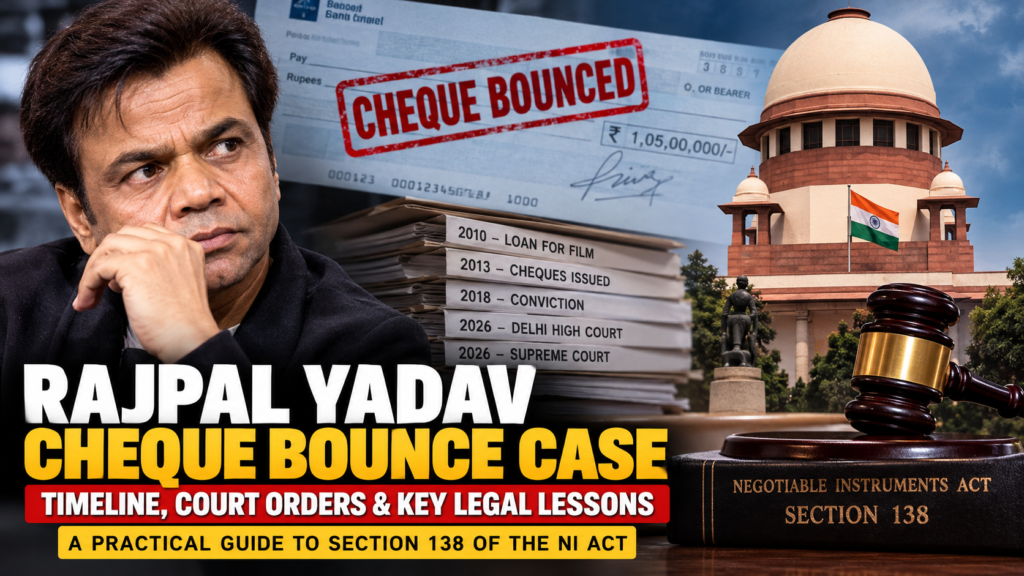
The cheque-bounce proceedings involving actor Rajpal Yadav have once again reached the Supreme Court, bringing a long-running financial dispute back into the spotlight. The case is particularly useful for understanding how Section 138 of the Negotiable Instruments Act, 1881 operates when a cheque issued towards repayment of a financial liability is dishonoured and the subsequent legal process is not complied with.
The important point is that this is not simply a story about a celebrity facing imprisonment. It raises practical questions that arise in thousands of cheque-dishonour cases: What happens when a cheque is dishonoured? What is the effect of a settlement agreement? Can a person argue that the cheque was only a security cheque? Can civil recovery and criminal proceedings continue simultaneously? And how does a court treat repeated undertakings to pay that are not honoured?
How the dispute began
According to the record considered by the Delhi High Court, the dispute involving Rajpal Yadav originated in 2010, when Murli Projects Pvt. Ltd. became involved in financing the film Ata Pata Laapata. The financial arrangement involved approximately ₹5 crore.
The film could not be completed within the agreed period, following which the parties entered into a series of agreements concerning repayment of the amount. As part of these arrangements, Rajpal Yadav and the concerned parties issued cheques towards the repayment of the outstanding liability.
The complainant later presented seven of these cheques, which were dishonoured. This resulted in seven separate complaints against Rajpal Yadav under Section 138 of the Negotiable Instruments Act, 1881. The proceedings therefore turned on an important question: when does the dishonour of a cheque become a criminal offence under Section 138?
A cheque-bounce case is not created merely because a cheque has been dishonoured. The statutory requirements under Section 138 must be satisfied, including the existence of a legally enforceable debt or liability, proper presentation of the cheque, issuance of the statutory demand notice and failure to make payment within the prescribed period.ounced. Section 138 contains several statutory conditions that must be satisfied before criminal liability arises.
What Section 138 actually requires
Section 138 of the Negotiable Instruments Act deals with the dishonour of a cheque for insufficiency of funds or because it exceeds the arrangement made with the bank. But the provision is subject to conditions.
Broadly, the complainant must establish that:
- The cheque was drawn by the accused on an account maintained by him.
- It was issued towards discharge, wholly or partly, of a legally enforceable debt or liability.
- The cheque was presented within the prescribed period.
- The bank returned the cheque unpaid for a reason covered by Section 138.
- The payee or holder issued the statutory demand notice within the prescribed period after receiving information regarding dishonour.
- The drawer failed to make payment within the statutory period after receiving the notice.
- The complaint was thereafter instituted within the prescribed limitation, subject to the provisions permitting condonation where applicable.
Therefore, “the cheque bounced” is only the beginning of the legal analysis. The entire statutory chain has to be examined.
The importance of the legally enforceable debt
One of the most important expressions in Section 138 is “legally enforceable debt or other liability.” A cheque does not automatically create criminal liability simply because it was dishonoured. The underlying liability matters.
In the Rajpal Yadav proceedings, the dispute involved money advanced in connection with the production of a film and subsequent contractual arrangements concerning repayment. The accused challenged the maintainability of the complaints on, among other grounds, the effect of subsequent agreements and the nature of the cheques.
The Delhi High Court rejected the challenge and upheld the convictions, while dealing with the contractual history and the legal effect of the subsequent consent agreement.
“Security cheque” is not an automatic defence
This case also illustrates a common misunderstanding in cheque-bounce litigation. An accused may argue: “It was only a security cheque.” That statement, by itself, does not necessarily end a prosecution under Section 138. The real question is whether, on the date the cheque became payable and was presented, there existed a legally enforceable debt or liability for which the cheque could operate.
Therefore, courts examine the underlying transaction, agreements between the parties, the circumstances in which the cheque was issued and the liability existing when the cheque was presented. The label attached to a cheque is not necessarily decisive.
The presumption under Section 139
Section 139 of the Negotiable Instruments Act is another important part of the statutory framework. Once the foundational facts required for the statutory presumption are established, the law provides a presumption in favour of the holder that the cheque was received for the discharge, wholly or partly, of a debt or other liability. This does not mean that the accused has no defence.
The accused can seek to rebut the statutory presumption by relying upon admissible evidence and the circumstances of the case. But the defence cannot simply assume that the complainant must prove every aspect of the underlying transaction from the beginning as though no statutory presumption existed. That is one reason why cheque-bounce litigation requires careful attention to the documentary record.
What happened in the courts
The trial proceedings resulted in a conviction. In May 2024, the Sessions Court convicted Yadav and imposed a sentence of imprisonment. The Delhi High Court subsequently dealt with several challenges and applications arising from the matter. The Delhi High Court delivered a common judgment on 10 July 2026 in the batch of petitions arising from the seven Section 138 complaints.
The High Court upheld the conviction, while modifying the sentencing position in light of amounts subsequently deposited. It also declined to extend the benefit of probation, taking into account, among other things, the repeated undertakings made during the proceedings and the failure to honour them. That aspect deserves particular attention.
Why an undertaking to the court matters
Litigants frequently request additional time from courts by giving an undertaking that a particular amount will be paid on or before a specified date. Such an undertaking should never be treated as an informal promise.
Once a party gives an undertaking to a court, compliance becomes a serious matter. Repeated failure to honour undertakings can influence the court’s approach to discretionary relief, including requests for probation or further indulgence.
The Delhi High Court specifically considered Yadav’s conduct during the litigation while examining his plea for probation. The court noted that undertakings concerning payment had been given on several occasions but had not been honoured. This provides an important lesson for every litigant: Never give the court a payment commitment merely to obtain time unless you have a realistic and documented ability to comply with it.
Civil recovery and criminal proceedings can coexist
Another important legal issue arising from the case is the relationship between civil recovery proceedings and a prosecution under Section 138. A common misconception is that if the complainant can file a civil case for recovery of money, a criminal complaint under Section 138 cannot be maintained. That is incorrect.
The Delhi High Court discussed the settled principle that civil proceedings for recovery and proceedings under Section 138 may operate simultaneously because they arise from different causes of action and have different purposes. A civil proceeding primarily seeks recovery of money. A Section 138 prosecution concerns the statutory offence arising from the dishonour of the cheque and failure to make payment after the statutory demand. Therefore, the existence of a civil dispute does not automatically wipe out criminal liability under Section 138.
The matter reaches the Supreme Court
The latest development came before the Supreme Court in October 2026. On 7 October 2026, a Bench comprising Chief Justice of India Surya Kant, Justice Joymalya Bagchi and Justice V. Mohana considered Yadav’s challenge to the Delhi High Court proceedings. Yadav’s counsel informed the Court that ₹1.15 crore had been arranged through demand drafts. Another ₹85 lakh was proposed to be arranged through a prospective purchaser of his ancestral property.
The Supreme Court directed that the ₹1.15 crore be deposited and granted time for the remaining ₹85 lakh, with the matter to be considered further thereafter. The Court also considered the proposal involving the sale of ancestral property and indicated that a schedule for payment of the remaining liability would be considered.
Importantly, the Supreme Court’s accommodation should not be misunderstood as an acquittal or as setting aside the conviction. The legal proceedings remain pending before the Supreme Court.
The Court’s concern about repeated defaults
The October 7 proceedings also demonstrated why compliance with previous court directions had become significant. The Supreme Court expressed dissatisfaction with the conduct recorded in the proceedings and indicated that it was granting accommodation primarily to facilitate recovery for the complainant. The Bench also warned that the sentence could potentially be enhanced. That observation is legally important.
Appellate relief is discretionary in many situations. A litigant who repeatedly seeks time, makes undertakings and then fails to comply may find it increasingly difficult to persuade the court to grant further indulgence. The lesson extends well beyond this particular case.
What ordinary people should learn from the case
For anyone involved in a loan, business transaction or private financial arrangement, the Rajpal Yadav case provides several practical lessons.
1. Do not issue cheques casually
A cheque issued towards a genuine financial liability can have serious legal consequences if it is dishonoured. Before issuing a cheque, the drawer should understand exactly what liability the cheque represents.
2. Put financial settlements in writing
If parties renegotiate a loan or settle an existing dispute, the settlement should clearly record:
- the total outstanding amount;
- payment dates;
- instalment arrangements;
- treatment of earlier cheques;
- whether old cheques are to be returned or cancelled;
- new cheques, if any;
- consequences of default; and
- whether existing legal proceedings will continue or be withdrawn upon compliance.
Ambiguous settlement documentation can create years of litigation.
3. Do not assume that a “security cheque” has no consequences
The expression “security cheque” is frequently used in commercial disputes. But its legal effect depends upon the facts and the liability existing when the cheque is presented.
4. Respond to a statutory notice carefully
A Section 138 notice should never be ignored. The drawer should immediately obtain the relevant bank records, cheque details, agreements, correspondence and payment records and seek proper legal advice. A defective defence strategy at the notice stage can make subsequent litigation more difficult.
5. Keep proof of every payment
If money is paid after dishonour, preserve bank statements, receipts, demand drafts, settlement documents and correspondence. Oral claims such as “I already paid the amount” are much weaker than contemporaneous documentary evidence.
6. Treat every court undertaking seriously
This may be one of the strongest practical lessons from the present case. If a person tells the court that a specified amount will be paid by a specified date, the commitment should be honoured. If circumstances genuinely make compliance impossible, the appropriate course is to approach the court before the deadline with a proper explanation and supporting material rather than simply defaulting.
A word of legal caution for accused persons
A cheque-bounce prosecution is a criminal proceeding, but that does not mean that every dishonoured cheque automatically results in a conviction. The defence must examine the complete statutory and factual foundation of the complaint.
Among the issues that may require examination are:
- whether there was a legally enforceable debt;
- whether the cheque was issued in respect of that liability;
- whether the cheque was presented within the legally permissible period;
- whether the statutory notice was properly issued and served;
- whether payment was made within the statutory period;
- whether the complaint was filed within limitation;
- whether the complainant has complied with the procedural requirements;
- whether the statutory presumptions have been properly invoked; and
- whether the accused has sufficient evidence to rebut those presumptions.
These questions are highly fact-specific.
A person facing a Section 138 complaint should therefore obtain the complete complaint, affidavit, bank return memo, statutory notice, postal records, agreements, account statements and relevant correspondence before deciding upon a defence.
A word of legal caution for complainants
The law also requires discipline from the cheque holder. A complainant should maintain the original cheque, bank return memo, statutory notice, proof of service and documents establishing the underlying transaction.
Where substantial money is involved, the underlying loan or commercial transaction should be properly documented. The objective should not merely be to obtain a conviction. The practical objective is to establish the liability clearly and pursue legally available remedies for recovery.
What this case teaches about cheque-bounce litigation
The Rajpal Yadav proceedings demonstrate how a relatively simple-looking cheque transaction can develop into years of litigation when the underlying financial dispute remains unresolved.
The case also shows that Section 138 is not merely a debt-recovery shortcut. It creates a statutory offence subject to specific conditions. At the same time, the proceedings cannot be understood separately from the underlying financial liability and the conduct of the parties throughout the litigation.
The courts have to balance the statutory requirements, the accused’s legal rights, the complainant’s entitlement and the integrity of the judicial process.
For litigants, perhaps the most practical lesson is simple: take the cheque seriously before issuing it, take the statutory notice seriously after receiving it, and take every undertaking given to a court seriously.
Legal advice: what should you do if your cheque has bounced?
If you are a drawer whose cheque has been dishonoured, do not ignore the matter or assume that payment at a later stage will automatically end the proceedings. Immediately consult a lawyer, examine whether the statutory requirements have been complied with, and determine whether the underlying liability is disputed or admitted.
If you are a payee whose cheque has bounced, preserve the cheque, return memo and transaction documents and ensure that the statutory notice and subsequent complaint comply with the requirements of the Negotiable Instruments Act.
If a settlement is being negotiated, put the settlement in writing and clearly specify what happens to previously issued cheques and pending proceedings. Most importantly, do not give an undertaking to a court unless you have a genuine and workable plan to comply with it.
Final note
The Supreme Court proceedings concerning Rajpal Yadav are still ongoing. The developments reported on 7 October 2026 concern conditional arrangements for payment and further consideration of his challenge; they should not be described as a final acquittal or final disposal of the case.
Legal Disclaimer: This article is for general information and educational purposes only. It does not constitute legal advice or a legal opinion. Laws and court proceedings may change, and readers should consult a qualified advocate for advice based on their specific facts and documents.