

By Suman Moktan
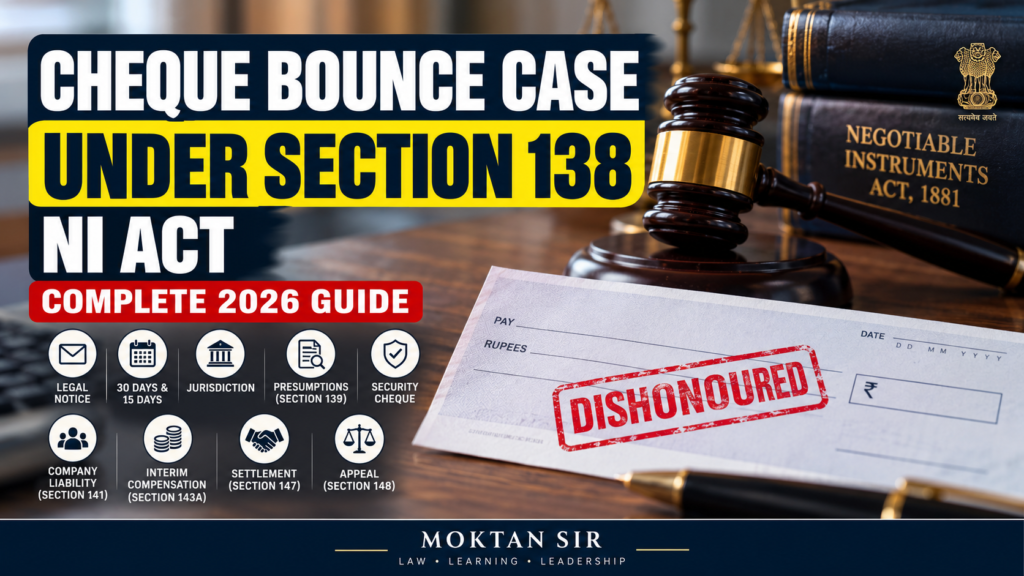
A cheque bounce case under Section 138 of the Negotiable Instruments Act, 1881 may appear simple at first. A cheque is issued, presented to the bank, returned unpaid and a legal notice follows. In practice, however, Section 138 litigation involves several statutory requirements relating to the underlying liability, presentation of the cheque, statutory notice, limitation, jurisdiction, evidence and presumptions.
For a complainant, the dishonour of the cheque is only the beginning. For the accused, the signature on the cheque does not necessarily end the matter. The entire transaction and the statutory requirements have to be examined carefully. An effective approach to a cheque bounce case therefore begins with the documents and the timeline and then moves to the evidence and legal issues.
What Is a Cheque Bounce Case Under Section 138 NI Act?
Section 138 of the Negotiable Instruments Act deals with the dishonour of a cheque for insufficiency of funds or where the amount exceeds the arrangement made with the bank, when the cheque was issued for the discharge, wholly or partly, of a legally enforceable debt or other liability. The section also prescribes specific conditions relating to presentation, notice and payment.
The cheque must be presented within the period prescribed by law. After receiving notice of dishonour from the bank, the payee or holder in due course must issue a written demand notice within 30 days. The drawer is then given 15 days from receipt of the notice to make payment. If the amount remains unpaid after that period, the statutory requirements for prosecution under Section 138 may be satisfied, subject to the other requirements of the Act. This sequence is the foundation of a cheque dishonour case.
The First Question: Was There a Legally Enforceable Liability?
Never examine a cheque in isolation. The first question for an advocate is why the cheque was issued. It may have been issued towards repayment of a loan, payment for goods or services, settlement of a business account or discharge of another legally enforceable obligation. This underlying transaction is important because Section 138 specifically refers to a legally enforceable debt or other liability.
An advocate should therefore examine the documents supporting the transaction. Depending on the case, these may include agreements, invoices, receipts, bank statements, account statements, correspondence, acknowledgements, and other records. The strength of a cheque bounce case often depends on how convincingly the underlying transaction can be established through the evidence.
The Importance of the 30-Day Notice
The cheque bounce notice is a critical stage in proceedings under Section 138. After receiving information from the bank that the cheque has been returned unpaid, the payee or holder in due course must issue a written demand notice within 30 days. The notice must demand payment of the cheque amount, and the drawer is then given 15 days from receipt of the notice to make payment. The advocate should therefore preserve the complete record of the notice process, including the copy of the notice, postal receipt, tracking details, returned envelope where applicable and other relevant evidence of dispatch or service.
Questions concerning service of notice can become important during the proceedings. The particular facts and applicable law must therefore be examined rather than assuming that service can be established in every case in the same manner.
Section 139 NI Act and the Presumption in Favour of the Holder
Section 139 of the Negotiable Instruments Act creates an important statutory presumption. The law provides that, unless the contrary is proved, the holder of a cheque is presumed to have received it for the discharge, wholly or partly, of a debt or other liability. This presumption has an important effect on the defence in a cheque bounce case.
The accused cannot necessarily succeed by simply stating that no debt existed. The defence has to be considered in light of the statutory presumption and the evidence available before the court. At the same time, the presumption is rebuttable. The accused can rely on the evidence and circumstances of the case to raise a probable defence.
For this reason, an effective defence should normally be based on the actual transaction, documents and surrounding circumstances rather than a general denial.
Security Cheque and Section 138
The expression “security cheque” is frequently used in cheque dishonour litigation. However, simply describing a cheque as a security cheque does not by itself answer the question whether Section 138 applies. The court may have to examine the circumstances in which the cheque was issued and whether a legally enforceable liability existed when the cheque was presented. The underlying transaction therefore remains important.
The complainant should be able to explain the liability for which the cheque was presented. The accused, where appropriate, may challenge the existence, nature or amount of that liability through the evidence.
Jurisdiction in a Cheque Bounce Case
Jurisdiction is another issue that should be examined before filing a complaint. Section 142 and related provisions of the Negotiable Instruments Act govern important aspects of cognizance and jurisdiction in Section 138 proceedings. The correct court must therefore be identified by applying the statutory provisions to the facts of the particular case.
An advocate should carefully examine the relevant banking arrangements and the circumstances in which the cheque was presented for collection. Filing a complaint in a convenient location is not enough. The court must have jurisdiction under the applicable law.
Cross-Examination in a Cheque Bounce Case
Cross-examination can become one of the most important stages of a Section 138 trial. An experienced defence lawyer will examine the complainant’s version of the transaction, the alleged liability, the source and movement of funds where relevant, the circumstances in which the cheque was issued, the supporting documents and any contradictions between the complaint, affidavit and oral evidence. The purpose of cross-examination is not simply to ask a large number of questions.
Each question should have a purpose. The advocate should know whether a particular question is intended to establish a contradiction, challenge a document, test the complainant’s version or support the defence theory. Good cross-examination is therefore planned before the witness enters the box.
Company Cheques and Section 141 NI Act
Where the dishonoured cheque is issued by a company, Section 141 becomes relevant. Section 141 deals with offences by companies and the liability of persons who, at the relevant time, were in charge of and responsible for the conduct of the company’s business, subject to the statutory requirements and available defences. The involvement of a person as a director or officer, therefore needs to be examined carefully.
The complaint should contain the necessary allegations, and the evidence must be considered in light of the statutory requirements. The question is not simply whether the person’s name appears in the company’s records, but whether the legal requirements for individual liability have been satisfied.
Interim Compensation Under Section 143A
Section 143A gives the trial court power to direct payment of interim compensation in specified Section 138 proceedings. The statutory provision permits interim compensation of up to 20 per cent of the cheque amount, subject to the conditions contained in the provision. This provision can have significant financial consequences for the accused during the pendency of the proceedings.
The complainant and accused should therefore understand the statutory requirements and the circumstances relevant to the court’s exercise of this power.
Settlement and Compounding of a Cheque Bounce Case
A cheque bounce case does not necessarily have to continue until final judgment. Section 147 of the Negotiable Instruments Act provides that offences under the Act are compoundable. Settlement can therefore form an important part of litigation strategy.
In many cases, the complainant’s primary objective is recovery of the money. If the parties reach an acceptable settlement, compounding may provide a practical way to resolve the dispute. Any settlement should clearly record the amount agreed upon, payment schedule, consequences of default and the manner in which the pending proceedings will be dealt with.
Appeal After Conviction
A Section 138 case may continue beyond the trial court. Section 148 of the Negotiable Instruments Act deals with the power of the appellate court to order payment pending an appeal against conviction.
An advocate handling an appeal should therefore carefully examine the trial court judgment, findings on evidence, sentence, compensation or fine and the grounds available for challenging the conviction. The appellate strategy should be based on the findings actually recorded by the trial court.
A Practical Checklist for a Section 138 Case
Before filing or defending a cheque bounce case under Section 138 NI Act, an advocate should verify the complete sequence of events. The cheque should be examined for its date, amount and other particulars. The underlying debt or liability should be identified and supported by relevant documents. The bank return memo should be preserved. The date of receipt of information about dishonour should be recorded. The statutory notice should be checked for compliance with the 30-day requirement. Proof of dispatch and service should be preserved.
The lawyer should then calculate the 15-day payment period, determine when the cause of action arose and verify the limitation for filing the complaint. Jurisdiction should be checked separately. Finally, the evidence should be reviewed with the statutory presumptions and possible defences in mind.
Common Mistakes in Cheque Bounce Cases
Many Section 138 cases become complicated because of avoidable procedural mistakes. One common mistake is failing to calculate the statutory dates correctly. Another is issuing the demand notice outside the prescribed period. Filing the complaint before the cause of action arises can also create a serious problem.
Other difficulties may arise from inadequate pleadings, failure to establish service of notice, filing before a court without jurisdiction, lack of documentary support for the underlying transaction or an unfocused cross-examination.
The accused can make similar strategic mistakes by relying entirely on a bare denial or assuming that describing the cheque as a security cheque automatically defeats the prosecution. The court ultimately examines the statutory requirements and evidence on record.
How an Experienced Advocate Approaches a Section 138 Case
A professional approach begins with preparation. The advocate should first understand the underlying transaction. The next step is to prepare a complete chronology of the cheque, presentation, dishonour, notice, service and payment period. The statutory ingredients should then be identified and matched with the available evidence.
For the complainant, the focus is on establishing the legally enforceable liability and satisfying the statutory requirements. For the accused, the focus is on testing the complainant’s evidence, raising a probable defence and rebutting the statutory presumption where appropriate. The approach should remain evidence-based throughout the proceedings.
Conclusion
A cheque bounce case under Section 138 NI Act is not simply a case about a cheque being returned unpaid. It is a statutory proceeding involving the underlying liability, cheque, dishonour, notice, service, limitation, jurisdiction, presumptions and evidence.
For law students and young advocates, understanding the sequence is essential:
Legally enforceable liability → Cheque → Presentation → Dishonour → Statutory Notice → 15-Day Payment Period → Cause of Action → Complaint → Evidence → Trial → Judgment → Appeal or Settlement.
The most useful question at every stage is simple: What has to be proved, and what evidence proves it? That approach helps keep a Section 138 case focused from the first cheque bounce notice to the final judgment.
Legal Disclaimer
This article is intended for educational and general informational purposes only. It does not constitute legal advice and does not create an advocate-client relationship. The outcome of a cheque-dishonour case depends on the facts, documents, evidence and applicable law. Readers dealing with a specific case should consult a qualified legal professional.