


By Suman Moktan
Yesterday, I took my father to the doctor. He is almost 71 years old and has been living as a diabetic for many years. The reason for the visit was a small but unusual change in his foot, particularly around his big toe. He was not complaining of pain. What we noticed was a change in the sensitivity of the big toe. It did not feel quite the way it normally did, and the difference became more noticeable when the toe was moved and when he used that part of the foot while standing and walking.
At first, this may sound like a very small issue. But when a person is nearly 71 and has diabetes, I do not think a new change in the feet should simply be ignored. The feet carry us through almost everything we do during the day. We stand, walk, climb stairs and move around without thinking about the complicated work our feet are doing. A change in sensation or function can sometimes be an early sign that something needs attention.
I decided that the safest thing was to take my father for a medical examination rather than trying to work out the cause ourselves. That distinction is important. A change in sensation does not automatically mean diabetic neuropathy. There can be several reasons for an unusual sensation in the toe or foot, including problems involving the joints, circulation, inflammation, injury, footwear, infection or other nerve conditions. A proper examination is needed to understand what is actually happening.
A personal experience as a son
This experience also made me think about something beyond the medical issue itself. I am working in the police service, and my work can be demanding. There are duties, responsibilities and long hours, and sometimes it is difficult to give our parents as much time as we would like.
I think many sons and daughters experience the same thing. We become busy with our careers and families, while our parents gradually grow older. Parents also have a habit of saying that they are fine, even when something is bothering them. Sometimes they do not want to disturb their children because they know they are busy.
That is why I think we need to ask questions ourselves. How are you feeling? Are you having any difficulty walking? Are your feet feeling normal? Have you noticed anything different?
My father’s situation reminded me that even when we cannot always be there, we can still pay attention when something changes. I may not always have the time I would like to spend with my father, but I can listen to him, notice changes in his health and make sure that he gets medical attention when something does not seem right. Sometimes, that is simply part of being a son.
What is diabetic peripheral neuropathy?
Diabetic peripheral neuropathy is a complication of diabetes. It happens when diabetes-related nerve degeneration affects the peripheral nerves, which often supply the feet and lower legs.
Our nerves transmit information from different sections of the body to the brain. They aid in the perception of touch, pressure, warmth, and pain, as well as the awareness of where our feet are as we stand and move.
When these nerves are destroyed, a person may suffer symptoms such as numbness, tingling, burning, pins and needles, shooting or electric-like sensations, greater sensitivity, or decreased sensibility. Some people have severe symptoms, while others may have little obvious symptoms.
This is one of the reasons why diabetic foot care requires special attention. A person does not have to be in acute pain before there is an issue.
Why reduced sensation can be dangerous
Sensation has an important protective function, especially when it comes to diabetic neuropathy and foot health. If a shoe is rubbing against the skin, we normally feel it. If a small stone gets inside the shoe, we notice it. If we step on something sharp, pain tells us to move away.
When diabetic neuropathy reduces protective sensation, these warning signals may become weaker. A person may develop a blister, cut or burn without realizing it. If they continue walking on the injured area, the damage can become worse.
For a person with diabetes, this can be particularly concerning because some foot wounds may heal slowly, especially when circulation is also affected. An injury that begins as a small blister or cut can sometimes develop into a more serious wound or ulcer.
That is why the absence of pain should not always be taken as proof that the foot is healthy. In people with diabetic neuropathy, reduced sensation can sometimes hide an injury that needs attention.
Why the big toe matters
The big toe plays an important role in standing and walking. During a normal step, the foot carries and transfers the body’s weight, while the big toe contributes to stability and helps with the final part of the movement as the body moves forward. In a person with diabetic neuropathy, changes in sensation in the feet can sometimes make normal movement and weight-bearing feel different.
This is why a change affecting the big toe can become noticeable during walking or when putting weight on the foot. In my father’s case, the change in sensitivity became more apparent when the toe was moving and when he was using that part of the foot while standing and walking. Because he is diabetic, I felt that this change should not simply be ignored.
Again, this does not tell us what caused the problem. Diabetic neuropathy is only one possible explanation for changes in foot sensation. The important point was that there had been a change from his normal condition, and that was enough reason to have it properly examined by a doctor.
Not every foot problem in a person with diabetes is neuropathy
This is an important point because it is easy to connect every foot symptom in a diabetic person to diabetic neuropathy. That would not be correct. Not every foot problem in a diabetic person is caused by nerve damage.
A diabetic person can develop many of the same foot and joint problems that occur in people without diabetes. Changes in sensation or movement may have different causes, and a doctor may need to examine the nerves, circulation, joints, skin and other structures before reaching a diagnosis.
In my father’s case, I am sharing what we observed, not claiming that his change in sensitivity was definitely caused by diabetic neuropathy. The purpose of sharing this experience is to show why a new or unusual foot change in a diabetic person should not simply be dismissed and should be properly evaluated.
What should people with diabetes watch for?
Regular foot inspection is a simple habit that can be very useful. People with diabetes should look at the tops and bottoms of their feet, the heels, the toes, the spaces between the toes and the toenails.
Look for cuts, blisters, redness, swelling, dry or cracked skin, calluses, changes in colour, sores or changes in the shape of the foot. Also pay attention to changes in how the feet feel or function.
If you notice persistent numbness, burning, tingling, unusual sensitivity or a change in the way you walk, it is worth discussing the problem with your healthcare professional.
You do not need to wait for a large ulcer before taking a foot problem seriously.
Protecting diabetic feet
Good diabetes management remains an important part of protecting the nerves and feet. Blood glucose should be managed according to the treatment plan provided by your healthcare team. Blood pressure, cholesterol, weight and smoking status may also affect the risk of diabetes-related complications.
Foot protection is equally practical. Wear properly fitting footwear and avoid walking barefoot if you have reduced sensation. Be careful with very hot water because reduced sensation can make burns easier to notice. Do not use sharp instruments to cut corns or calluses yourself. Most importantly, if you notice something unusual, do not simply wait and hope that it will disappear.
When should you seek medical attention?
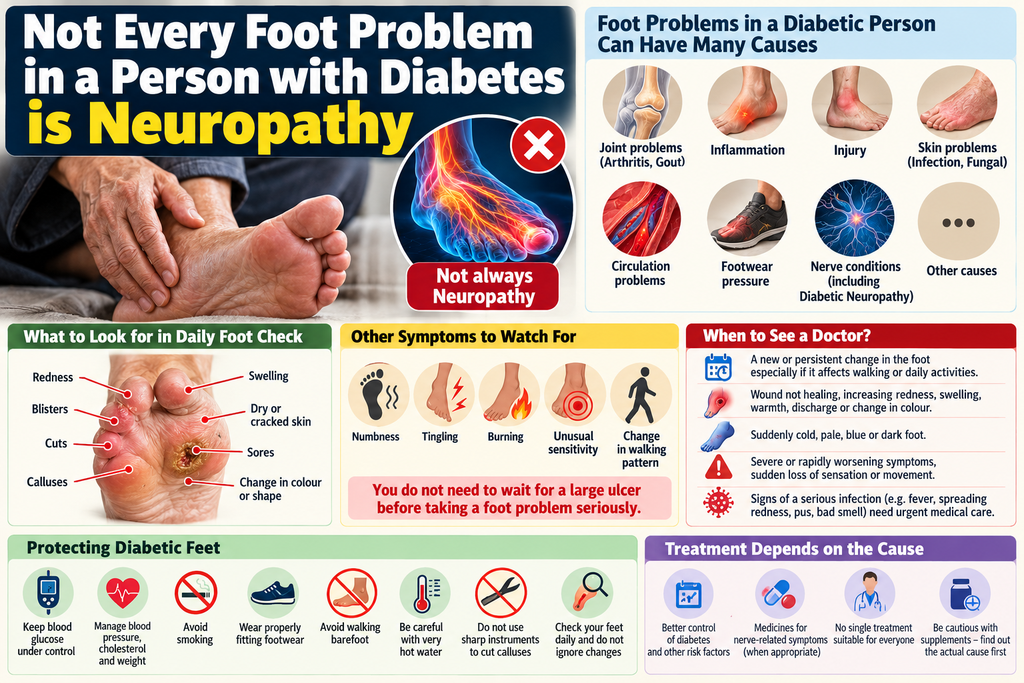
A new or persistent change in the foot should be discussed with a healthcare professional, particularly if it affects walking or normal daily activities. Medical attention is especially important if there is a wound that is not healing, increasing redness or swelling, warmth, discharge, a significant change in colour or temperature, or new or worsening loss of sensation.
A suddenly cold, pale, blue or dark foot, severe or rapidly worsening symptoms, sudden loss of sensation or movement, or signs of a serious infection require urgent medical assessment. These signs do not tell us what the diagnosis is. They simply mean that delaying medical care may be unsafe.
What about treatment?
Treatment depends on the cause of the problem. If diabetic neuropathy is diagnosed, management may involve improving control of diabetes and other risk factors and, when appropriate, medicines to manage nerve-related symptoms.
There is no single treatment that is suitable for everyone. Medicines can have side effects and may interact with other treatments. The same caution applies to supplements advertised for “nerve health” or “nerve repair.” It is better to find out what is causing the problem before starting a treatment on your own.
What my father’s experience taught me
My father’s experience may sound ordinary. There was no major injury, no large wound and no severe pain. There was simply a change in the way his big toe felt and functioned. But that small change made me stop and pay attention.
It reminded me that health problems do not always arrive with a dramatic warning. Sometimes the first indication is simply that something feels different from before. We may notice a change in sensation, a change in movement or a change in the way someone walks.
These changes are easy to dismiss, especially when they are not causing significant discomfort. But for an older person living with diabetes, I believe they deserve proper attention.
A message for sons and daughters
There is another lesson I took from this experience. As children, we grow up watching our parents take care of us. When we are sick, they worry about us. When we need help, they make time for us. As we grow older, however, our own responsibilities become greater. We get jobs, build families and become occupied with our own lives.
For me, working in the police service sometimes makes it difficult to spend as much time with my parents as I would like. There are days when duty comes first, and there are times when I cannot simply leave work because of family responsibilities.
But our parents are getting older while we are busy. That thought stayed with me while taking my father to the doctor. Perhaps I cannot always give him as much time as I want. But I can listen when he tells me something feels different. I can pay attention. I can make sure he gets medical advice when necessary.
Sometimes caring for our parents does not require doing something extraordinary. Sometimes it simply means noticing the small things.
If your parents have diabetes, ask about their feet
If your father or mother has diabetes, ask them about their feet from time to time. Ask whether they have noticed any numbness, tingling, burning or unusual changes in sensation. Ask whether walking feels different or whether they have noticed any swelling, wound or change in the appearance of their feet.
These are simple questions, but older people may become accustomed to gradual changes and may not always mention them. A little attention from a son or daughter can sometimes help a parent recognize that a medical check-up is needed.
Final thought
My father’s experience has made me think about diabetic foot care in a slightly different way. We usually think about diabetes in terms of blood sugar, medicines, diet and exercise. Those things are important, but diabetic foot health also deserves attention.
In my father’s case, the warning was not pain. It was a change in sensitivity around the big toe that became noticeable during movement and while using the foot for standing and walking. We did not try to diagnose the problem ourselves. We took him to the doctor, because any unusual change in a diabetic person’s foot deserves proper attention.
If you have diabetes, pay attention to your feet. Regular diabetic foot care means looking at your feet, noticing changes and protecting them from injury. If something feels different or does not seem right, get it checked by a healthcare professional. Sometimes the body does not give us a dramatic warning. Sometimes it simply tells us that something has changed. We just need to stop long enough to notice.
Medical Disclaimer
This article is based partly on my personal experience with my father and is intended for general health education. A change in sensation in the big toe or foot can have many causes and cannot be diagnosed from symptoms alone. Diabetes can increase the risk of nerve and foot complications. Anyone with diabetes who develops new or persistent changes in sensation, a wound, swelling, redness, colour or temperature changes, or difficulty walking should seek appropriate medical evaluation. This article does not replace professional medical advice, diagnosis or treatment.