
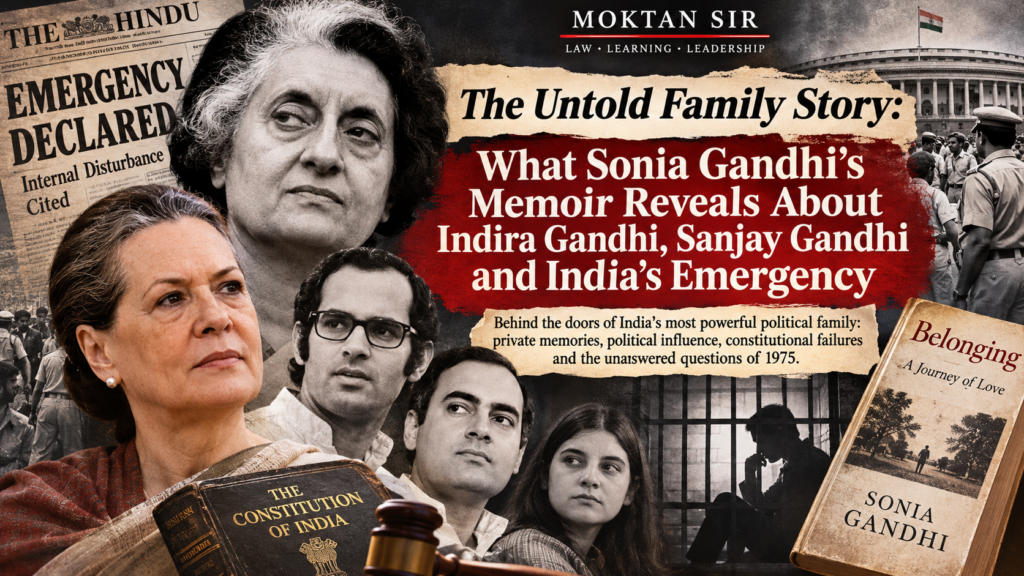

What happened inside India’s most powerful political family during the Emergency? How did Sanjay Gandhi exercise influence without holding constitutional office? And what can this period teach us about the responsibility of police officers and public servants?
The film that made me ask questions
Recently, I watched the film Emergency, based on the life and political career of former Prime Minister Indira Gandhi, particularly the events surrounding India’s Emergency of 1975–1977. When the film ended, I found myself thinking about something beyond the political drama. I began asking questions.
How did a country that had proudly adopted democracy and a Constitution reach a point where fundamental freedoms could be restricted so extensively? What was happening inside the family of the Prime Minister? How much influence did Sanjay Gandhi really exercise? What role did Rajiv Gandhi play during those difficult days? And perhaps most importantly, how did the government machinery, including the police and civil administration, respond to the decisions taken by those in power?
A film can introduce us to history, but it cannot answer every historical question. Cinema uses scenes, dialogue and dramatic moments to tell a story. History requires something more. It requires records, documents, testimonies, court judgments and the willingness to examine different accounts.
That curiosity led me to explore the subject further. I came across discussions surrounding Sonia Gandhi’s memoir, Belonging: A Journey of Love, published by HarperCollins India on 10 November 2026. The book offers her personal recollections of life within the Nehru-Gandhi family and revisits several important political events, including the Emergency.
I wanted to understand what her account adds to the story, what it leaves unanswered and what independent historical records tell us. As I read more, I realised that the Emergency was not simply a story about one Prime Minister or one political family. It was a story about power, fear, institutions and ordinary people. It was also a story about the choices made by those who worked within the government.
There is one question that stayed with me throughout this research:
When a politically powerful person gives an instruction that violates the law, should a public servant obey the person or uphold the Constitution?
Understanding the family behind the political story
To understand the Emergency and Sonia Gandhi’s recollections, it helps to understand the family at the centre of the events. Indira Gandhi was the daughter of Jawaharlal Nehru, India’s first Prime Minister. She became Prime Minister in January 1966 and remained one of the most influential political figures in modern Indian history.
Her husband, Feroze Gandhi, was a Member of Parliament known for his parliamentary interventions and his criticism of corruption and misuse of public office. Their two sons were Rajiv Gandhi and Sanjay Gandhi. Rajiv married Sonia Maino, who later became known as Sonia Gandhi. Sanjay married Maneka Gandhi.
The family lived under unusual circumstances. Politics was part of everyday life. Decisions taken inside the household could attract national attention, and personal relationships existed alongside the pressures of public office. This is important because the Emergency cannot be understood only through official government documents. Personal relationships and informal political influence also shaped the period.
But there is a distinction we must maintain. A family member’s recollection can help us understand the atmosphere inside a household. It cannot, by itself, establish exactly how a government decision was made or who was legally responsible for it. That is why memoirs should be read alongside independent records.
Sonia Gandhi’s memoir: a personal account of a political family
Sonia Gandhi’s Belonging: A Journey of Love provides a personal perspective on her life with Rajiv Gandhi and her experiences within the Nehru-Gandhi family. A memoir is different from an official inquiry report or a judicial judgment. It is written from the author’s own memories, experiences and understanding of events. It can reveal private emotions and family tensions that official documents rarely record.
The book revisits the Emergency and the role of Indira and Sanjay Gandhi. In interviews and reports surrounding its publication, Sonia has described the Emergency as a mistake. She has also expressed the belief that Indira Gandhi eventually recognised the damage caused by it.
One reported recollection concerns a family dinner in June 1975, shortly before the Emergency was declared. According to accounts of Sonia’s memoir, Rajiv Gandhi advised his mother to wait for the next election, while Sanjay Gandhi favoured a tougher response to the political opposition. If accurately represented, this recollection offers an interesting view of the disagreement within the family.
But it raises further questions. Was this conversation decisive in the government’s decision? How much influence did Sanjay actually have? Were the views expressed at a family dinner reflected in formal government decisions? What did Indira Gandhi herself believe at that moment? These questions cannot be answered simply by accepting one recollection as the complete historical record.
I believe the value of a memoir lies partly in the questions it encourages us to ask. It allows us to look beyond public speeches and official positions. At the same time, we must test its claims against documents, contemporary reporting, court records and independent investigations. Sonia’s account is an important personal perspective. It should be considered seriously, but it should not be treated as the final word on the Emergency.
Sanjay Gandhi: power without constitutional office
One of the most striking aspects of the Emergency was the influence exercised by Sanjay Gandhi. He was not the Prime Minister. He was not a Cabinet minister. He did not hold a constitutional office that gave him authority to issue government orders. Yet, his influence over political and administrative affairs became a major subject of public discussion and later inquiry.
This raises a basic question about democratic government: can a person exercise substantial public power without being formally accountable for it? Sanjay Gandhi became associated with a Five-Point Programme that included family planning, tree planting, adult literacy, the abolition of dowry and the ending of caste discrimination. Some of these objectives were socially desirable in themselves. The serious problem was the manner in which certain programmes were implemented, particularly the family-planning campaign and urban clearance operations.
During the Emergency, sterilisation targets became a source of pressure on officials. In several places, people were subjected to coercion, intimidation and abuses in the name of meeting targets. The demolition of settlements around Turkman Gate in Delhi became another deeply controversial episode. The removal of homes and the use of force against residents raised serious questions about the treatment of vulnerable citizens.
The problem was not simply that a government had introduced ambitious programmes. Governments are entitled to pursue public policies within the law. The problem arose when administrative targets and political pressure displaced consent, legal procedure and basic human dignity. The Shah Commission later examined several of these matters, including the sterilisation campaign, demolitions and the misuse of official authority.
The lesson is uncomfortable. When political influence operates outside formal constitutional channels, accountability becomes difficult. Officials may feel pressure to comply, while the person exercising influence may not be directly answerable through the normal structures of government. This is one reason why transparent decision-making and clear lines of authority matter in a democracy.
How did India reach the Emergency?
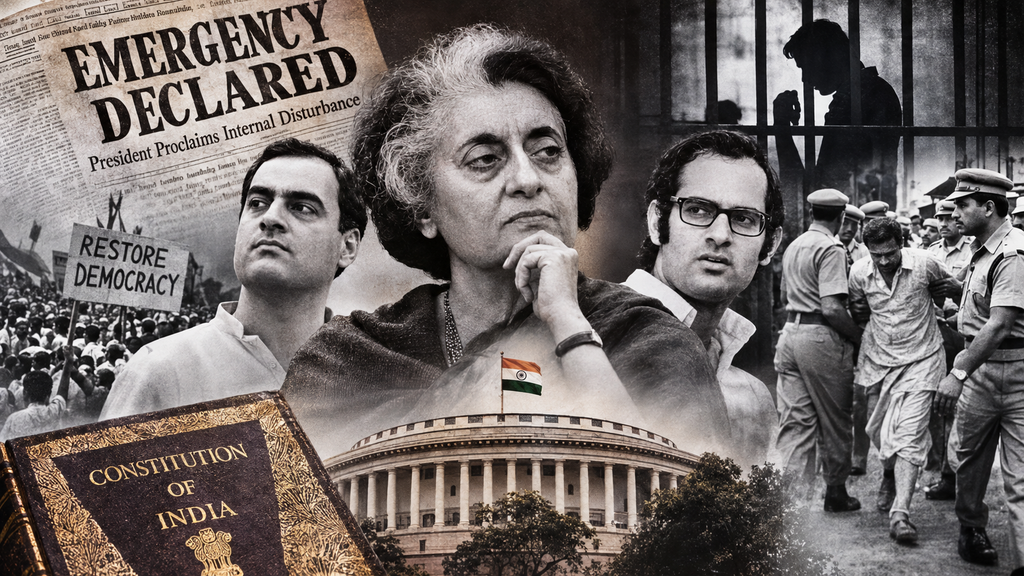
The Emergency did not begin in isolation. India was experiencing serious political and economic tensions in the early 1970s. Inflation, unemployment, public dissatisfaction and allegations of corruption had created an atmosphere of unrest. Student movements in Gujarat and Bihar gained momentum. Jayaprakash Narayan emerged as a major voice of opposition and called for a broad movement for political and social change.
The political crisis became more serious after a court judgment involving Indira Gandhi. On 12 June 1975, the Allahabad High Court, in the election case brought by Raj Narain, set aside Indira Gandhi’s 1971 election to the Lok Sabha on grounds involving electoral malpractice under the Representation of the People Act.
The judgment created a major political crisis. The Supreme Court subsequently granted a conditional stay on 24 June 1975, allowing her to continue as Prime Minister while placing restrictions on her parliamentary participation. The Opposition continued to demand her resignation.
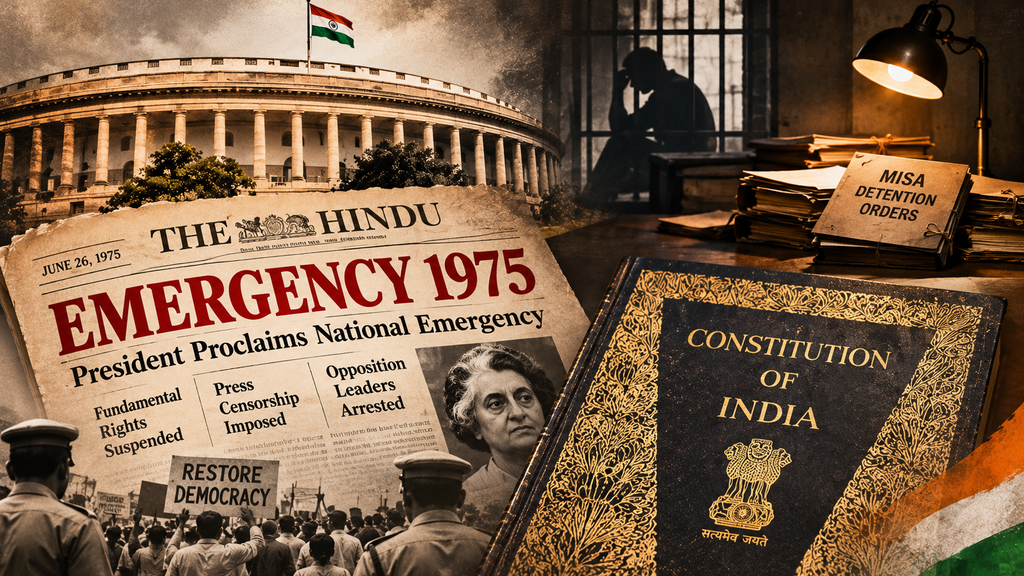
On the night of 25 June 1975, President Fakhruddin Ali Ahmed issued a proclamation of Emergency under Article 352 of the Constitution, citing internal disturbance. The proclamation was formally announced to the country on 26 June. India had entered a new and deeply troubling phase of its democratic history. The Emergency continued until 21 March 1977.
What happened to constitutional freedoms?
The Emergency is often remembered through arrests, press censorship and restrictions on political activity. But to understand its legal significance, we must look at the Constitution. The Constitution provides for emergency powers because a country may face extraordinary threats. However, these powers are exceptional. They are not intended to give the government unlimited authority. During the 1975 Emergency, several constitutional provisions became central to the exercise of state power.
Article 352: Proclamation of Emergency
At the time, Article 352 allowed the President to proclaim an Emergency if the security of India was threatened by war, external aggression or internal disturbance. The 1975 proclamation relied on the ground of internal disturbance. The 44th Constitutional Amendment Act, 1978 later replaced the expression “internal disturbance” with “armed rebellion”. It also introduced safeguards intended to make the declaration of an Emergency more difficult.
Article 358: Suspension of Article 19 protections
Under the constitutional arrangement then in force, the proclamation of Emergency affected the operation of Article 19. The 44th Amendment changed this position. The automatic suspension of Article 19 under Article 358 was restricted to Emergencies declared on the grounds of war or external aggression, rather than every ground under Article 352.
Article 359: Enforcement of fundamental rights
Article 359 allows the President, during an Emergency, to suspend the right to move courts for the enforcement of specified fundamental rights, subject to constitutional conditions. It is important to understand the distinction: suspending the ability to approach a court for enforcement is not the same thing as deleting the rights from the Constitution. The orders issued during the Emergency had serious consequences for people seeking judicial remedies against detention.
MISA: Preventive detention
The Maintenance of Internal Security Act, 1971, commonly known as MISA, was used extensively for preventive detention during the Emergency. Political leaders, activists, journalists and other individuals were detained under preventive detention powers. The use of such powers raised difficult questions about liberty, due process and the limits of executive authority. The constitutional framework and its later amendments show that India eventually recognised the need for stronger safeguards against the misuse of Emergency powers.
ADM Jabalpur: when the courts faced a constitutional test
One of the most controversial judicial decisions of the Emergency period was Additional District Magistrate, Jabalpur v. Shivkant Shukla (1976). The central issue concerned whether a person detained during the Emergency could approach a High Court to challenge the legality of detention when the enforcement of specified fundamental rights had been suspended. The Supreme Court majority took a position that severely restricted access to judicial relief during the Emergency.
Justice H.R. Khanna dissented.
His position defended the principle that life and personal liberty could not be treated as entirely dependent on the government’s willingness to recognise them. His dissent later became one of the most discussed judicial opinions in Indian constitutional history.
In 2017, the Supreme Court’s nine-judge bench in Justice K.S. Puttaswamy (Retd.) v. Union of India, while recognising privacy as a fundamental right, expressly disapproved the reasoning in ADM Jabalpur. For me, this part of the Emergency raises an important question about the role of institutions.
A democracy needs courts that can examine executive action, especially when individual liberty is at stake. The independence of the judiciary is tested most seriously when the government is under pressure and citizens are most vulnerable. The lesson is that constitutional rights must have practical protection. A right that cannot be defended before an independent court may become difficult to exercise when it matters most.
The police and civil administration: the difficult question of obedience
This is the part of the Emergency that I find particularly important. Political leaders make decisions. Governments issue policies. But the actual implementation of those decisions often depends on the police, district administration and other public servants.
A decision taken in the capital can reach a district office, a police station or a local administrative unit through official instructions. An officer may receive an order from a superior. A district official may face pressure from political authorities. A police officer may be told to arrest someone, remove a gathering, restrict a meeting or carry out an administrative operation. In ordinary circumstances, officers are expected to follow lawful orders within their duties. But what happens when an instruction appears to violate the law?
The Emergency reminds us that this is not merely a theoretical question. The Shah Commission of Inquiry, established in May 1977 under the chairmanship of former Chief Justice J.C. Shah, examined excesses committed during the Emergency. Its work included the misuse of government authority, preventive detention, press censorship, sterilisation and the conduct of public officials.
The Commission examined records and heard evidence concerning the actions of senior administrators, police officers and other officials. Its reports provide an important historical record of how public institutions functioned during this period.
For police officers and civil servants, the most difficult lesson is that an official instruction does not automatically become lawful merely because it comes from a powerful person. An officer should ask:
- Is the instruction issued by an authority legally empowered to issue it?
- Does the law permit the proposed action?
- Is there a proper written order or statutory basis where required?
- Does the action violate a person’s legal or constitutional rights?
- Are the relevant records being maintained accurately?
- Is the officer being asked to act beyond the scope of official duty?
A public servant must understand the difference between lawful discipline and blind obedience. There is a chain of command in every disciplined organisation. That chain is necessary for effective administration. But it exists within the framework of law.
The Constitution is not an optional instruction that can be ignored when political pressure becomes intense. I believe this is one of the most important lessons that anyone studying the Emergency should take away. A police officer is expected to maintain public order, protect life and property, enforce the law and act within legal authority. The office carries responsibility. It does not provide a licence to violate the rights of citizens. The same principle applies to district magistrates, senior administrators and every other public servant.
The real test of public service is not how quickly an officer follows an order. It is whether the officer has the courage and judgment to recognise the limits of that order.
The Shah Commission: examining what went wrong
After the Emergency ended, the new government established the Shah Commission of Inquiry in May 1977. It was chaired by Justice J.C. Shah, a former Chief Justice of India. The Commission examined allegations of excesses and misuse of authority during the period from 25 June 1975 to 21 March 1977. Its investigations covered several areas, including:
- Arrests and preventive detention.
- Restrictions and censorship imposed on the press.
- The sterilisation campaign and alleged coercion.
- Demolition operations and administrative excesses.
- Misuse of official positions and government machinery.
- The conduct of public officials and the implementation of political instructions.
The Commission submitted reports between 1978 and 1979. Its findings remain an important source for anyone studying the Emergency, particularly from the perspective of public administration and institutional accountability. The reports also remind us that the actions of government officials do not disappear simply because the political leadership changes. Public authority must be capable of examination. Records, decisions and individual responsibilities matter.
The family story: Rajiv, Sanjay, Sonia and Maneka
The Emergency was also a period of personal and family tensions. Rajiv Gandhi was not then the central political figure that he later became. He was a pilot and, according to Sonia Gandhi’s recollections reported around the publication of her memoir, he was uncomfortable with the decision to impose the Emergency. Sanjay Gandhi, in contrast, became increasingly influential during this period.
The difference between the brothers is often presented as a contrast between two approaches to the political crisis. However, we should be cautious about reducing their positions to a simple family disagreement. Their actual roles and responsibilities must be understood through the available evidence.
The relationship between Sonia Gandhi and Maneka Gandhi also became a subject of public attention, particularly after Sanjay Gandhi’s death in an aircraft accident in June 1980. Maneka later entered politics and developed her own public career. The two women followed different political paths, and their relationship has often been described as strained.
These family relationships matter because they help us understand the private world surrounding public power. But they should not distract us from the larger historical issue: how decisions taken by political leaders affected the lives and rights of millions of citizens.
Indira Gandhi was assassinated on 31 October 1984. Rajiv Gandhi was assassinated on 21 May 1991. These tragedies shaped the family’s later history and Sonia Gandhi’s eventual entry into public life.
What does the memoir reveal, and what remains unanswered?
After examining the memoir-related reporting and the historical record, I think it is useful to separate the questions into two categories.
What the personal account adds
Sonia Gandhi’s recollections offer a view of the family atmosphere during a period of intense political pressure. They provide reported details about differences between Rajiv and Sanjay, Indira Gandhi’s state of mind and the personal consequences of political decisions.
Her description of the Emergency as a mistake is also significant because it reflects how she now views that period from within the family. These are valuable perspectives, especially when considered alongside other accounts.
What still requires independent examination
Several important questions remain.
How much did Sanjay Gandhi influence the government?
His informal influence is widely discussed, but the precise connection between his wishes and particular official decisions must be examined through documentary evidence.
How much did Indira Gandhi know about the excesses committed in the name of the Emergency?
This requires careful examination of official records, testimonies and the findings of the Shah Commission.
Was Rajiv Gandhi’s reported opposition decisive?
A family conversation, even if accurately recalled, does not by itself establish the process through which the government made its decision.
Why did public officials fail to prevent abuses?
This is perhaps the most important administrative question. It requires us to examine the pressure faced by officials, the orders they received, the legal powers available to them and the choices they made.
Could stronger institutions have limited the damage?
The Emergency exposed weaknesses in political accountability, judicial protection, parliamentary oversight and administrative independence.
These questions cannot be answered by one memoir, one film or one political party. They require careful historical and legal research.
The constitutional response: lessons from the 44th Amendment
The Emergency ended on 21 March 1977. Indira Gandhi called a general election, and the Congress party suffered a major defeat. The Janata Party government that came to power introduced the 44th Constitutional Amendment Act, 1978. The amendment sought to reduce the possibility of another Emergency being declared and used in the same manner.
Among its important changes were:
- Replacing “internal disturbance” with “armed rebellion” as a ground for declaring a national Emergency.
- Requiring written advice from the Union Cabinet before the President could issue an Emergency proclamation.
- Introducing parliamentary safeguards and procedures for approval and continuation.
- Restricting the automatic suspension of Article 19 under Article 358 to Emergencies declared on the grounds of war or external aggression.
- Strengthening the protection of the rights to life and personal liberty under Articles 20 and 21 against suspension of their enforcement under Article 359.
The 44th Amendment did not make misuse of power impossible. No constitutional amendment can guarantee that every future government will act wisely. But it recognised that Emergency powers need safeguards and that individual liberty must not depend entirely on executive discretion.
The 42nd Amendment, passed during the Emergency in 1976, had also made major changes to the Constitution. Some of those changes were later modified or reversed through subsequent constitutional and judicial developments. Together, these events show that constitutional systems can be damaged by the misuse of power, but they can also respond through reform.
Why this history still matters to public servants
While researching this subject, I kept returning to the role of the ordinary officer. It is easy to discuss the Prime Minister, political leaders, Parliament and the Supreme Court. Their decisions are recorded in history books. Their names are familiar.
But a government works through thousands of people whose names may never appear in a history book. A police officer at a station. A district magistrate. A superintendent of police. A government doctor. A municipal official. A clerk preparing an order. A field officer implementing a policy.
Each may face a moment when an instruction conflicts with personal judgment, legal responsibility or professional ethics. In such moments, the officer must remember that public authority comes from law. It does not belong personally to the person who occupies a position of power.
An officer should not assume that an instruction is lawful simply because it comes from a senior officer or political authority. The relevant law, authority and circumstances must be examined. Where an instruction is unlawful, the officer should use the available official channels to seek clarification, record the objection where appropriate and refuse to participate in an unlawful act. The precise legal response will depend on the facts and applicable service rules. This is not an argument against discipline. It is an argument for lawful discipline.
A disciplined police force is essential to democracy. But discipline without legal boundaries can become an instrument of oppression. The Emergency gives us a historical example of what can happen when the machinery of the state is used without sufficient checks.
I do not think we should study this period merely to blame individuals who lived through it. We should study it to understand the systems that failed, the safeguards that were missing and the responsibilities that every public servant carries.
A timeline of the Emergency
| Date | Event |
|---|---|
| 12 June 1975 | Allahabad High Court sets aside Indira Gandhi’s 1971 election. |
| 24 June 1975 | Supreme Court grants a conditional stay. |
| 25 June 1975 | President issues the Emergency proclamation under Article 352. |
| 26 June 1975 | Emergency is publicly announced. |
| 1975–1977 | Political detentions, press censorship and controversial government campaigns take place. |
| May 1977 | Shah Commission of Inquiry is established. |
| March 1977 | Emergency ends and general elections bring a change of government. |
| 1978 | 44th Constitutional Amendment is enacted to introduce safeguards. |
| 1978–1979 | Shah Commission submits its reports. |
What I took away from watching the film and researching the history
When I first watched Emergency, I was interested in the political story. I wanted to know what had happened, why it happened and how the country reached that point. But the more I read, the more my attention shifted from the personalities to the institutions.
A Prime Minister has enormous authority, but that authority is limited by the Constitution. A political leader may have influence, but influence does not automatically create lawful power. A police officer may receive an order, but the existence of an order does not remove the responsibility to act within the law. The story of the Emergency is therefore much bigger than a family story.
Sonia Gandhi’s memoir offers one personal perspective. Historical records, court judgments and the Shah Commission provide other perspectives. The film may help bring the subject to a wider audience, but it is the evidence that allows us to understand what happened.
I began this research with curiosity about a film. I ended up thinking about the responsibility that comes with public authority. History should not be used simply to defend one political party or condemn another. It should help us recognise the conditions under which democratic institutions become weak.
The Emergency reminds us that constitutional safeguards matter most when they are inconvenient to those in power. It reminds us that the press, Parliament, the courts, the civil service and the police must retain their proper roles even during a political crisis.
And it reminds us that public servants are accountable for their actions, even when they are acting under pressure.
A democracy does not weaken only when leaders misuse power. It also weakens when institutions stop questioning them and public servants forget that their ultimate duty is to the Constitution.
That is the lesson I take from this chapter of Indian history. I began by watching a film. I continued by reading a memoir and examining historical records. What I found was a reminder that the Constitution is not merely a book of laws kept in a government office. It is a responsibility carried by every institution and every person entrusted with public power.
Disclaimer
This article is intended for educational and historical purposes only. It reflects the author’s personal views based on publicly available records, books, reports and other sources. Every effort has been made to ensure accuracy, but readers are encouraged to verify facts through original sources. The article is not intended to promote or oppose any political party or individual, nor does it constitute legal advice.