

By Suman Moktan

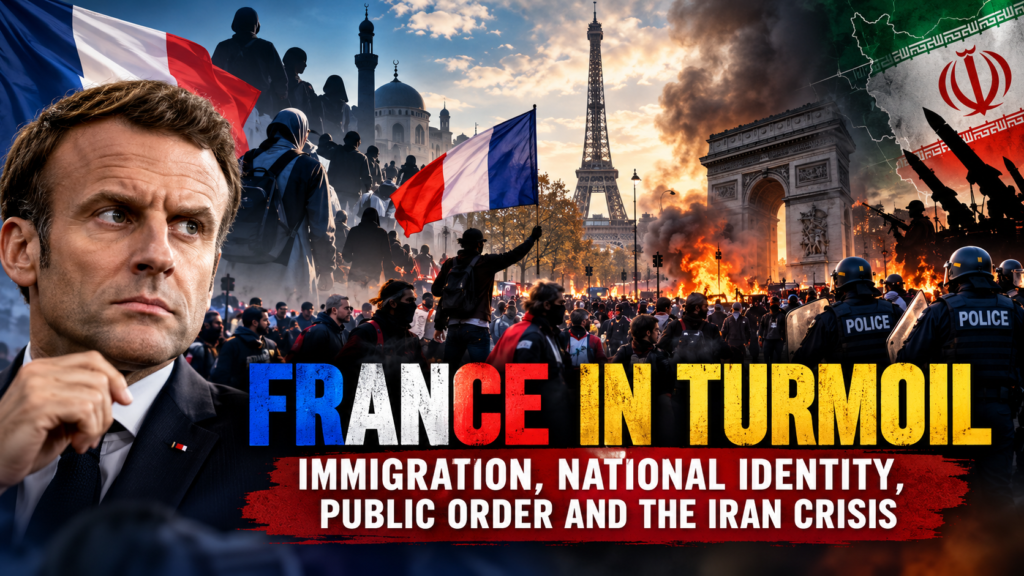
France is confronting a serious crisis of public order at a time when economic frustration, political paralysis and disputes over the country’s future are already putting pressure on its government. Nationwide demonstrations that began around the cost of living and deteriorating school conditions have escalated into violent confrontations, looting and attacks on public buildings. The unrest has also exposed growing tensions over policing, political authority and the ability of the state to respond to public anger.
The latest developments, reported on 17–19 October, suggest that the crisis cannot be understood through a single explanation. Peaceful protesters have raised concerns about living costs and public services, while some people have engaged in criminal violence. The government has blamed radical groups and looters, and critics have questioned the police response and the administration’s handling of the demonstrations.
The questions facing France are difficult but important. How much of the unrest reflects economic hardship? What role do immigration, integration and religious identity play in the country’s wider political debate? Is the government losing its authority? And does the conflict involving Iran have a meaningful connection to the unrest inside France?
These questions deserve investigation rather than easy answers. Immigration, Islam, public disorder and international conflict can intersect, but they are not interchangeable explanations. Each connection must be established through evidence.
1. What happened in France?

The immediate crisis grew out of several weeks of student demonstrations and wider public protests. High-school students, university students, trade unions and citizens associated with the Yellow Vest movement expressed anger over the cost of living, rising fuel prices, educational conditions and what they viewed as the government’s failure to respond to their concerns.
On 17 October, demonstrations took place across the country. France’s Interior Ministry was reported to estimate participation at approximately 550,000 people, including around 110,000 in Paris. The protests were not uniformly violent: large numbers of people demonstrated peacefully, while some groups clashed with police, damaged property and attempted to enter public buildings.
The situation deteriorated further over the weekend. Reports described burning cars, looted businesses, damaged public buildings and violent encounters with law enforcement in cities including Paris, Marseille and Lyon. In Limoges, a fire destroyed the historic city hall, according to Associated Press reporting.
By 19 October, approximately 2,400 arrests had been reported in connection with the weekend’s unrest. That figure is a reported arrest total, not the number of people convicted of crimes. The legal outcomes of individual cases must be established separately.
President Emmanuel Macron condemned the violence and promised a firm response. The government moved toward local curfews and restrictions in affected areas instead of declaring a nationwide state of emergency. Authorities also announced a review of possible failures in intelligence and police preparedness.
The immediate challenge is therefore twofold: restore public order and determine why a broad protest movement became a setting for serious violence.
A responsible account must distinguish between demonstrators exercising their right to protest, people accused of committing offences, and any organised groups shown to have deliberately escalated confrontations. Treating all protesters as rioters would be inaccurate. Equally, peaceful political grievances do not excuse arson, assault or looting.
2. The roots of the unrest: More than one grievance
The latest demonstrations developed against a background of economic pressure and frustration with public institutions.
The cost of living
Fuel prices have become a particularly sensitive issue because they affect people who depend on cars to commute, work or reach essential services. Higher transport costs can place a disproportionate burden on households outside major cities, where public transport may be limited.
The Yellow Vest protests of 2018–2019 showed how a dispute involving fuel taxation and household expenses could develop into a much wider challenge to the political establishment. The movement brought together people with different political views and economic circumstances, united by a sense that the cost of government policies was falling unfairly on ordinary citizens.
The current protests share some of those characteristics. However, similarity does not establish that the movements have identical causes or participants.
Reuters reported on 19 October that France’s financial constraints and fragmented political environment had limited Macron’s ability to respond to public anger through the kind of costly concessions offered during the earlier Yellow Vest crisis.
Schools and young people’s frustration
Educational conditions are another immediate source of tension. Reports from early October described student complaints about absent teachers, overcrowded classrooms, outdated facilities and insufficient resources.
The movement also became more confrontational after footage circulated of forceful police interventions and injured teenagers. Le Monde reported that authorities recorded 6,059 arrests between 28 September and 5 October in connection with the unrest surrounding the student movement. The same report said 87% of those taken into police custody during that period were minors. These are figures for an earlier reporting window and must not be added to the weekend’s reported 2,400 arrests without checking for overlap and differences in counting.
This matters because the police response can influence the direction of a protest. Heavy-handed tactics, where established, may turn a dispute about public services into a wider argument about state authority and individual rights. Police officers, meanwhile, can face dangerous situations when crowds become violent or officers are attacked.
The correct response is neither to assume that every police intervention was justified nor to presume that every officer acted unlawfully. Specific allegations require evidence, independent scrutiny and, where appropriate, judicial investigation.
Political paralysis
France’s political difficulties form a third part of the story. Macron’s decision to dissolve parliament in 2024 weakened his political position, and the country has struggled with a divided legislature and difficult budget choices.
By October 2026, the president was approaching the final months of his term. The unrest has intensified questions about his ability to govern and created opportunities for rival political movements to present themselves as alternatives.
Reuters reported that Marine Le Pen and other political figures were seeking to benefit from public dissatisfaction, while former allies of Macron criticised his handling of the crisis.
Economic hardship, poor services, disputes over policing and weak political leadership can reinforce one another. None alone explains every act of violence, but together they help explain why a protest can attract a much wider public than the original issue might suggest.
3. Is immigration part of the story?
Immigration is one of the most politically sensitive questions in France. It has shaped debates about employment, housing, public services, national identity, security and the country’s relationship with its former colonies. However, the first task is to distinguish demographic facts from political interpretations.
According to France’s National Institute of Statistics and Economic Studies (INSEE), 6 million foreign nationals lived in France in 2024, equivalent to 8.8% of the population. Of these, 5.1 million were born abroad. The remaining 900,000 were born in France and did not hold French nationality.
These categories matter. An immigrant is someone born abroad who has moved to France. A foreign national is someone who does not hold French nationality. Some immigrants become French citizens, while some foreign nationals are born in France.
Consequently, immigration figures cannot be used as a direct measure of the number of people who are culturally, linguistically or socially different from the wider population.
What are the actual pressures?
France faces several questions related to immigration and integration.
- Employment: How effectively are newcomers and their descendants entering the labour market? Are language barriers, discrimination, qualifications or local economic conditions limiting their opportunities?
- Housing: Are affordable homes and public services keeping pace with demand in areas experiencing population growth?
- Education: Do schools have sufficient resources to support students from different linguistic and social backgrounds?
- Public safety: Are particular neighbourhoods experiencing persistent crime or violence, and what do reliable statistics show about the people responsible?
- National identity: How should France reconcile cultural diversity with a common commitment to its laws, institutions and constitutional principles?
These are legitimate subjects for public debate. But they require different forms of evidence. Housing shortages, for example, may be affected by population growth, construction constraints, income inequality and local planning decisions. Crime rates require reliable comparisons that account for age, location, socioeconomic conditions and the specific offence being examined.
It would be misleading to use the destruction of public buildings during the October protests as proof that immigration has failed. The reporting available for this article identifies economic grievances, student protests and confrontations with police as immediate drivers. It does not establish that immigration caused the violence.
Immigration and the far-right political debate
The unrest is unfolding as France prepares for its next presidential election in 2027. Marine Le Pen’s National Rally has long argued for tighter immigration controls and a stronger emphasis on national identity and law and order.
The party may benefit politically from images of burning buildings, looted shops and an apparently weakened government. Reuters reported on 19 October that the unrest had strengthened the political opportunities available to Le Pen and other opponents of Macron.
Yet political advantage is not proof of causation. The fact that an anti-immigration party benefits from unrest does not demonstrate that immigration caused it.
The more useful question is whether France’s political institutions can respond to public concerns about immigration and integration while protecting equal treatment under the law and avoiding the collective blame of entire communities.
4. Muslim communities, demographic change and French secularism
France’s relationship with Islam is frequently at the centre of its national debate. The country has a substantial Muslim population, shaped by migration, family histories, citizenship and generations born in France.
But France does not maintain a simple official census of religious affiliation comparable to that of some countries. Estimates of the Muslim population therefore depend on surveys and the definitions researchers use.
An INSEE study based on 2019–2020 data found that 10% of people aged 18–59 in metropolitan France identified as Muslim, while 51% reported having no religion. Catholicism remained the largest named religious affiliation in the study, at 29%. These figures describe that survey population and period; they should not be presented as an exact measurement of France’s religious composition in 2026.
The figures also demonstrate why demographic change needs careful interpretation. Religious identity does not automatically determine political opinion, social behaviour or attitudes towards the French Republic.
Millions of Muslims in France are French citizens. Their backgrounds, levels of religious observance, political views and social circumstances vary widely. Some are immigrants; others belong to families that have lived in France for generations.
What does laïcité mean?
French secularism, known as laïcité, is a principle governing the relationship between the state and religion. The French Republic is secular. Public institutions must operate within the applicable rules on religious neutrality, while individuals retain the right to freedom of conscience and religious practice, subject to lawful restrictions.
The principle is sometimes misunderstood in two opposing ways. One interpretation treats secularism as requiring religion to disappear from public life. Another treats any restriction on religious expression as inherently discriminatory.
Neither captures the full legal position. The rules differ according to the setting. Public officials are subject to duties of religious neutrality, and specific restrictions apply in state schools. The legal position of ordinary citizens in public spaces is different.
France’s 2004 law restricts the wearing of conspicuous religious symbols in public primary and secondary schools, while the 2010 law prohibits concealing one’s face in public spaces, subject to statutory exceptions. These measures have generated sustained public debate about religious freedom, gender equality, integration and state neutrality.
The important question is how the law is applied and whether restrictions are justified, proportionate and consistent with constitutional and human-rights protections.
Does Islam explain the unrest?
The available reporting does not establish that Islam or Muslim population growth was a principal cause of the October 2026 violence. The immediate protests were associated with economic hardship, fuel prices, school conditions and opposition to the government. Reports of vandalism and clashes with police do not establish the religious identity of those responsible.
If particular individuals or organisations are accused of religious extremism, those allegations must be investigated on their own evidence. They should not be extended to an entire religious community. The same standard applies to allegations of racism, religious discrimination or police misconduct. Each requires evidence and a fair investigation.
France must be able to discuss integration problems openly. That includes questions about language acquisition, employment, discrimination, social segregation and respect for the law. But the discussion becomes less accurate when it assumes that Muslims form a single political or cultural bloc.
5. Public order, policing and the limits of state authority

The state’s first responsibility during violent disorder is to protect life, prevent serious offences and maintain public order. It must also respect the right to peaceful assembly and ensure that police powers are used lawfully. The latest unrest has raised questions on both sides of this responsibility.
On one side, businesses have been looted, public buildings attacked, and officers confronted by violent groups. Such conduct threatens residents and workers who may have had no involvement in the demonstrations. It also imposes financial costs on businesses, local authorities and taxpayers.
On the other side, footage of police interventions and reports of serious injuries among young demonstrators have intensified scrutiny of law-enforcement tactics. The earlier student protests had already generated complaints about the use of tear gas and other crowd-control weapons.
What should the authorities do?
A credible response should have four elements.
First, police must protect the public and intervene against arson, assault, looting and attacks on public institutions. Arrests must be based on lawful grounds, and evidence should be preserved for prosecution.
Second, allegations of excessive force must be investigated independently. The existence of serious injuries does not by itself prove misconduct in every case, but neither should such injuries be dismissed without examination.
Third, courts must distinguish between people accused of violence and those who merely attended demonstrations. An arrest is not a conviction, and peaceful protest is not a crime simply because it challenges the government.
Fourth, authorities must explain their decisions. Clear information about arrests, injuries, restrictions, investigations and legal proceedings can help prevent rumours from filling the information gap.
What happened on 19 October?
By 19 October, the government had adopted more localised restrictions. Reuters reported curfews and other measures in Paris, Lille, Nice and additional locations. Paris police imposed restrictions in areas considered vulnerable to further disorder.
Interior Minister Laurent Nuñez offered to resign amid questions about security failures, but Macron declined the offer and instructed him to address the problems. The government also faced pressure to support affected businesses and restore confidence. These measures may help contain immediate violence. They cannot, on their own, resolve the underlying grievances.
A curfew is a temporary public-order measure. It is not an economic policy, an education reform or a substitute for political accountability.
6. The Iran crisis: A direct connection, but what kind?

The Iran question requires particular care because it involves two different issues: the international conflict affecting France’s economic environment and the information dispute between Paris and Tehran.
The economic connection
Reporting by Euronews on 17 October linked the protests over living costs and fuel prices to the US-Israeli war involving Iran. Rising fuel costs were part of the public anger that brought protesters into the streets. If conflict in the Middle East disrupts energy production, shipping routes or insurance markets, the effects can spread to European economies. Higher energy costs may then increase transport and household expenses.
However, a sound analysis must distinguish the international event from its domestic consequences. The existence of a conflict involving Iran does not, by itself, explain why French students are protesting about classrooms or why some individuals are looting shops.
The chain of causation needs to be examined: what happened to energy prices, how those changes affected French households, what other domestic pressures existed, and why particular protests escalated.
The information-war connection
There is also a documented diplomatic dispute. On 7 October, France’s foreign ministry announced that it had summoned Iran’s ambassador in Paris in response to what it described as a disinformation campaign by Iranian authorities concerning the French student movement.
According to the French statement, official Iranian Foreign Ministry accounts had circulated false content about the protests. France also objected to Iran’s summoning of the French ambassador in Tehran the previous day. This establishes that the French government publicly accused Iranian authorities of spreading disinformation about the student protests.
It does not establish that Iran organised the demonstrations, directed the rioters or caused the unrest. Those are separate allegations that would require independent evidence. The distinction is important. Foreign governments can exploit domestic tensions through propaganda, selective reporting or misleading online content. But the circulation of propaganda does not prove that the underlying grievance is fabricated or that the foreign government created the movement.
France should investigate credible evidence of foreign interference while addressing the domestic problems that made the protests possible.
Three questions investigators should ask
1. Who created the disputed content? Investigators should identify the original accounts, establish whether they are genuinely linked to state institutions and preserve verifiable evidence.
2. What was false or misleading? Specific claims should be compared with reliable records, photographs, videos and official information. Political disagreement should not automatically be classified as disinformation.
3. Did the activity change events on the ground? Evidence of an online campaign is different from evidence that the campaign mobilised rioters, coordinated criminal acts or materially escalated violence.
Until those questions are answered, the responsible conclusion is limited: there is a reported diplomatic dispute over Iranian communications about the protests, but a direct operational role in the riots has not been established by the sources reviewed here.
7. What the unrest reveals about France’s political future

France’s immediate crisis is unfolding at a politically sensitive moment. The next presidential election is approaching, and public confidence in the government’s ability to deliver economic stability and effective administration has become a central issue.
Macron’s position is weakened by a divided parliament, difficult fiscal choices and criticism from both former allies and political opponents. Reuters reported that the unrest was adding to investor concerns about France’s debt and budget deficit. The political consequences could extend beyond the immediate security response.
The right may gain from demands for order. Images of damaged businesses and public buildings can strengthen arguments for tougher policing, stricter sentencing and tighter immigration controls. National Rally may attempt to connect the unrest with its wider criticism of immigration and national integration. Whether voters accept that explanation will depend on their own priorities and on what further evidence emerges.
The left may gain from the protests’ original demands. Concerns about schools, purchasing power, inequality and police conduct can strengthen calls for greater public investment and institutional reform. But political parties must also explain how they would prevent violence and protect public services.
The political centre faces a credibility test. Macron’s government must demonstrate that it can maintain order without treating all demonstrators as criminals, and that it can respond to legitimate grievances despite financial constraints.
The central political risk is that the country becomes trapped between two increasingly hostile interpretations: one that attributes the crisis principally to immigration and a loss of national identity, and another that treats the violence as merely a symptom of economic inequality or state repression.
Both may identify issues relevant to particular cases. Neither should be accepted as a complete explanation without evidence. France’s future depends in part on whether political leaders can address public safety, economic pressures and integration without turning every incident into a referendum on an entire community.
8. What journalists should watch next
As of 20 October 2026, several developments deserve close monitoring.
| Issue | What needs verification |
|---|---|
| Arrests and prosecutions | How many people have been charged, released or convicted, and for which offences? |
| Injuries and deaths | Confirmed totals, causes of death and the status of investigations into serious injuries |
| Property damage | Verified losses to businesses, schools, public buildings and transport infrastructure |
| Police conduct | Independent findings concerning crowd-control tactics, use of weapons and alleged excessive force |
| Government response | Duration and legal basis of curfews, restrictions on assembly and announced security reforms |
| Economic grievances | Changes in fuel prices, household costs, employment and school funding |
| Immigration and integration | Reliable local evidence on employment, housing, education, discrimination and crime |
| Foreign interference | Independently verified evidence of state-linked disinformation, coordination or operational involvement |
| Political consequences | Public opinion, party responses and the effect of the crisis on the 2027 presidential campaign |
These questions should be investigated separately before being combined into a wider explanation.
It is particularly important to avoid mixing figures from different reporting periods. The thousands of arrests reported during the early student demonstrations and the approximately 2,400 arrests reported for the later weekend may cover different incidents, counting methods or overlapping cases. They should not be added together without a verified breakdown.
The same caution applies to claims about injuries, deaths and economic losses. Preliminary reports can change as authorities complete investigations.
Conclusion: France needs answers, not convenient scapegoats
France is facing a serious test of public order and political leadership. The October unrest has exposed anger over living costs, dissatisfaction with educational conditions, concerns about policing and a broader crisis of confidence in the government.
Immigration and integration remain important questions in French public life. So do secularism, religious freedom, national identity and the ability of public institutions to serve diverse communities. These issues deserve open debate, supported by reliable statistics and consistent legal standards.
But the evidence available for this analysis does not justify treating immigration or Muslim population growth as the established cause of the latest violence. Nor does the diplomatic dispute with Iran establish that Tehran organised the riots. The more direct links currently documented concern economic grievances, the student protest movement, confrontations with police and allegations of Iranian disinformation about the demonstrations.
The French state must protect citizens, prosecute proven offences and investigate allegations of police misconduct. Political leaders must also explain how they intend to improve public services and respond to economic hardship. Those responsibilities cannot be discharged through rhetoric alone.
The deeper test is whether France can enforce its laws while preserving civil liberties, confront integration problems without collective blame, and investigate foreign interference without exaggerating what the evidence proves.
A country does not resolve a crisis by choosing its most convenient explanation. It resolves it by establishing what happened, identifying who was responsible, correcting institutional failures and addressing the grievances that can be demonstrated to be real.