
By Suman Moktan | Moktan Sir — Law • Learning • Leadership
A court has pronounced the death sentence. The courtroom has heard the verdict. News channels are discussing it, social media is full of reactions, and people are asking whether justice has finally been delivered. But a question keeps coming to mind: What happens now?
Will Muskan Rastogi and Sahil Shukla be taken to the gallows immediately? Can they challenge the death sentence? Will another court examine the evidence? Can the sentence be reduced to life imprisonment? And what happens if every appeal fails? These are natural questions, especially in a case that has attracted so much public attention.
The Meerut Case and Death Sentence have brought these questions into the public discussion following the reported murder of Saurabh Rajput and the concealment of his remains in a cement-filled drum. According to reports, a Meerut court sentenced Muskan Rastogi and Sahil Shukla to death on 14 October 2026.
For many people, the announcement of a sentence may seem like the end of the story. From a legal perspective, however, it may be the beginning of another long and important chapter. In India, a death sentence passed by a trial court does not mean that an execution will take place immediately. The law requires further judicial examination, and the convicted persons have legal remedies available to them.
The First Question: Can They Be Executed Immediately?
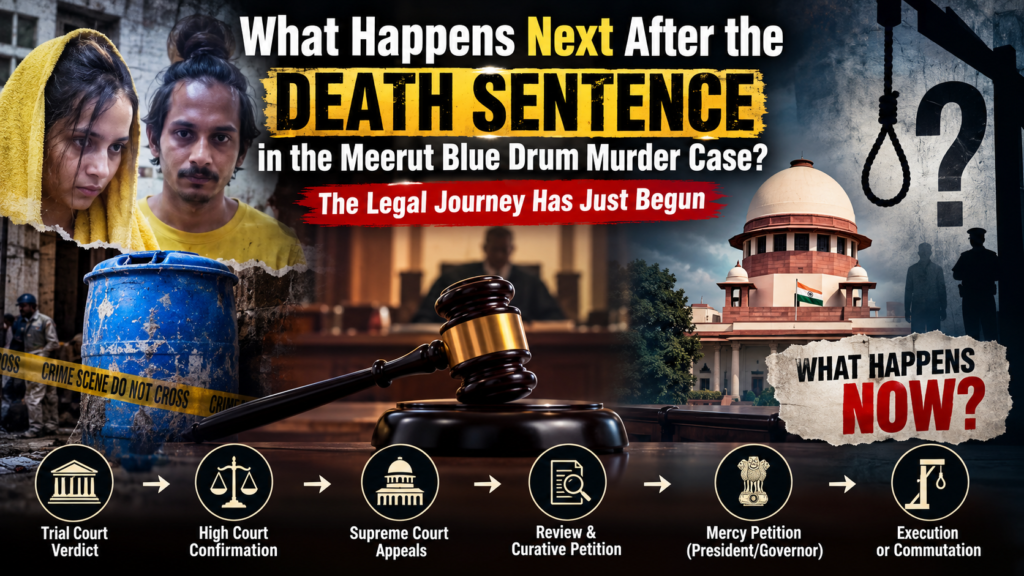
The short answer is no. When a Sessions Court awards the death penalty, the case must be sent to the High Court for confirmation. Section 407 of the Bharatiya Nagarik Suraksha Sanhita, 2023 (BNSS) lays down this requirement. Why does the law require another court to examine the sentence? Because the death penalty is different from any other punishment. Imprisonment can, in appropriate circumstances, be reconsidered or reversed. An execution, once carried out, cannot be undone. The law therefore requires an additional level of scrutiny before a trial court’s death sentence can be implemented.
The High Court will examine the case, including the evidence, the conviction and the reasons for imposing the death penalty. It must decide whether the sentence should be confirmed or whether another lawful outcome is appropriate. Imagine the question facing the High Court: Has the prosecution proved its case beyond a reasonable doubt? Has the trial court correctly applied the law? And even if the conviction is justified, does the case legally warrant the death penalty? These questions must be answered through judicial reasoning, not public emotion.
What If the Convicts Challenge the Verdict?
The next question is almost inevitable. What if Muskan Rastogi and Sahil Shukla disagree with the trial court’s decision? They can challenge the conviction and sentence through the applicable legal process.
Their lawyers may argue that the evidence was wrongly assessed, that certain legal requirements were not satisfied, or that the prosecution failed to establish the case beyond reasonable doubt. They may also challenge the decision to impose the death penalty. This is where the distinction between a murder conviction and a death sentence becomes important.
A court may find a person guilty of murder and still conclude that life imprisonment, rather than death, is the appropriate punishment. In Bachan Singh v. State of Punjab (1980), the Supreme Court established the principle that the death penalty should be imposed only in the “rarest of rare” cases, when the alternative of life imprisonment is unquestionably foreclosed.
In simple language, the court must ask whether the crime and the circumstances make death the only appropriate legal option after considering all relevant factors. The brutality of a crime matters. But it does not automatically settle the question of punishment.
Could the Supreme Court Become Involved?
Yes. The legal journey may continue beyond the High Court. If the High Court confirms the death sentence, the convicted persons may pursue the available remedies before the Supreme Court, depending on the applicable constitutional and procedural provisions. The Supreme Court may examine whether the conviction is legally sustainable and whether the death sentence meets the required legal standards.
This is particularly important in a case based on circumstantial evidence. Where there is no direct eyewitness to the killing, the prosecution must establish a complete chain of circumstances pointing to the guilt of the accused and excluding reasonable alternative explanations. In Sharad Birdhichand Sarda v. State of Maharashtra (1984), the Supreme Court laid down important principles for assessing circumstantial evidence.
The Court’s task is not to decide whether the prosecution story appears convincing at first glance. It must determine whether the evidence satisfies the legal standard required for conviction. The Supreme Court may uphold the decision, alter the sentence or grant other relief permitted by law. The result will depend on the evidence, the arguments and the applicable legal principles.
What If the Supreme Court Also Upholds the Death Sentence?
Suppose the High Court confirms the sentence and the Supreme Court also rejects the available challenge. Is that the end? There may still be further legal remedies. The convicted persons may seek a review of the Supreme Court’s judgment. A review petition is limited in scope; it is not simply another opportunity to argue the entire case again.
In exceptional circumstances, a curative petition may also be considered under the Supreme Court’s established procedure. This remedy is intended to address a serious failure of justice that meets the Court’s strict requirements. These proceedings do not guarantee that the outcome will change. Their purpose is to ensure that a serious legal error is not left uncorrected where the law permits further intervention.
The important point is that each remedy has its own requirements. None should be treated as an automatic ticket to a different verdict.
The Mercy Petition: Can the President or Governor Intervene?
There is another part of India’s legal system that many people may not immediately think about: constitutional clemency. Articles 72 and 161 of the Constitution provide powers of pardon, reprieve, respite, remission, suspension or commutation within their respective constitutional limits.
Article 72 gives the President specific powers in matters including death sentences. Article 161 provides the Governor with powers concerning offences within the constitutional framework, subject to its limitations. A death-row convict may seek mercy through the applicable process under Section 472 of the BNSS and the relevant constitutional procedures.
A mercy petition is different from an appeal. An appeal asks whether the conviction or sentence is legally sustainable. A mercy petition asks the competent authority to consider whether clemency or a reduction of punishment is warranted within the constitutional framework. The outcome is not guaranteed. The petition must be considered under the applicable rules and constitutional principles.
So, even after the judicial proceedings, another question may arise: Should the death sentence be carried out, or should it be commuted? That question belongs to the constitutional process, not to social media polls or public campaigns.
Can a Death Sentence Become Life Imprisonment?
Yes, that is legally possible. A competent court may replace the death sentence with another lawful punishment. A death sentence may also be commuted through the applicable constitutional process.
The Supreme Court has repeatedly emphasised that capital punishment requires careful consideration of the individual offender and the circumstances of the crime. In Manoj v. State of Madhya Pradesh (2022), the Court highlighted the importance of examining relevant material about the accused’s background, mental health and prospects of reformation during capital sentencing.
This means that the court must look beyond the immediate horror of the offence. It must consider whether the legal conditions for imposing death have actually been met. Whether the sentence in the Meerut case will ultimately remain unchanged is something that cannot responsibly be predicted without examining the judgments and the subsequent proceedings.
What About the Family of Saurabh Rajput?
While lawyers prepare appeals and courts examine the case, one must not forget the human tragedy behind the legal proceedings. Saurabh Rajput lost his life. His family has suffered a loss that no court order can reverse.
For the victim’s family, the announcement of a death sentence may bring a sense of relief or the feeling that justice has been done. The continued legal process may also bring uncertainty, emotional strain and difficult questions. Their pain deserves to be treated with sensitivity and respect.
At the same time, the legal system must ensure that every sentence is imposed and implemented according to law. Protecting the rights of a convicted person does not mean disregarding the victim. It means ensuring that justice rests on a fair and lawful process. That distinction is essential in a constitutional democracy.
One Final Question: What Should the Public Expect Now?
The most sensible expectation is that the legal process will continue through the stages required by law. The first major step is the High Court’s examination of the death sentence. Depending on the outcome, further proceedings may follow before the Supreme Court, including review or curative proceedings where legally available. A mercy petition may also be considered through the prescribed process.
The exact timeline cannot be predicted. It will depend on the proceedings, the applications filed, the decisions of the courts and the requirements of the law. It is also important to distinguish a reported verdict from the final legal position. Before concluding the case’s present status, readers should consult reliable reporting and, where available, the official court orders.
For now, the most useful question is not simply whether the convicts will be executed. It is whether the entire process will satisfy the standards of evidence, fairness and law that India requires in a case involving the death penalty.
Conclusion: The Verdict Is a Milestone, but Is It the Final Chapter?
The Meerut Blue Drum Murder Case has brought intense public attention to the question of punishment for a grave crime. The reported death sentence is a major development, but it does not end the legal process. The High Court must examine the sentence. Further judicial remedies may follow. Constitutional clemency may also become relevant at the appropriate stage.
What will happen to Muskan Rastogi and Sahil Shukla? Will the death sentence be confirmed? Could it be reduced? Will the case reach the Supreme Court? These questions can be answered only as the legal proceedings develop. For now, the law provides a clear framework, even if the outcome remains uncertain.
A death sentence is one of the most serious decisions a court can make. That is precisely why the law insists on careful scrutiny before it can be carried out.
As the next chapter of the Meerut case unfolds, the country will be watching. The responsibility of the courts will be to ensure that the outcome is determined by evidence, law and constitutional safeguards. That is how justice must work, even in the most disturbing cases.
Legal note: This article explains the general legal process after a death sentence in India. The reported sentence and the current status of the Meerut proceedings should be verified against official court records before publication. The article does not predict the outcome of any pending or future appeal.