
Suman Moktan
Why I Wanted to Understand the Removal Process of the Chief Election Commissioner (CEC )? Over the past few days, while following political discussions and posts on social media, one question has caught my attention:
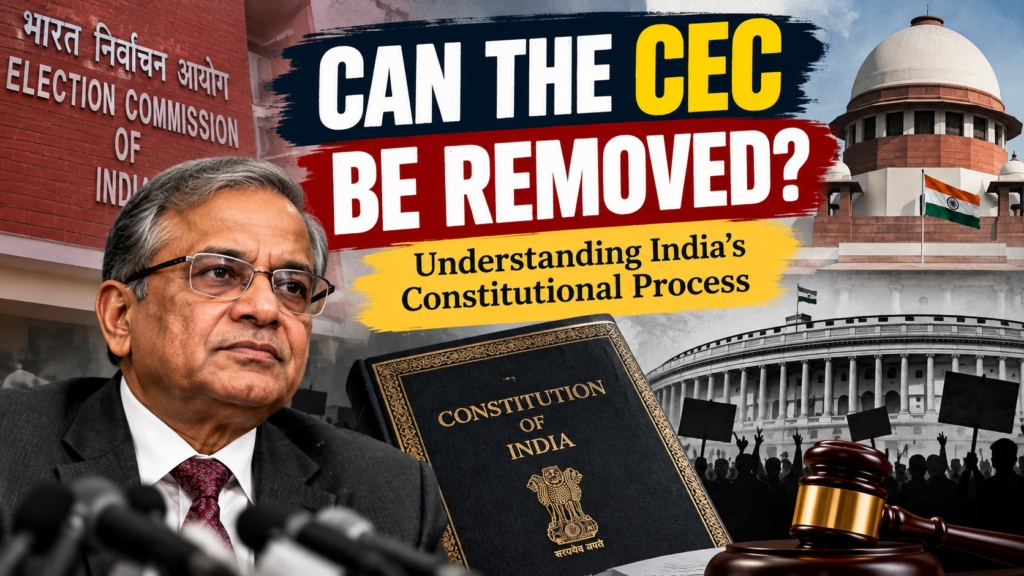
Can the Chief Election Commissioner of India actually be removed from office?
The question has become especially relevant amid the recent agitation demanding the resignation of Chief Election Commissioner Gyanesh Kumar. Opposition leaders and protesters have alleged that the Election Commission mishandled electoral rolls and the Special Intensive Revision (SIR). The Election Commission and the BJP have rejected allegations of wrongdoing. These are contested political claims, and they must be distinguished from findings established through a legal process.
As I followed the debate, I realised that demanding the resignation of a constitutional authority and legally removing that authority are two very different things.
This made me curious about the actual procedure. Who has the power to remove the Chief Election Commissioner? Can the Prime Minister or the President remove him? Can Parliament pass a resolution and end his tenure? What happens if a large number of MPs demand his removal? And what role does the Constitution play in the entire process?
I decided to examine the relevant constitutional provisions and laws to understand the answer. What I found is that the removal of the Chief Election Commissioner is governed by a special constitutional procedure. It is designed to protect the independence of the office while providing a legal mechanism for removal on specified grounds. Let us understand this process in simple language.
1. First, Why Is It So Difficult to Remove the CEC?
To understand the removal procedure, I first looked at the constitutional position of the Chief Election Commissioner. The Election Commission of India is established under Article 324 of the Constitution. It supervises the preparation of electoral rolls and the conduct of elections to Parliament, State Legislatures, and the offices of the President and Vice-President.
This is a significant responsibility. The Commission administers elections that determine who represents citizens in elected institutions. Its independence is therefore important to the functioning of India’s electoral democracy. The Constitution recognises this need for independence. Article 324(5) provides that the Chief Election Commissioner cannot be removed from office except in the same manner and on the same grounds as a Judge of the Supreme Court.
When I examined this provision, the reason for the special protection became clearer. If the government of the day could dismiss the CEC whenever it disagreed with an election-related decision, the independence of the office could be affected. The Constitution therefore does not give the executive an unrestricted power to remove the CEC.
This brings us to the next question: if the government cannot simply dismiss the CEC, who can initiate the process?
2. What Are the Grounds for Removing the Chief Election Commissioner?
Article 324(5) refers to Article 124(4), which deals with the removal of a Supreme Court judge. Article 124(4) recognises two grounds for removal:
- Proved misbehaviour
- Incapacity
These are specific constitutional grounds. They are not the same as political disagreement, public criticism or dissatisfaction with an official decision.
Proved misbehaviour means that the alleged conduct must be established through the prescribed process. A political party may accuse the CEC of acting unfairly, but making an accusation does not automatically prove misconduct.
Incapacity refers to an inability to discharge the duties of the office. This, too, must be established under the applicable procedure.
Consider the present controversy. Suppose a political organisation alleges that eligible voters have been wrongly excluded from electoral rolls. The allegation may warrant investigation, scrutiny of records or legal proceedings, depending on the facts. However, the allegation alone does not establish the constitutional ground required for removal.
This distinction is important. In a democracy, public officials must be open to scrutiny, but the legal consequences of alleged misconduct must follow the applicable law.
3. Can the President or the Prime Minister Remove the CEC?
My next question was whether the President, the Prime Minister or the Union Government could directly remove the Chief Election Commissioner. The constitutional provisions provide a clear answer. The President does not have an unrestricted personal power to remove the CEC. Article 324(5), read with Article 124(4), requires the special parliamentary procedure to be followed. The Prime Minister and the Union Government likewise cannot remove the CEC through an ordinary executive dismissal order.
The President’s role comes at the final stage, after both Houses of Parliament have adopted the required address for removal in accordance with the Constitution. In other words, the removal process cannot be completed simply because the government has lost confidence in the office-holder. This is where Parliament becomes central to the process.
4. How Does the Removal Process Actually Begin?
The procedure is governed by the constitutional provisions and the Judges (Inquiry) Act, 1968. The first step is the submission of a formal notice of motion to the Speaker of the Lok Sabha or the Chairman of the Rajya Sabha.
Section 3(1) of the Judges (Inquiry) Act, 1968, prescribes the minimum number of members required to sign the notice:
- At least 100 members of the Lok Sabha; or
- At least 50 members of the Rajya Sabha.
These thresholds allow a motion to be submitted for consideration. They do not automatically guarantee its admission. I found this distinction particularly interesting. Even when a motion has the required number of signatures, the removal process does not immediately move to an inquiry. The Speaker or Chairman must first decide whether to admit the motion under the applicable law. If the motion is refused, the inquiry process does not begin under that motion. If it is admitted, the next stage follows.
5. What Happens After a Motion Is Admitted?
If the motion is admitted, the Judges (Inquiry) Act, 1968 provides for the constitution of a three-member inquiry committee. The committee consists of:
- A person chosen from among the Chief Justice and other Judges of the Supreme Court.
- A Chief Justice of a High Court.
- A distinguished jurist.
The committee examines the charges and follows the prescribed inquiry procedure. The person concerned must be given an opportunity to respond to the allegations and present a defence as provided by law. The committee then submits its findings.
If the committee does not find the charge of misbehaviour or incapacity established, Section 6 provides that no further steps are taken in either House in relation to that report and motion. If the charge is found proved, the process can proceed to parliamentary consideration.
One point is worth remembering: even an adverse inquiry finding does not, by itself, remove the CEC from office. Parliament must still complete the constitutionally required process.
6. What Majority Is Required in Parliament?
This was another question I wanted to clarify. A simple majority is not enough to remove the Chief Election Commissioner. Under Article 124(4), each House of Parliament must adopt the address by a special majority. Both of the following conditions must be satisfied:
- First, the address must be supported by a majority of the total membership of that House.
- Second, it must be supported by a majority of not less than two-thirds of the members present and voting.
- Both conditions apply in each House.
The addresses must also be adopted in the same session of Parliament. Once both Houses adopt the address in the constitutionally required manner, it is presented to the President, who issues the order of removal.
The process therefore has several distinct stages: a motion, admission, inquiry, parliamentary approval by special majorities and a presidential order. It is a demanding procedure, but that is precisely why the office enjoys protection against arbitrary dismissal.
7. Has Parliament Already Tried to Remove Gyanesh Kumar?
While researching this subject, I came across an important development that makes the legal procedure more than a theoretical question. In March 2026, opposition Members of Parliament submitted notices seeking the removal of Chief Election Commissioner Gyanesh Kumar.
According to the official parliamentary records, the notice submitted in the Lok Sabha on 12 March 2026 was signed by 130 members. A separate notice submitted in the Rajya Sabha was signed by 63 members. On 6 April 2026, the Lok Sabha Speaker and the Rajya Sabha Chairman refused to admit the respective notices under Section 3 of the Judges (Inquiry) Act, 1968.
This development illustrates the importance of the admission stage. The motions had the required number of signatures, but they did not proceed to the inquiry-committee stage because the notices were refused admission.
The parliamentary notices record the procedural decisions. They should not be interpreted as judicial findings that every allegation against the CEC was true or false.
For anyone trying to understand the current controversy, this is an important distinction. A demand for removal is one thing. Submitting a motion is another. Admitting a motion and completing the constitutional process are separate legal stages.
8. Can a Public Agitation Force the CEC to Leave Office?
This question brings us back to the issue that first made me curious about the subject. Can a political party, a citizens’ organisation or a large public movement remove the CEC? The answer is no. A public agitation cannot itself remove the Chief Election Commissioner.
Citizens have the right to express their views, organise peaceful protests subject to applicable law, submit representations and demand accountability. Members of Parliament can also use the procedures available to them under the Constitution and parliamentary law. However, public pressure does not replace the legal procedure. There is a difference between demanding resignation and removing someone from office.
A resignation is voluntary. Section 11(1) of the Chief Election Commissioner and Other Election Commissioners (Appointment, Conditions of Service and Term of Office) Act, 2023, permits the CEC to resign by submitting a written resignation to the President.
Removal, on the other hand, is governed by Section 11(2) of the Act, Article 324(5) and the procedure applicable to the removal of a Supreme Court judge. Therefore, a demand that the CEC resign does not automatically terminate his tenure. Unless he resigns or is removed through the prescribed process, the demand alone has no such legal effect.
9. What If a Voter’s Name Has Been Wrongly Deleted?
The controversy over electoral rolls raises another important issue: what can an individual citizen do if their name has been omitted? The removal of the CEC and the restoration of an individual voter’s name are separate legal questions.
A person who believes that their name has been wrongly omitted should first check the current electoral roll and the status of their registration. Depending on the stage of the revision and the circumstances, the person may approach the Booth Level Officer or Electoral Registration Officer, submit the prescribed application for inclusion or correction, and preserve relevant records and acknowledgements.
Where appropriate, the person may also consider the available statutory appeal or judicial remedies. The exact procedure depends on the applicable electoral-roll rules and the individual’s circumstances.
A demand for the CEC’s resignation does not automatically restore a deleted name. Equally, a complaint about an omitted name should be assessed on its evidence rather than treated, by itself, as proof of deliberate wrongdoing by a particular official. For the affected voter, the immediate priority is to establish the facts and use the appropriate legal remedy.
10. What Does This Teach Us About Constitutional Accountability?
After examining the relevant provisions, I came to understand why the removal procedure is deliberately difficult. The Election Commission must be able to perform its duties without fear of arbitrary dismissal. At the same time, its decisions and conduct can be questioned through lawful channels.
The Constitution attempts to balance these two concerns. It protects the CEC against removal at the government’s discretion while allowing removal when the specified grounds are established through the prescribed process.
Public protests may bring allegations into the public domain. Parliamentary proceedings may create an opportunity for formal scrutiny. Electoral authorities and courts may also have roles, depending on the issue and the remedies available. But each process has its own legal requirements.
This is why it is important to examine the constitutional provisions rather than rely only on slogans, short videos or social-media posts. The legal position may be more complicated than a trending hashtag suggests, but understanding it helps us participate in public debate with greater clarity.
Conclusion: A Demand Is Not the Same as Removal
My curiosity about the trending debate led me to a clear conclusion: the Chief Election Commissioner cannot be removed merely because a political party or a public movement demands it.
Article 324(5) of the Constitution, read with Article 124(4), protects the CEC through a special removal procedure. The Judges (Inquiry) Act, 1968 governs important stages of the process, including the submission and admission of a motion and the inquiry that follows admission.
The process requires specified grounds, an inquiry where applicable, approval by both Houses of Parliament through special majorities, and an order of the President. The March 2026 motions concerning Gyanesh Kumar also show that a motion can be refused admission before an inquiry begins.
Whether one agrees or disagrees with the current political demands, the legal process must be understood separately from the political debate.
For me, the most important lesson is simple: in a constitutional democracy, public accountability matters, but the removal of a constitutional office-holder must follow the Constitution. That is the law behind the headlines, and it is worth understanding before drawing conclusions from what we see on social media.
Legal Disclaimer
This article is intended for general legal education and public awareness. It is not legal advice. Readers should consult the current official legal texts and relevant parliamentary records before relying on the information for a legal proceeding.