
By Suman Moktan
Some stories of India’s freedom struggle are remembered in textbooks, public celebrations and monuments. Others remain largely outside the national conversation, even though the people behind them made sacrifices of their own.
The story of Helen Lepcha, also known as Savitri Devi, belongs to that second category.
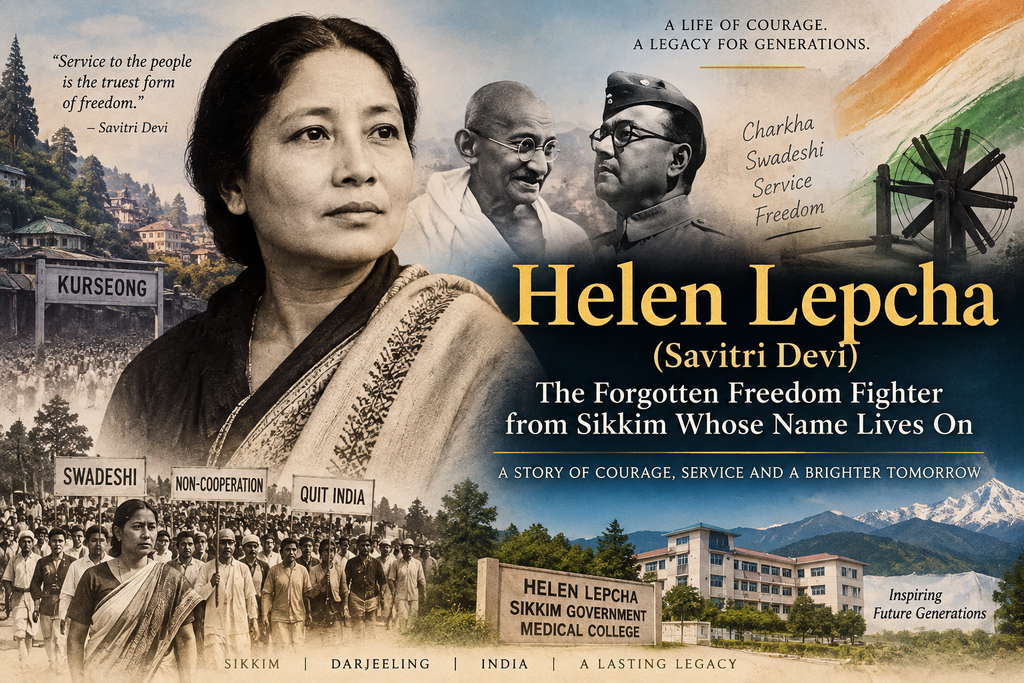
Born in 1902 in Sangmu village near Namchi, South Sikkim, she grew up to become a freedom fighter, social worker and Congress activist. Her life took her from the hills of Sikkim and Darjeeling to the political movements of British India, where she worked among workers, supported disaster victims, and faced imprisonment for her activism.
Her story is also tied to one of the most dramatic episodes in India’s freedom struggle: the reported assistance she provided to Netaji Subhas Chandra Bose while he was confined in Kurseong. More than a century after her birth, her name gained renewed public recognition when the Sikkim government announced it would name its first government medical college after her. But who was Helen Lepcha? What led her to the freedom movement? And why does her story deserve to be remembered today? To understand her life, we must return to the hills of Sikkim at the beginning of the twentieth century.
From Sangmu Village to the Hills of Kurseong
Helen Lepcha was born on 14 January 1902 in Sangmu village, near Namchi in present-day South Sikkim. She was the third of seven children born to Achung Lepcha and his wife. Her family later moved to Kurseong, in present-day West Bengal, in search of better educational and employment opportunities. Although she was born in Sikkim, much of her life and public work would be connected to Darjeeling and the wider freedom movement in British India.
Kurseong, with its surrounding hills and growing colonial-era institutions, became the setting in which Helen’s early interest in public service developed. As a young girl, she encountered the ideas of the Charkha and Swadeshi movements. These movements encouraged Indians to support indigenous production, particularly hand-spun and handwoven cloth, while challenging dependence on British goods.
Around 1917–1918, she became interested in spinning and travelled to Calcutta to receive training under the granddaughter of educationist and social reformer Ishwar Chandra Vidyasagar. Her training introduced her to a form of political participation that connected everyday work with the larger struggle against colonial rule. For Helen, the freedom movement was not simply a matter of political speeches or public demonstrations. It was also about work, discipline and service.
The Charkha, Swadeshi and a New Direction
The spinning wheel, or charkha, had become an important symbol of the Indian national movement. Mahatma Gandhi promoted khadi and hand-spinning as ways to encourage economic self-reliance and challenge colonial economic practices. Helen’s decision to learn spinning placed her within this wider movement. According to government and historical accounts, she represented her training centre at a Khadi and Charkha exhibition in Muzaffarpur, Bihar.
Her journey from the hills to Calcutta and then Bihar reflected a widening engagement with the national movement. She was moving beyond her immediate surroundings and becoming involved in a network of people working for social and political change. It was in Bihar, during the floods of 1920, that her service work brought her into contact with Mahatma Gandhi.
Meeting Mahatma Gandhi: The Birth of Savitri Devi
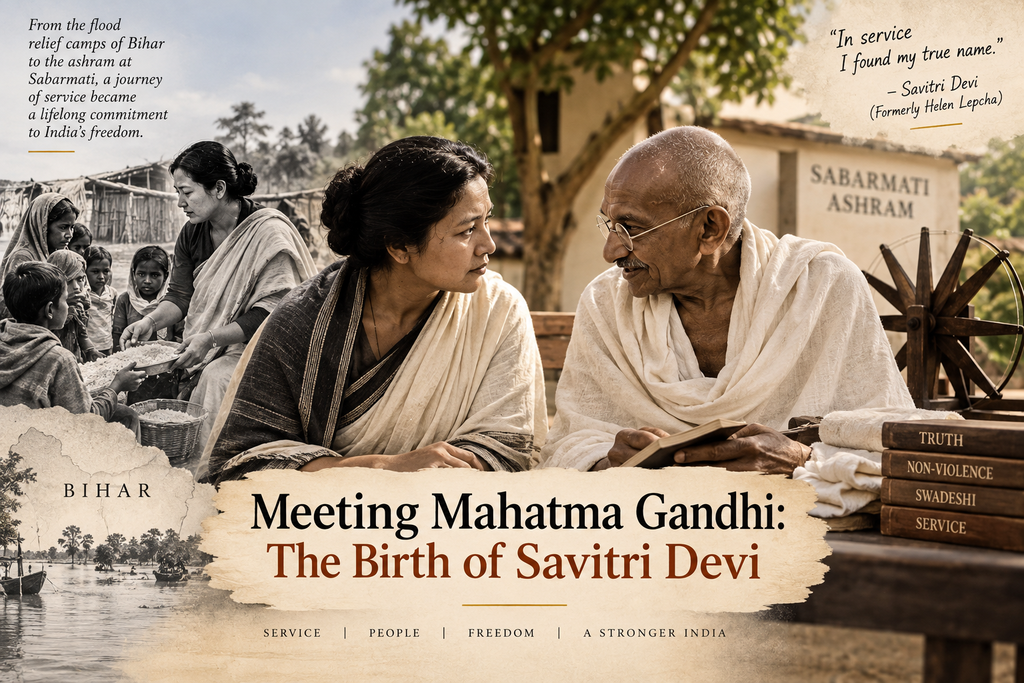
In 1920, Helen Lepcha worked among people affected by floods and famine in Bihar. Her relief work attracted Gandhi’s attention, and the two met during this period. Gandhi subsequently invited her to Sabarmati Ashram in Gujarat. During her association with the ashram, he gave her the name Savitri Devi, which became the name by which she was known during much of her public life.
The change of name marked an important point in the accounts of her life, although her original identity as Helen Lepcha remained part of her history. From that period onward, she became associated with Congress activities and the freedom movement in Bihar, Uttar Pradesh and the Darjeeling hills. Her story also raises an important question about the nature of leadership during India’s independence movement: how did people who came from relatively remote communities find their way into a nationwide political struggle? Helen’s life provides one answer. She combined social service with political activism, building connections through her work among ordinary people.
Standing with Coal-Mine Workers
The freedom movement in the early 1920s was spreading through different sections of Indian society. Workers, farmers, students and political volunteers were participating in campaigns against colonial rule. Helen Lepcha became involved in organising workers, including those in the Jharia coalfields.
In 1921, she is reported to have led a procession of more than 10,000 coal-mine workers at Mohammed Ali Park in Calcutta. The gathering was associated with opposition to the exploitation of workers, including tribal labourers. Historical accounts identify prominent nationalist leaders, including Mahatma Gandhi, Chittaranjan Das and Maulana Abul Kalam Azad, as having been present at the event.
The reported scale of the procession illustrates the public role she had assumed during the Non-Cooperation Movement. Her activism was not limited to attending meetings. She also worked to mobilise people through campaigns against foreign goods, including door-to-door efforts in and around Kurseong. Such activities brought her into conflict with the colonial authorities.
Imprisonment and House Arrest
Political activism during the Non-Cooperation Movement carried serious risks. British authorities monitored and arrested people involved in campaigns that challenged colonial rule. Helen Lepcha was arrested for her activities and spent three months in Darjeeling Sadar Jail. She was subsequently placed under restrictions in Kurseong, where historical accounts describe her being kept under house arrest or strict surveillance for approximately three years.
Her imprisonment demonstrates the personal cost of participating in the independence movement. She had already moved from social service into organised political action, and the colonial government responded by restricting her freedom. The experience did not end her public life. She continued to be associated with social and political activities in the region. In 1942, she also participated in the Quit India Movement, another major phase of the struggle against British rule.
Helen Lepcha and Netaji Subhas Chandra Bose
Among the most widely remembered accounts of Helen Lepcha’s life is her reported involvement in helping Netaji Subhas Chandra Bose during his house arrest in Kurseong. Bose was placed under house arrest at Giddapahar, Kurseong, around 1939–1940. Historical accounts describe Helen, also known as Savitri Devi, as one of the people who assisted him during this period.
According to these accounts, secret messages were concealed in bread sent from her husband Ishan Ahmed’s bakery. She is also reported to have helped prepare the disguise Bose used before his escape. These details form part of the historical record and regional memory surrounding Bose’s escape. However, individual details about the planning and the precise roles played by different people should be presented with appropriate source attribution.
The account is significant because it places a woman from the Darjeeling-Sikkim region within one of the most closely followed episodes of the Indian independence movement. Bose eventually left India in January 1941, travelling through Kabul before reaching Germany. The wider escape operation involved several individuals, and historical accounts describe different forms of assistance provided along the way. Helen Lepcha’s reported role is therefore best understood within that larger network of people who supported Bose during his escape.
Beyond the Freedom Struggle: A Life of Social Service
Helen Lepcha’s public life continued beyond the major phases of the independence movement. Historical sources describe her involvement in several social and community organisations in Kurseong, including the Sherpa Association, Nagar Congress, Anjuman Islamia and the Lepcha Association. She also served as the first woman Commissioner of Kurseong Municipality in 1936, according to historical documentation.
These activities show that her work extended into civic and community affairs. Her contribution should therefore be viewed in the context of both political activism and social service. The freedom movement was one part of her life, while her later work continued to involve local communities and public responsibilities. For people studying the history of Darjeeling and Sikkim, this aspect of her life is important. It shows how individuals involved in the independence movement could continue serving their communities after the end of British rule.
Recognition After Independence
In 1972, Helen Lepcha received the Tamra Patra, an honour associated with India’s freedom fighters. The award was presented by Prime Minister Indira Gandhi, along with a freedom fighter’s pension. The recognition came decades after the activities for which she had been imprisoned and monitored. The Tamra Patra was part of the Government of India’s effort to recognise freedom fighters. For Helen Lepcha, it represented formal recognition of her participation in the independence movement.
Historical accounts also record that she was affectionately known as “Saili Didi.” This name reflects the way she was remembered within the community, although individual accounts of the origins and use of the name should be distinguished from documented official facts.
The Naming of a Medical College in Her Honour
In February 2026, Sikkim Chief Minister Prem Singh Tamang announced that the state’s first government medical college, being developed on the campus of Sir Thutob Namgyal Memorial Hospital in Gangtok, would be named Helen Lepcha Sikkim Government Medical College. The decision was announced as a tribute to her contribution to India’s freedom struggle and her service to society.
Naming an educational institution after a historical figure creates an opportunity to introduce that person’s story to a new generation. In Helen Lepcha’s case, it connects a medical institution in contemporary Sikkim with the history of a woman who was born in the region and participated in India’s independence movement. The recognition also provides an opportunity to examine the contributions of people from the Himalayan region whose work has received less attention in mainstream historical narratives.
Remembering Helen Lepcha
Helen Lepcha’s life crossed several geographical and historical boundaries. She was born in Sikkim, grew up in Kurseong, trained in Calcutta, worked in Bihar and Uttar Pradesh, participated in the Non-Cooperation Movement, and later became associated with the Quit India Movement. Her story includes social service, political activism, imprisonment and reported assistance to Netaji Subhas Chandra Bose.
Yet the value of remembering her life does not depend on presenting every historical account as beyond question. A responsible approach to history requires examining the available evidence, acknowledging uncertainty where it exists and preserving the voices of people whose contributions deserve study.
Helen Lepcha’s life offers an opportunity to look more closely at the participation of women, indigenous communities and people from the Himalayan region in India’s freedom struggle. Her name now lives on through a government medical college in Sikkim. The larger responsibility is to ensure that her history is also remembered, studied and passed on.
Helen Lepcha was more than a name associated with the freedom movement. She was a woman whose life connected public service, political action and regional history. Remembering her means making space for those stories in the history of India.
#HelenLepcha #SavitriDevi #SikkimHistory #IndianHistory #FreedomFighters #MoktanSir