
By Suman Moktan
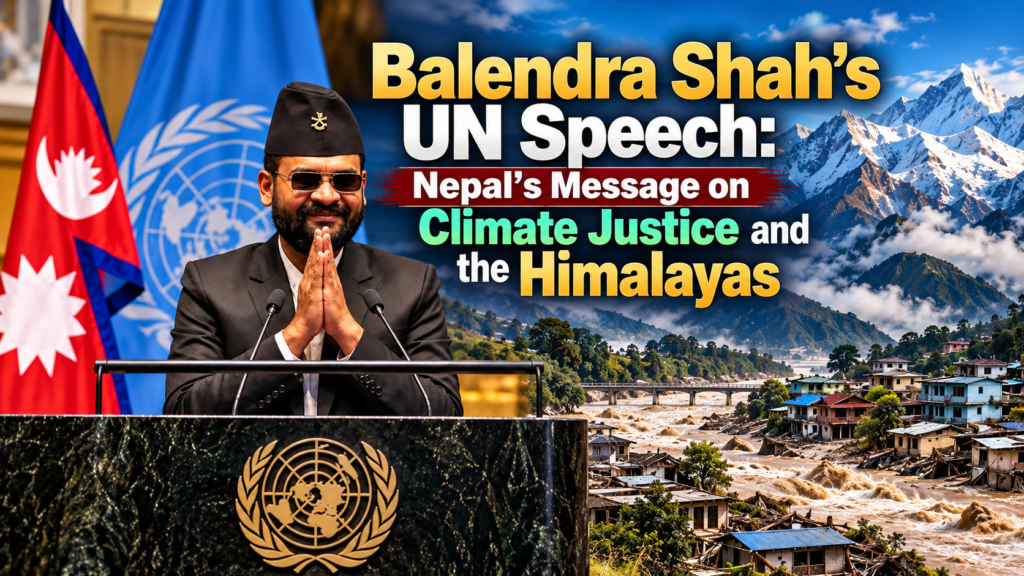
On September 24, 2026, Nepal’s Prime Minister Balendra Shah stood before the 81st United Nations General Assembly in New York and spoke from the perspective of a country living at the foot of the Himalayas. His speech was shaped by a disaster at home, but its message was directed far beyond Nepal’s borders. He used the devastation caused by floods to raise a larger question about climate change, responsibility and the way the international community responds when vulnerable countries are forced to pay the price for a crisis they did little to create.
Climate change is no longer a topic reserved for international conferences and environmental reports in Nepal. It is becoming more obvious in the lives of everyday people. Floods, landslides, unstable mountain slopes, and changing water patterns are becoming a reality for communities to deal with. Shah took that reality into the General Assembly floor, asking the world to consider climate change through the lens of countries like Nepal.
His speech combined several topics that are frequently debated separately: climate justice, catastrophe preparedness, regional collaboration, food security, climate financing, and human security. The connection between these topics was what made the address so engaging. Shah was not referring to climate change solely as an issue of rising temperatures. He was discussing what happens to a country when a climate calamity ruins infrastructure, disrupts livelihoods, and slows progress.
Balendra Shah’s speech that began with a disaster
Instead of using diplomatic words, Balendra Shah began by discussing the human cost of the event. He spoke about families waiting for word of lost relatives and towns grappling with the devastation caused by floods. Roads, bridges, schools, homes, and livelihoods built over years might be obliterated in hours.
According to the data revealed in his talk, Nepal had at least 1,400 confirmed deaths and over 6,000 people missing. Balendra Shah also cited preliminary estimates that physical recovery costs could total roughly 10% of Nepal’s GDP. The data provided instant context for the lecture, but Shah did not stop there. He used it to demonstrate how climate change has become a development and security concern in Nepal.
When a flood damages a bridge, the damage is not limited to the structure itself. Farmers may lose access to markets. Children may lose access to education. Medical services may be affected. Businesses can cease operations. Government resources that were allocated for development must be repurposed to reconstruction.
Repeated disasters might set off a vicious cycle in a developing country. Money that should be utilized to create the future is constantly spent mending the damage done in the past. That was the broader issue behind Shah’s statement.
1. Balendra Shah UN Speech and the Question of Climate Justice
The lecture revolved around a simple but challenging question: who should bear the costs of climate change? Balendra Shah said that Nepal contributes less than 0.1 percent of global greenhouse-gas emissions, yet the country is nonetheless highly vulnerable to the impacts of a warming globe. Glacier retreat, floods, landslides, and shifting water patterns all pose significant dangers to Himalayan communities and infrastructure.
This is when Balendra Shah argument shifts from climate vulnerability to climate justice. His position was that countries with a longer history of greenhouse-gas emissions and more financial resources should have a higher share of the responsibility for assisting vulnerable countries in responding to climate change. He pointed to the recognized idea of shared but distinct responsibilities and capacities.
Behind the diplomatic rhetoric lies a question that poor countries have been asking for years: if a country has made minimal contributions to the crisis, should it be forced to bear significant financial costs in order to recover from its consequences?
For Nepal, this is not a hypothetical debate. Every significant disaster results in both urgent humanitarian requirements and long-term reconstruction expenses. The more frequently such tragedies strike, the more difficult it is for a developing economy to sustain its growth trajectory.
Shah’s message to the international community was unambiguous. Nepal does not seek sympathy alone. It wants accountability to be turned into tangible assistance.
2. The Himalayas do not recognise borders
The most significant regional aspect of Balendra Shah’s address was his proposal for a Himalayan Climate Resilience Mechanism comprising Nepal, India, and China. The plan was based on a simple geographic reality. Despite the fact that the Himalayas are split between countries, they form a single integrated ecological system. Glaciers do not follow political boundaries. Rivers do not recognize passports. A calamity in one region of the mountain system can have far-reaching consequences.
Shah recommended collaboration in fields such as satellite data, technological skills, glacial-lake monitoring, early warning systems, and disaster response. The plan is especially noteworthy because Nepal is situated between India and China, two countries with complex political and strategic ties. Climate cooperation does not eliminate these divides, but it may create an environment in which practical collaboration is possible because the underlying dangers are shared.
The concept will require far more than a political announcement. Data sharing agreements, financing, institutional obligations, emergency coordination, and sovereignty issues would all need to be addressed. Future diplomacy will determine if the proposed system becomes a functioning regional arrangement. However, the basic premise is difficult to deny: catastrophe preparedness in the Himalayas cannot be fully separated by national lines.
3. From relief to resilience
One of the most effective sections of Balendra Shah’s speech was his formulation of six words:
Relief. Rehabilitation. Reconstruction.
And then:
Responsibility. Reparation. Resilience.
The first three describe what occurs following a disaster. The second three question what should happen before the next one. That distinction is essential.
Emergency support can save lives and help communities rebuild. Reconstruction can help to repair roads, bridges, residences, and public structures. However, if the same communities continue to face increasingly severe climatic hazards, simply reconstructing what has been destroyed may leave them vulnerable to the next calamity.
Resilience necessitates an other strategy. It entails planning infrastructure to withstand future threats. It entails investing in early warning systems before a calamity occurs. It entails improving local institutions and emergency services. It entails ensuring that disadvantaged populations have enough resources to recover without slipping deeper into poverty or debt.
As a result, Shah advocated for increased grant-based climate support and criticized the barriers that disadvantaged nations face in getting climate funds. His point was that countries that are already in debt due to climate-related calamities should not be forced to incur additional debt in order to recover.
4. When climate change becomes a question of food
The speech then moved on to an unexpected topic: the global food and military logistics system. Balendra Shah discussed the problems average farmers have in accessing essential agricultural inputs like fertilizer and fuel. He compared these limitations with the surprising ease with which military weaponry may be transported across international borders.
Then followed one of the most remembered phrases from the speech:
“We have built a world with flawless logistics for war and broken logistics for food.”
The statement’s potency comes from its simplicity. It’s not only a criticism about transportation. It’s a question of priorities. Modern economies have created extremely complex systems for transporting goods, money, technology, and military weapons across continents. Farmers in many regions of the world continue to struggle to access the basic ingredients required to grow food.
Shah exploited the contrast to broaden the topic beyond climate financing. His point was that international cooperation should ultimately be measured on how well it saves people from hunger, poverty, and insecurity.
5. Rethinking what security means
That introduced another key concept into the speech: human security. Traditional concepts of national security tend to emphasize boundaries, military might, and territorial sovereignty. People can nevertheless feel insecure even when a country’s borders are not under military attack.
A family can become insecure after a flood damages their home. Crop failure can leave a farmer feeling insecure. A town can become vulnerable when a bridge that connects it to the rest of the country disappears. Repeated disasters can deplete a government’s development resources, leaving it financially vulnerable. When viewed from this perspective, climate resilience becomes a component of national security.
An early warning system is more than just an environmental endeavor. It may save lives.
A stronger bridge is more than just infrastructure. It can keep a community together amid an emergency.
Reliable food supply are more than just an economic concern. They are part of human security.
This was one of the more general implications of Shah’s speech: climate policy cannot be limited to environmental ministries. It is increasingly affecting infrastructure, agriculture, public health, finance, disaster management, and national planning.
6. A message that was also meant for Nepal
Although Shah was speaking to the international community, he also addressed a domestic audience. He linked his government’s program to demands for jobs, social security, accountability, and improved public services. He framed these concerns as part of the aspirations of a younger generation seeking more possibilities at home.
This gave the discourse two dimensions.
One was international: Nepal seeks increased cooperation, climate finance, and recognition of Himalayan countries’ unique vulnerabilities.
The other was domestic: Nepal must establish institutions capable of protecting its population and responding efficiently when calamity strikes.
The two messages are related. While international assistance can help Nepal, long-term resilience is also dependent on the country’s own institutions, infrastructure, planning, and governance.
7. Balendra Shah speech ends, but the difficult work begins
A speech at the United Nations can draw international attention to a particular issue. It can raise a country’s problems in front of governments, international organizations, and the general public.
However, a speech cannot create a bridge.
It cannot set up an early warning system.
It cannot establish a regional institution.
It cannot, by itself, provide climate funds.
Those things necessitate policy, funding, institutions, and ongoing diplomacy. As a result, what happens after Shah’s speech will determine its true significance.
Will Nepal be able to strengthen its catastrophe preparedness systems? Will India and China accept practical cooperation on Himalayan climate risks? Will international institutions facilitate vulnerable countries’ access to climate finance? And can Nepal convert its vulnerability into a long-term regional agenda item, rather than something mentioned only after another disaster? These questions are more significant than the applause that may accompany a speech before the General Assembly.
From the Himalayas to the world
Finally, Shah returned to where his argument began: the Himalayas. The mountains are frequently regarded as a remote and majestic landscape, yet they also provide water, ecosystems, agriculture, and livelihoods for millions of people. Whatever happens there does not stay there. That is why Nepal’s warning has far-reaching implications.
Climate change is frequently considered in terms of future generations. However, for populations living in risky alpine regions, the future has already here. A flood can undo years of progress in a single day. A broken road can cut off a whole village. A shifting river can endanger farms and communities. A melting glacier can change the risks for people living further downstream.
Shah’s speech tried to bring this truth to the forefront of international discourse. It is unclear whether every idea he made will become policy. Diplomacy will determine the extent of proposed Himalayan cooperation, while domestic institutions will determine how well Nepal can prepare for future disasters.
However, the overall message is tough to miss. For countries on the front lines of climate change, climate policy is no longer a distant future discussion. It is a discourse about survival, development, and the ability to prepare for the future without continuously recreating the past. From New York, Nepal urged the world to heed the Himalayan warning. The speech was delivered. Now comes the more difficult question: what will the world do with it.