
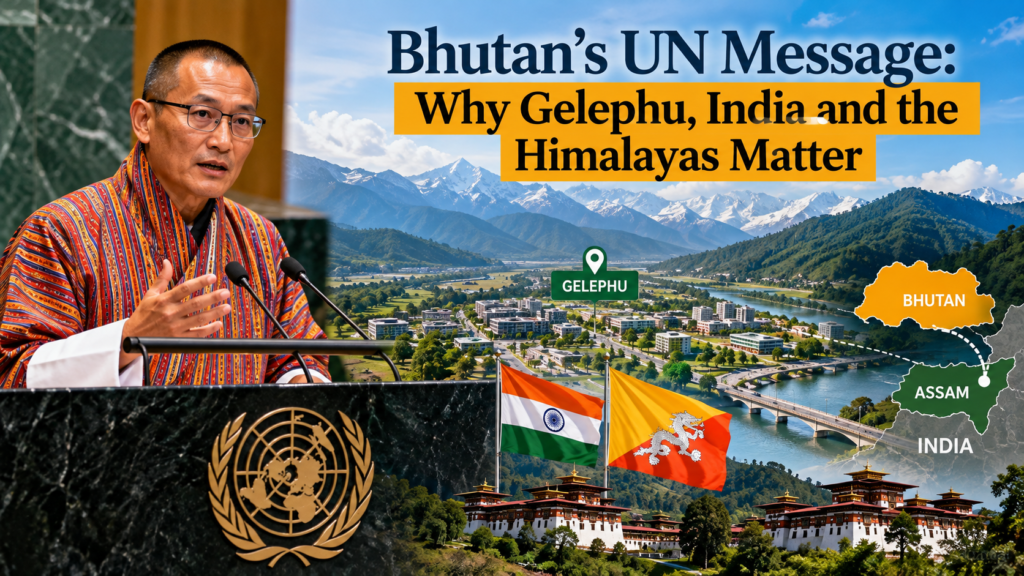

Bhutan Prime Minister (PM)Tshering Tobgay’s address at the 81st United Nations General Assembly has drawn attention for a reason that goes beyond Bhutan’s small size. His remarks placed India, Assam and the proposed Gelephu Mindfulness City at the centre of Bhutan’s plans for economic connectivity and regional development.
Bhutan is often seen from outside as a quiet Himalayan kingdom known for mountains, Buddhism, environmental protection and Gross National Happiness. But the country is now trying to build a new economic future. Bhutan PM Tshering Tobgay used his recent UN appearance to explain part of that vision.
At the heart of his message was Gelephu Mindfulness City, a major development project in southern Bhutan, close to the Indian border. Bhutan PM Tobgay described Gelephu as having the potential to connect Bhutan with markets in South Asia and Southeast Asia. The location matters. Gelephu lies close to India’s Assam state. Beyond the Bhutanese border is India’s large domestic market and the wider transport and economic network of South Asia.
Tobgay specifically acknowledged the support of Prime Minister Narendra Modi, the Government of India and communities in Assam for the Gelephu project. That reference to Assam is important because the future of Gelephu cannot be separated from its geographical connection with India.
Gelephu: Bhutan’s proposed gateway to the region
Bhutan has limited geographical access to international markets. Its mountainous terrain makes large-scale transport infrastructure difficult and expensive. Gelephu offers a different possibility. Instead of looking only north towards the mountains, Bhutan can use its southern border to connect with India’s transport system and, through India, with larger regional markets.
The proposed Gelephu Mindfulness City is therefore more than an urban development project. It is part of Bhutan’s attempt to create a new economic gateway. Bhutan PM Mr Tobgay presented the project as having the potential to connect Bhutan with markets across South Asia and Southeast Asia. If the required infrastructure develops, the effects could extend beyond Gelephu itself.
Businesses, tourists, investors, students and service providers could potentially move through this corridor. The project could also create new opportunities for areas on the Indian side of the border. That makes Assam particularly important.
Why Assam matters to Bhutan
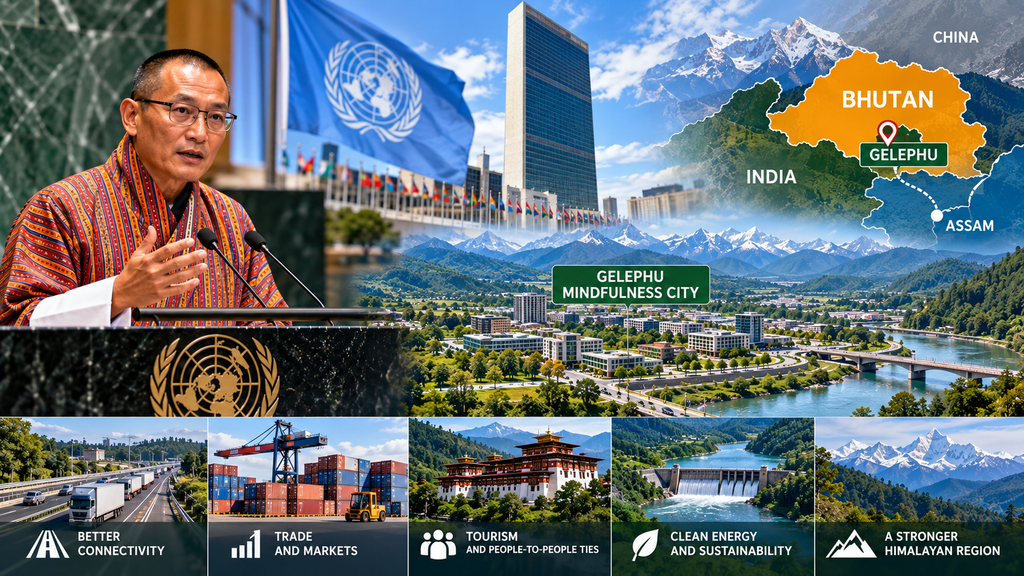
For many years, the discussion on India-Bhutan relations has concentrated largely on national governments and bilateral diplomacy. The Gelephu project adds a strong regional dimension. Assam is geographically close to Gelephu and can become an important link between Bhutan and India’s wider economy. This creates the possibility of greater cooperation in areas such as transportation, tourism, trade, logistics, digital services and other economic activities.
Assam Chief Minister Himanta Biswa Sarma also responded positively to Tobgay’s remarks, saying the state would continue working to strengthen the India-Bhutan partnership. The development could therefore create a relationship involving three important players: Bhutan, India and Assam. The success of this idea, however, will depend on what happens on the ground. Roads, border facilities, customs arrangements, transport links and other infrastructure will have to develop alongside the economic project.
A new economic role for India’s Northeast
There is one more reason why the Gelephu project deserves attention in India. The Northeast of India has been traditionally referred to as a country with strong geographical ties with its neighbors. Bhutan’s plans could add another level to that interconnectedness. If Gelephu develops as planned, it might become a significant point in Bhutan’s access to the Indian market.
That is not to say that there is currently a major regional economic corridor. Much of the potential is contingent on future investment and infrastructure. But the geographical logic is obvious. Bhutan needs connection. It is in Gelephu. The immediate southern neighbour is India. And Assam is right on that link. And this is why Bhutan PM’s allusion to Assam at the UN is worth noting.
The environmental question
But there is another side to Bhutan’s economic objectives. Much of the worldwide persona that Bhutan has constructed has been focused on environmental conservation and sustainable development. The country has always positioned its development plan as different from traditional approaches that focus primarily on economic growth. Gelephu will give that a go.
Big development projects require roads, buildings, energy, water, transit and other infrastructure. These can provide economic opportunities, but can also put pressure on the environment. Bhutan’s goal will be to develop Gelephu without compromising the environmental norms that have become an integral part of its national policy. This is especially true in the Himalayas, which have fragile ecosystems and growing dangers due to climate.
The wider Himalayan picture
Tobgay’s speech matters beyond Bhutan and India. The Himalayan region is facing a common problem. Mountain countries and communities require economic possibilities, better infrastructure and employment, while safeguarding forests, rivers, glaciers and vulnerable ecosystems. Bhutan’s approach is consequently being watched as an example of a tricky balancing act.
The challenge is straightforward: Can a Himalayan country integrate with global commerce without abandoning its environmental priorities? Gelephu could be a critical test of that hypothesis. If it works, it can serve as a lesson for other regions of the Himalayas and Northeast. In case of major environmental or infrastructure problems the project might also serve as an example of the limits of fast expansion in vulnerable alpine environments.
There is also a geopolitical dimension: Bhutan PM
The geographical location of Bhutan adds added regional significance to the development goals of the country. Bhutan is squeezed between two Asian giants, India and China. Hence, infrastructure and connectivity developments in Bhutan tend to attract geopolitical interest. But Tobgay’s letter to the UN was not, however, framed as a declaration against China.
Instead, the emphasis had been on Bhutan’s economic development, regional connectivity and its close partnership with India. That is a big difference. Bhutan may deepen its economic engagement with India without losing sight of its broader diplomatic and strategic relations. For India, the principal takeaway is that Bhutan continues to view it as an essential partner in its economic connection schemes.
What does this mean for India?
The Gelephu project can open up potential for India, especially for Assam and the Northeast, in various areas. Improved connection will also benefit tourism and trade. New transport linkages might ease access to markets. More economic activity would benefit border communities. There may also be opportunities in logistics, services, education, healthcare and digital connectivity.
But these results are not fated. Infrastructure needs to be planned well. More migration means border management has to keep up. Environmental problems will need to be addressed. Economic gains will have to flow to communities on both sides of the border. Thus the initiative will have to work together at national and state level.
A relationship moving beyond traditional diplomacy
The most noteworthy part of Tobgay’s speech is that it shows India-Bhutan relations in both economic and diplomatic terms. The connection is more than just a friendship between two neighboring countries. It is increasingly associated with concerns of infrastructure, markets, regional connectivity and growth. Gelephu might be one of the most obvious illustrations of such transition.
It provides Bhutan a possible route to greater economic diversification. It gives India another chance to connect the Northeast with a neighboring Himalayan country. It could pave the way for a new cross-border commercial connection for Assam. And in the case of the Himalayan region it presents a bigger concern regarding the coexistence of development and environmental protection.
Conclusion
Bhutan PM’s words at the UN should be placed within the greater economic aspirations of Bhutan. The larger story is bigger than a speech or a development initiative. Bhutan is seeking to leverage its geographic location to develop closer ties with India and the broader region. Gelephu is at the core of that strategy.
It is of a special interest to India due to its proximity to Assam. But, at the same time, Bhutan’s dedication to environmental protection means the project will have to reconcile economic ambition with ecological stewardship. Whether Gelephu can become the regional gateway Bhutan seeks remains to be seen in the coming years.
This issue has great interest for India as what occurs in Gelephu could have ramifications far beyond Bhutan’s borders. Bhutan is trying to make a virtue of the geographical obstacle of the rugged terrain of the Himalayas to generate economic opportunities, even if connection may be a challenge.