
By Suman Moktan
In India, an election symbol has always been more than a picture displayed on a voting machine. It helps voters identify political parties and candidates. For many voters, a symbol becomes familiar through years of elections, public communication, and political activity.
But the problem is: what happens when a recognised political party splits and two rival groups claim the same name and election symbol? Who has the legal authority to decide which group represents the recognised party? What principles should guide that decision? And how can the electoral process protect voters from confusion?
These questions go beyond a political organisation’s internal affairs. They involve constitutional law, election administration, procedural fairness, and the rule of law. The Indian Constitution, together with the Election Symbols (Reservation and Allotment) Order, 1968, provides the legal framework for examining these disputes. Judicial decisions have also helped explain the powers of the Election Commission and the principles that guide its decision-making.
This article examines the constitutional and legal framework surrounding election symbol disputes in India. It focuses on the law and the institutional process without supporting or opposing any political party or faction. The central question is simple: When a political party splits, how should the law resolve competing claims over its name and election symbol?
Why Are Election Symbols Important in India?
India conducts elections across a large and diverse population. Voters come from different linguistic, educational, and social backgrounds. In this environment, election symbols provide a familiar visual means of identifying candidates and political parties.
Under the Election Symbols (Reservation and Allotment) Order, 1968, recognised political parties may have reserved election symbols. Other parties and candidates receive symbols according to the applicable rules. The importance of a symbol becomes particularly clear when a political party experiences an internal division. If two groups claim to represent the same recognised party, both may seek to use its established name and symbol. This creates a legal and administrative problem. Allowing competing groups to use the same electoral identity without a clear framework could create uncertainty for candidates, election officials, and voters.
The law therefore provides a mechanism for addressing these competing claims. The question is not simply who wants to use the symbol, but which group qualifies for recognition under the applicable legal framework.
Article 324: The Constitutional Foundation
Article 324 of the Indian Constitution establishes the Election Commission’s authority over the superintendence, direction, and control of elections to Parliament, state legislatures, and the offices of President and Vice-President. This provision gives the Commission its constitutional responsibility for election administration. It establishes the institution that oversees the electoral process and exercises powers provided by the Constitution and relevant laws.
However, Article 324 should not be understood in isolation. Specific election-related matters are governed by applicable legislation and rules. Disputes concerning recognised political parties and their election symbols are addressed under the Election Symbols (Reservation and Allotment) Order, 1968.
This distinction is important for legal analysis. Constitutional authority provides the foundation for the Commission’s responsibilities, while the relevant election rules establish the framework within which particular disputes are examined. When the Commission makes a decision, the legal assessment should consider its constitutional authority, the applicable provisions, the procedure followed, and the availability of judicial review.
Understanding Paragraph 15 of the Election Symbols Order, 1968
Paragraph 15 of the Election Symbols (Reservation and Allotment) Order, 1968, provides a mechanism for dealing with disputes between rival sections or groups of a recognised political party. Where competing groups claim to represent the same recognised party, the Election Commission may examine the matter under the provision. It can consider the relevant facts and circumstances and hear the representatives of the rival groups, as required by the Order. The Commission may then determine whether one group or none of the groups constitutes the recognised political party for the Symbols Order.
This provision addresses a specific electoral question: which group should be recognised under the applicable election-symbol framework? It should not automatically be treated as a final determination of every possible dispute concerning the internal affairs, legal identity, or ownership of a political organisation. The precise scope and effect of a decision depend on the applicable law and the wording of the order issued in the particular case.
How Should the Election Commission Determine the Competing Claims?
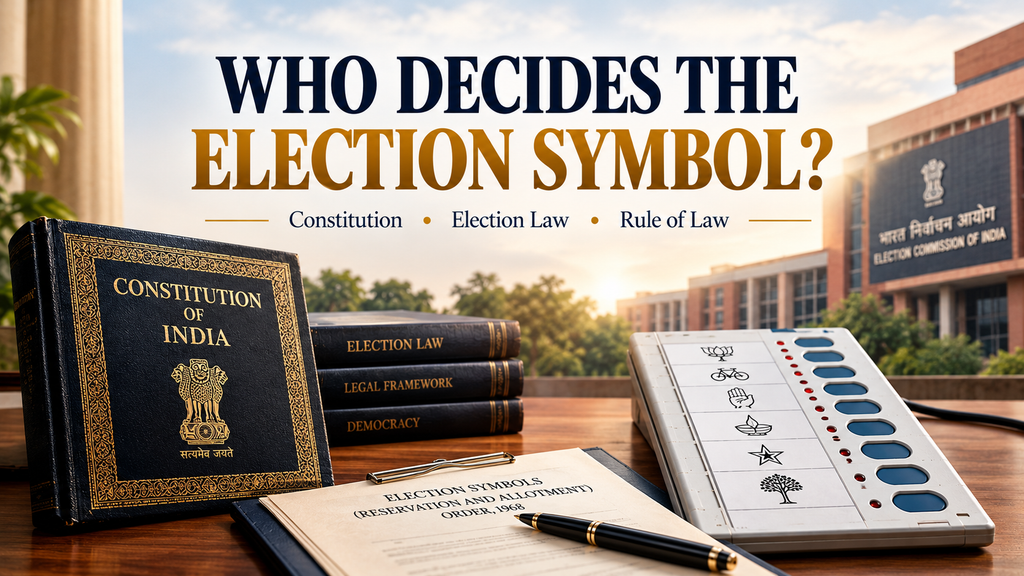
When rival groups claim the identity of a recognised political party, the Commission must examine the relevant facts and legal framework. The Supreme Court has considered this issue in several cases, including Sadiq Ali v. Election Commission of India (1971).
In that judgment, the Court examined the Commission’s authority to resolve a dispute concerning a recognised political party and its election symbol. The decision is relevant to understanding the legal basis of the Commission’s role under the Symbols Order.
In a later judgment concerning a party-symbol dispute, the Supreme Court examined the relevance of organisational and legislative support. The Court explained that the Commission is not required to rely exclusively on the numerical strength of elected representatives. Organisational structure, the party constitution, and other relevant evidence may also be considered. This means that the resolution of a dispute requires an examination of the applicable evidence rather than an automatic assumption that one particular factor determines the outcome in every case.
The party constitution may provide information about internal decision-making and organisational arrangements. Evidence of organisational support may be relevant to the competing claims. The support of elected representatives may also be considered where appropriate under the legal framework. The importance of each category of evidence depends on the facts and the applicable legal principles. A proper legal analysis must therefore examine the specific dispute rather than apply a single formula to every situation.
Natural Justice and the Right to Be Heard
The principle of natural justice is an important part of administrative law. One of its central elements is the opportunity to be heard before a decision is made that affects the interests of the parties involved. Paragraph 15 provides for hearing the representatives of rival groups and other persons who wish to be heard, in accordance with the provision. This reflects the importance of allowing the relevant parties to present their claims before the Commission.
A fair process requires the parties to understand the nature of the dispute and the issues under consideration. They should have an opportunity to submit relevant documents, explain their position, and respond to opposing claims within the applicable procedure. The decision-maker must then consider the relevant material and apply the governing legal framework.
A fair hearing does not guarantee that every party will receive the result it wants. Its purpose is to ensure that the decision-making process meets the applicable requirements of fairness and law. The precise procedural safeguards depend on the nature of the proceedings, the relevant rules, and the circumstances of the case.
Can an Election Symbol Be Frozen During a Dispute?
A dispute concerning a recognised political party may arise close to an election. This can create practical challenges for election administration, particularly when rival groups claim the same party name and symbol. In such circumstances, the legal question may involve both the substantive dispute and the immediate arrangements required for conducting the election.
An interim arrangement and a final determination are different legal stages. An interim measure may address an immediate electoral requirement while the underlying dispute continues to be examined. Its legal effect depends on the applicable law and the wording of the order. A final determination, on the other hand, addresses the competing claims within the scope of the Commission’s authority under the relevant provision.
This distinction is important because a temporary restriction on the use of a symbol does not automatically mean that a political organisation has permanently ceased to exist. Similarly, an interim allocation of a different name or symbol should not automatically be described as a final decision on every question concerning party identity. The legal effect of any particular arrangement must be determined by examining the actual order and the applicable rules.
Election Symbols and the Protection of Voters
The electoral process should provide voters with clear and accurate information about candidates and the symbols assigned to them. When a recognised political party faces an internal division, changes in names or symbols may create practical difficulties for voters who are familiar with an established electoral identity.
This makes official communication important. Election authorities should provide accurate information about the names and symbols applicable to the election, using appropriate official channels and election materials. Where a temporary arrangement affects an upcoming election, timely communication can help voters understand the applicable information. These measures are part of sound election administration. They do not determine which rival group is legally entitled to represent a recognised political party. The legal entitlement must still be decided according to the applicable rules and evidence.
Judicial Review and the Role of the Courts
The Election Commission is a constitutional authority, but its decisions operate within the Constitution and the applicable legal framework. Judicial review provides a mechanism through which the courts may examine the legality of decisions when an appropriate challenge is brought. The availability and scope of a remedy depend on the nature of the decision, the stage of the proceedings, the grounds of challenge, and the relevant jurisdiction.
A legal challenge may raise questions about whether the Commission acted within its authority, followed the applicable procedure, considered relevant material, or applied the law correctly. The courts must examine such questions in accordance with the Constitution and applicable legal principles. Judicial review does not mean that every challenge will succeed. The outcome depends on the legal grounds, evidence, and circumstances of the particular case. Its importance lies in ensuring that the exercise of public power remains subject to the law.
Lessons from Supreme Court Decisions
The Supreme Court’s decisions in Sadiq Ali v. Election Commission of India and later party-symbol disputes provide useful material for understanding the legal framework. These judgments illustrate why the Commission’s authority, the relevant evidence, and the applicable procedure must be examined together. They also show the importance of distinguishing the legal question being decided from broader disputes concerning internal party affairs.
A judicial principle from an earlier case cannot simply be applied without considering the facts and legal issues of a new dispute. The proper approach is to identify the principle established by the judgment, understand its reasoning, and examine its relevance to the circumstances before the Commission or court. This approach helps prevent legal analysis from becoming a generalised opinion about a political organisation or its internal leadership.
How Should Election Symbol Disputes Be Resolved?
The existing legal framework provides a mechanism for resolving competing claims involving recognised political parties. The quality of the process depends on the lawful exercise of authority and the proper examination of the relevant facts.
- The first requirement is that the Commission should act within the Constitution and the applicable election rules. Paragraph 15 provides the framework for disputes falling within its scope.
- The second requirement is procedural fairness. Rival groups should have an opportunity to present their claims and respond to relevant submissions, subject to the applicable procedure.
- The third requirement is the examination of relevant evidence. Organisational records, party rules, legislative support, and other material may be considered in accordance with the legal framework.
- The fourth requirement concerns electoral administration. Where a dispute arises close to an election, the Commission may need to address immediate practical issues while following the applicable law.
Finally, the decision should provide the legal basis and reasoning required under the relevant framework. This helps the affected parties understand the decision and allows appropriate legal scrutiny where available. These principles provide a basis for discussing dispute resolution without prejudging the outcome of any particular case.
Should India Consider Reforms?
The Election Symbols Order provides a legal mechanism for addressing disputes involving recognised political parties. However, disputes that arise close to elections can raise questions about procedural clarity, public communication, and the time available for consideration. These questions can be examined through legal and institutional discussion.
One possible area of consideration is clearer procedural guidance. The relevant rules could be reviewed to determine whether greater clarity about procedural stages and timelines would assist in managing disputes that arise shortly before elections. Another area concerns public access to official orders. Making relevant decisions and procedural information accessible can help the public, legal professionals, researchers, and journalists understand the legal basis of the Commission’s actions.
Clear communication of interim arrangements is also important. Where temporary names or symbols are allotted, the official status and scope of the arrangement should be explained accurately. Judicial decisions can further clarify the relationship between constitutional authority, election rules, and procedural fairness.
Whether any specific reform is necessary requires separate legal and institutional assessment. The purpose of this discussion is to identify possible areas for examination rather than to reach a predetermined conclusion about any current dispute.
Constitutional Democracy and Institutional Responsibility
The Election Commission exercises public authority in the administration of elections. Its decisions can affect the participation of political parties and the information available to voters. That authority must be exercised within the Constitution and the applicable legal framework. At the same time, internal disputes within political organisations may involve different questions, including organisational control, leadership, and electoral recognition. These questions should be examined according to the legal provisions applicable to each matter.
A constitutional democracy depends on institutions exercising their powers lawfully and on affected parties having access to appropriate legal remedies. The resolution of an election symbol dispute should therefore be understood as a legal and institutional process, rather than simply a contest between rival political groups.
Conclusion: The Law Must Guide the Resolution
An election symbol is an important part of India’s electoral system. It helps voters identify candidates and political parties and supports the practical administration of elections. When a political party divides, competing claims over its name and symbol can raise questions concerning constitutional authority, election law, procedural fairness, and judicial review.
Article 324 provides the constitutional foundation for the Election Commission’s electoral responsibilities. Paragraph 15 of the Election Symbols (Reservation and Allotment) Order, 1968, provides a mechanism for resolving competing claims involving recognised political parties. Supreme Court judgments have helped explain the Commission’s authority and the relevance of different categories of evidence.
The resolution of such disputes should be examined through the applicable law, the relevant facts, procedural safeguards, and judicial principles. The strength of a constitutional democracy depends on the lawful exercise of public power and fair procedures for resolving disputes.
Disclaimer:
This article is intended for general educational and informational purposes. It provides a constitutional and legal overview and does not constitute legal advice. The legal position in any specific case should be examined with reference to the applicable law, official orders, and judicial decisions.