
By Suman Moktan
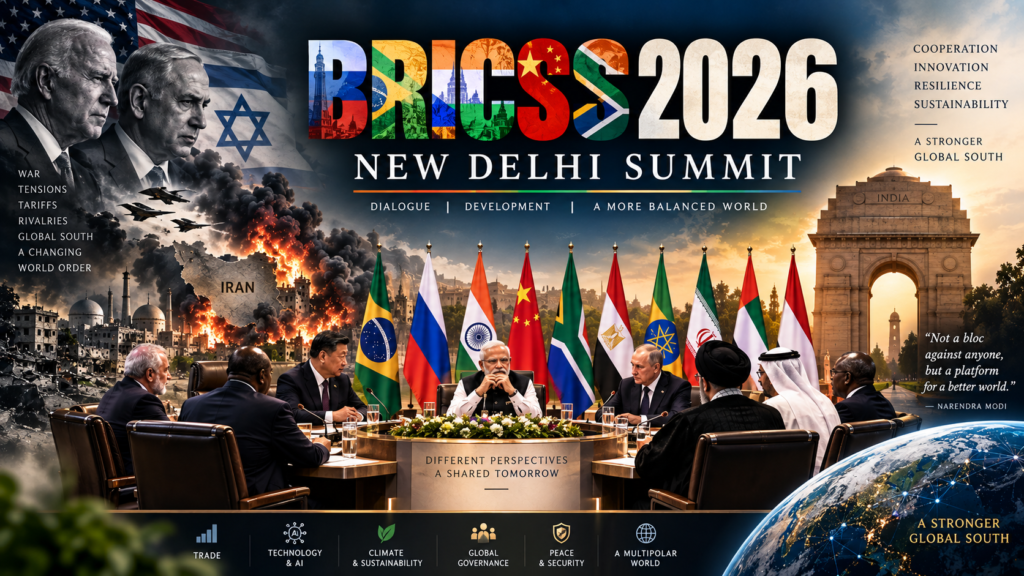
When world leaders gathered in New Delhi for the 18th BRICS Summit on 12–13 September 2026, they were not simply attending another international conference. They were meeting at a moment when the international order appears increasingly fractured wars are reshaping alliances, tariffs are redefining trade, and emerging powers are demanding a greater role in global decision-making.
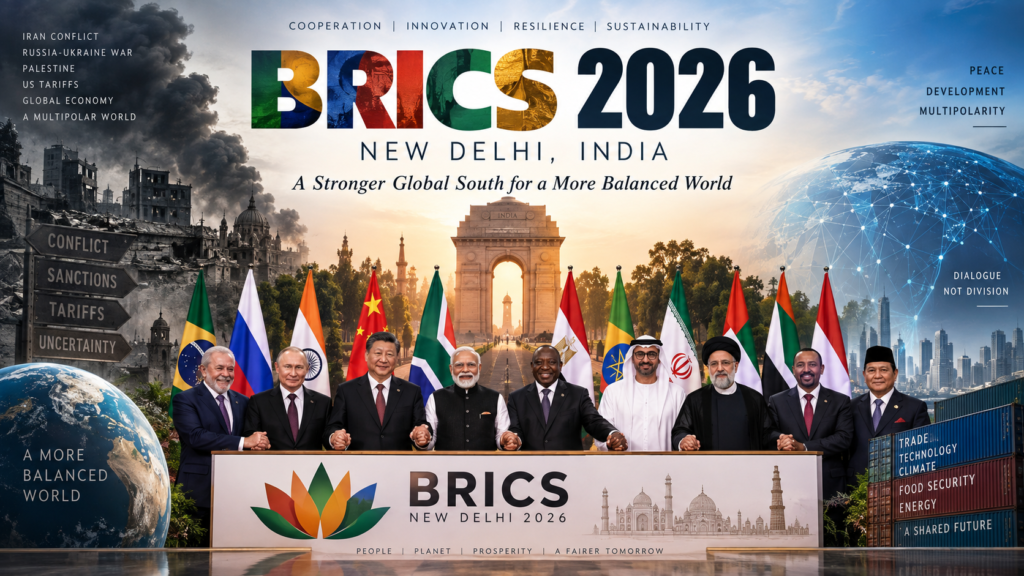
For India, hosting BRICS 2026 was more than a ceremonial responsibility. It was an opportunity to demonstrate that New Delhi can convene countries with competing interests, preserve dialogue during geopolitical crises, and position itself as a bridge between established and emerging powers.
The summit concluded with the adoption of the New Delhi Declaration, a consensus document that reflected both BRICS’ growing influence and its internal contradictions. The most revealing lesson from BRICS 2026 was not that a new world order has already arrived. It was that the old one is increasingly being challenged.
BRICS Has Changed and So Has the World
BRICS has travelled a long way from its origins as an economic acronym. Initially conceived around Brazil, Russia, India and China, with South Africa joining later, the grouping was expected to represent the rise of major emerging economies.
Today, it has evolved into something far more ambitious. The expanded BRICS now includes Brazil, Russia, India, China, South Africa, Egypt, Ethiopia, Iran, Indonesia and the United Arab Emirates, while partner countries continue to deepen their engagement with the bloc. This expansion has transformed BRICS into a platform that spans Asia, Africa, Latin America and the Middle East. But expansion has also made consensus significantly harder.
Unlike NATO or the European Union, BRICS does not operate through ideological alignment or collective security commitments. Instead, it functions as a coalition of countries that often disagree politically while seeking cooperation on issues where their interests converge. The New Delhi Summit demonstrated exactly how difficult and how valuable that balancing act has become.
India’s Chairship: Four Pillars That Defined the Summit
India deliberately avoided presenting BRICS as a bloc created to confront the West. Instead, New Delhi framed its presidency around four interconnected pillars:
- Cooperation
- Innovation
- Resilience
- Sustainability
These themes reflected India’s broader diplomatic philosophy: strengthen multilateral engagement, promote development-led partnerships, encourage technological collaboration, build resilience against global disruptions, and accelerate sustainable growth.
Cooperation
India emphasised deeper policy coordination among BRICS members through trade facilitation, development finance and reforms in global governance institutions.
Innovation
Artificial intelligence, digital public infrastructure and financial technology emerged as central priorities, with India advocating knowledge-sharing that could help developing countries build future-ready economies.
Resilience
Supply-chain disruptions, health emergencies, geopolitical conflicts and climate-related risks highlighted the need for stronger economic and institutional resilience.
Sustainability
Climate action, green finance and energy transitions were presented as essential components of long-term development rather than separate environmental concerns.
These priorities reveal something important about India’s foreign policy. Rather than positioning itself inside a single geopolitical camp, New Delhi continues to pursue strategic autonomy—working simultaneously with different centres of power while preserving independent decision-making. BRICS fits naturally into that approach.
The New Delhi Declaration: A Consensus That Was Hard-Won
The summit’s most significant formal outcome was the adoption of the New Delhi Declaration. The document reaffirmed commitments to multilateralism, sovereign equality, sustainable development, economic cooperation and reform of global governance.
On paper, these principles appear familiar. The real significance lies elsewhere. The declaration itself became evidence that BRICS could still produce consensus despite deep disagreements among its own members. That achievement was far from guaranteed.
In fact, only a few months earlier, BRICS foreign ministers had failed to agree on a joint statement because divisions over the Iran conflict proved too difficult to overcome. New Delhi succeeded where earlier negotiations had stalled.
The US–Israel War on Iran Exposed BRICS’ Biggest Internal Challenge
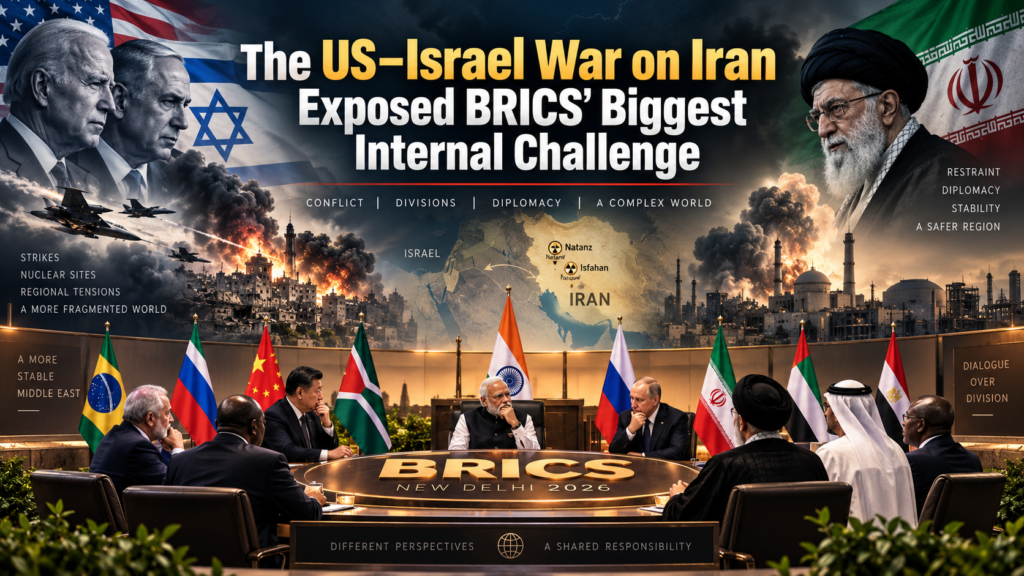
No issue tested BRICS more than the US–Israel war on Iran. The conflict became the strongest measure of whether an expanded BRICS could speak with one voice during a major international crisis.
The declaration expressed “deep concern over the continued escalation of tensions” in the Middle East and called for “maximum restraint”, urging all countries to avoid actions that could worsen the conflict. Yet the wording was carefully constructed.
Unlike the Rio Declaration issued during the previous summit—which had directly condemned the US and Israeli military campaign against Iran as a “blatant breach of international law”, the New Delhi Declaration avoided explicitly naming the United States, Israel, Iran or the Gulf states.
That omission was not accidental. It reflected the political realities inside BRICS itself. Iran is now a member of the grouping. So is the United Arab Emirates. These two countries occupy very different strategic positions within the same regional crisis. Finding language acceptable to both required extraordinary diplomatic caution.
Former Indian Foreign Secretary Nirupama Menon Rao described the declaration as a significant diplomatic success for India. Her assessment captures the summit’s central paradox. Consensus survived but only because the language became more general than specific.
In her words, BRICS demonstrated both its greatest value and its greatest limitation: it can keep difficult conversations alive and affirm broad principles, but it struggles to assign responsibility or organise collective action when the interests of its members collide. That observation deserves serious attention.
International institutions are often judged by whether they produce strong condemnations. BRICS may instead be demonstrating a different model, one where preserving dialogue itself becomes an achievement.
Even so, the declaration contained language widely interpreted as an indirect criticism of recent military operations against Iranian nuclear infrastructure. It expressed concern over attacks on civilian infrastructure and nuclear facilities protected under IAEA safeguards, wording that resonated with the strikes on Natanz, Isfahan and Fordow during the twelve-day conflict.
According to Praveen Donthi of the International Crisis Group, expectations for the summit had been relatively modest because of competing geopolitical interests. By that standard, simply producing a common declaration represented a meaningful diplomatic accomplishment.
Russia–Ukraine: Consensus Through Ambiguity
If Iran exposed one fault line inside BRICS, Ukraine exposed another. Russia remains one of BRICS’ founding members. At the same time, several other members maintain complex relationships with both Moscow and Western governments.
The New Delhi Declaration therefore adopted a deliberately restrained approach. Rather than addressing Ukraine directly, it called for disputes to be resolved through dialogue, consultation and diplomacy. However, the declaration took a much clearer position on another issue.
It criticised unilateral sanctions imposed without authorisation from the United Nations Security Council, arguing that such measures undermine international law and the UN Charter. For Russia, this language carries obvious significance given the extensive Western sanctions imposed since the 2022 invasion.
India’s own position remains more nuanced. New Delhi has maintained close ties with Moscow while simultaneously strengthening relationships with Western partners. The balancing act has become even more complicated because energy markets have been reshaped by conflicts stretching from Ukraine to the Middle East.
Kremlin spokesperson Dmitry Peskov later stated that both Modi and Xi had expressed willingness to support future peace efforts on Ukraine, an indication that diplomacy remains part of BRICS’ broader political narrative.
Palestine: The Strongest Language of the Summit
While BRICS adopted cautious wording on Iran and Ukraine, its language on Palestine was considerably stronger. The declaration expressed firm opposition to the forced displacement of Palestinians and rejected attempts to alter the geography or demography of occupied Palestinian territory.
It also called for:
- an end to the war in Gaza,
- unhindered humanitarian access,
- continued support for UNRWA, and
- full UN membership for Palestine.
Most importantly, BRICS reaffirmed its support for a two-state solution based on the 1967 borders, with East Jerusalem recognised as the capital of a future Palestinian state. Compared with other sections of the declaration, this represented one of the clearest collective positions adopted by the bloc.
Trade Wars and Trump’s Tariffs
Geopolitics is no longer shaped only by military conflicts. Trade has become another battlefield. The New Delhi Declaration raised concerns over unilateral tariffs and non-tariff measures that distort international commerce, while reiterating opposition to sanctions imposed without UN authorisation. The timing matters.
Several BRICS members, including China, Russia and India have faced trade restrictions from Washington.
US President Donald Trump has repeatedly described BRICS as an “anti-American” grouping and has threatened additional tariffs against countries aligning themselves with it.
Russian President Vladimir Putin used the summit to argue that tariffs, sanctions and economic pressure are increasingly being used to contain emerging competitors. At the same time, BRICS leaders emphasized protecting supply chains, energy flows and maritime trade as global conflicts continue to disrupt international commerce.
The message was clear. Economic security is becoming inseparable from geopolitical security.
Artificial Intelligence and the Race to Shape Future Rules
One of the summit’s most forward-looking discussions centred on Artificial Intelligence. The conversation was not merely about technology. It was about power.
AI increasingly influences productivity, national security, education, employment and digital governance. Countries that shape AI standards today may shape global economic competition for decades. BRICS therefore emphasised AI that is inclusive, ethical and secure, while promoting greater cooperation among developing countries in digital technologies.
China proposed expanding collaboration through open-source AI initiatives. India, meanwhile, highlighted its experience with digital public infrastructure and argued that emerging economies should become rule-shapers rather than rule-takers.
Prime Minister Modi captured this ambition with one memorable line:
“We have to transform this pyramid of privilege into a platform of partnership.”
That statement reflects a broader Indian vision. The future international order should not simply be inherited. It should be negotiated more inclusively.
Modi and Xi: Managing Competition Without Ending It
One of the summit’s most closely watched diplomatic moments was the meeting between Prime Minister Narendra Modi and Chinese President Xi Jinping. The two leaders discussed border stability, trade, economic cooperation and broader international issues. The meeting should not be interpreted as the end of India-China rivalry. It is better understood as an example of how international politics increasingly works.
Countries can compete strategically while cooperating institutionally. BRICS provides one of the few forums where India and China continue to engage constructively despite unresolved tensions elsewhere. That diplomatic space remains valuable.
A Multipolar World Is No Longer Just a Theory
Perhaps the strongest political message emerging from New Delhi was BRICS’ renewed commitment to multipolarity. The declaration argued that a more balanced international system could create greater opportunities for emerging markets and developing countries to participate in fairer and more inclusive globalisation.
Putin called for greater representation for Asia, Africa and Latin America within the United Nations Security Council. Xi argued that BRICS should help build a more equitable international order. Modi offered India’s own interpretation. He insisted that BRICS should not become an anti-Western project.
“We are not against anyone; rather, we strive to move forward with the approach of taking everyone along.”
That distinction is perhaps the defining feature of India’s diplomacy. New Delhi appears less interested in replacing one global bloc with another than in expanding the space available for independent decision-making.
The BRICS Paradox
The New Delhi Summit exposed BRICS’ greatest contradiction. Its diversity is both its greatest strength and its greatest weakness. Its members include democracies and authoritarian systems.
Energy exporters and importers. Strategic rivals. Countries with unresolved disputes. Yet they continue to cooperate. That alone makes BRICS unusual. But diversity also limits decisive collective action.
The carefully negotiated language on Iran demonstrated exactly where those limits begin. The organisation can preserve dialogue. Whether it can consistently produce coordinated action remains an open question.
What India Actually Achieved
Measured against political realities rather than unrealistic expectations, India’s chairship accomplished several important objectives.
- It preserved unity despite internal divisions.
- It secured adoption of the New Delhi Declaration after months of diplomatic disagreement.
- It positioned technology, resilience and sustainable development at the centre of the BRICS agenda.
- It reinforced India’s image as a bridge between competing geopolitical camps.
Most importantly, India demonstrated that leadership in today’s fragmented world may depend less on choosing sides than on keeping competing sides engaged in conversation.
Conclusion: New Delhi Didn’t Create a New World Order—But It Revealed One Emerging
The 18th BRICS Summit did not replace the existing international system. It did something more subtle. It revealed how global politics is gradually becoming less concentrated around a single centre of power. Emerging economies increasingly want a larger voice. Developing countries increasingly demand greater representation. Technology, trade and diplomacy are becoming as strategically important as military power.
India’s presidency reflected this changing reality. It sought to move BRICS beyond symbolic rhetoric and toward practical cooperation built on Cooperation, Innovation, Resilience and Sustainability. Whether those ambitions become lasting institutions will depend on implementation rather than declarations.
But one conclusion is already difficult to ignore. The New Delhi Summit showed that the future international order is unlikely to be shaped by one superpower alone. It will be shaped through overlapping partnerships, strategic autonomy and institutions capable of keeping dialogue alive even when consensus becomes difficult.
That may ultimately be BRICS’ greatest contribution and India’s most significant diplomatic achievement in 2026.