
From Sri Lanka’s Aragalaya to Bangladesh’s student uprising, Nepal’s digital revolt and India’s CJP movement, a new generation is changing how political pressure is created, communicated and absorbed.
Something fundamental is changing in South Asian politics.
Across countries with very different histories, political systems and economic conditions, young people are becoming increasingly willing to challenge governments, institutions and political elites. They are not necessarily joining traditional political parties, waiting for established leaders or organising themselves according to the political language of previous generations. Instead, they are creating their own symbols, slogans, communities and narratives, often beginning on the same smartphones they use for entertainment, education and everyday communication.
The pattern became impossible to ignore in Sri Lanka, where an economic catastrophe pushed people into the streets and eventually forced President Gotabaya Rajapaksa from power. Bangladesh followed with a student movement that began with a dispute over government-job quotas but developed into a much wider confrontation with the government of Sheikh Hasina. In Nepal, a government decision to restrict major social-media platforms became the spark for a much deeper explosion of anger over corruption, privilege and political dysfunction.
India has now entered this story, but in a very different way.
There was no single Indian equivalent of the Sri Lankan economic collapse, the Bangladeshi political uprising or the Nepali revolt. Instead, India’s youth mobilisation developed around examination controversies, unemployment anxiety, distrust of institutions and a new digital political culture. The emergence of the Cockroach Janta Party, or CJP, demonstrated how quickly an online joke could become a real-world youth movement.
But the most interesting question is not why young people are protesting.
The more important question is why similar youth anger produces dramatically different political outcomes in different countries.
That is where India’s story becomes particularly important.
The New Voice of South Asia
For much of South Asia’s modern political history, large political movements were built through established structures. Political parties, trade unions, student organisations, ideological groups and civil-society networks provided the organisational machinery through which public anger could become political pressure.
Gen Z has changed the speed and, to some extent, the architecture of that process.
A movement can now begin with a post rather than a party office. A meme can become a political symbol. A short video can reach millions before a television channel has even decided whether the story is important enough to cover. A protester can record an incident on a phone, upload it instantly and turn an individual experience into part of a national conversation.
This does not mean that Gen Z across South Asia shares one ideology. It clearly does not. Young people in Colombo, Dhaka, Kathmandu, Ranchi and Delhi have different histories, different grievances and different political expectations.
What they increasingly share is a different relationship with authority.
There is less automatic deference to institutions simply because they are institutions. Governments are questioned publicly. Political leaders are mocked. Official explanations are immediately compared with information circulating online. Young citizens are often willing to challenge authority before they have decided what political alternative they actually want.
That last point is particularly important.
Many of these movements are not fundamentally about replacing one political party with another. They are about forcing institutions to respond.
A young person protesting an examination paper leak may not want to become a politician. A student protesting corruption may not want to join the opposition. A job aspirant demanding recruitment reform may have no interest in party ideology at all.
The demand may be much simpler: make the system fair.
That is why describing every Gen Z protest as an “anti-government revolution” can be misleading.
In many cases, the deeper sentiment is not anti-government.
It is pro-accountability.
Sri Lanka showed what happens when that demand for accountability collides with a national crisis so severe that ordinary political mechanisms begin to fail.
Sri Lanka: When Economic Crisis Took People to the Streets
Sri Lanka’s Aragalaya, or “struggle”, was born from an economic crisis that had already moved beyond the boundaries of ordinary political disagreement.
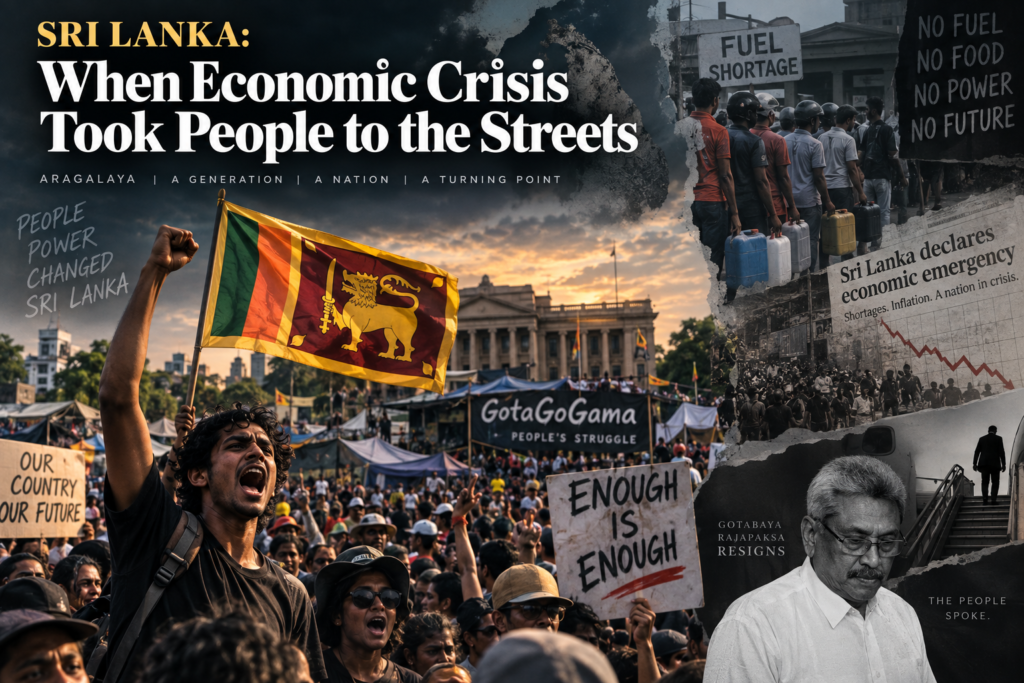
By 2022, the country’s economic breakdown was affecting almost every part of daily life. Foreign-exchange shortages contributed to severe shortages of fuel and other essential goods, while long power cuts and soaring prices made the crisis impossible to ignore. The country’s sovereign-debt crisis had turned economic mismanagement into a question of political survival.
The anger eventually moved beyond economic complaints.
For many Sri Lankans, the question became one of political responsibility. The Rajapaksa family’s long dominance over the country’s political system increasingly became associated with the failures of governance. Protesters gathered around the demand that the political leadership accept responsibility for the crisis.
Young people played a highly visible role, particularly at the GotaGoGama protest site in Colombo, but Aragalaya was never simply a Gen Z movement. It became a broad social coalition involving people from different economic and political backgrounds. That breadth was one of its greatest strengths.
This is an important distinction when discussing Gen Z politics.
Youth anger becomes especially powerful when it connects with a crisis that affects the entire population. A young person’s frustration over unemployment is politically important. But when that frustration is joined by parents who cannot buy fuel, workers facing inflation and families dealing with shortages of basic necessities, the protest becomes much larger than a generational movement.
The political system eventually reached a breaking point. Gotabaya Rajapaksa left the country and resigned as president.
Sri Lanka therefore offered one of the first major lessons of the new South Asian protest era: youth mobilisation becomes politically transformative when it connects with a crisis that the state can no longer manage through ordinary political mechanisms.
Bangladesh would demonstrate a different route from a student grievance to a national political crisis.
Bangladesh: When a Student Protest Became a Political Crisis
Bangladesh’s 2024 uprising began with a much narrower question: who should receive preferential access to government jobs?
Students opposed the reinstatement of a quota system that reserved a significant share of civil-service positions, including a controversial quota for descendants of Bangladesh’s 1971 war veterans. At first, the issue was primarily about fairness in employment and access to a highly competitive public-sector job market.
Then the conflict escalated.
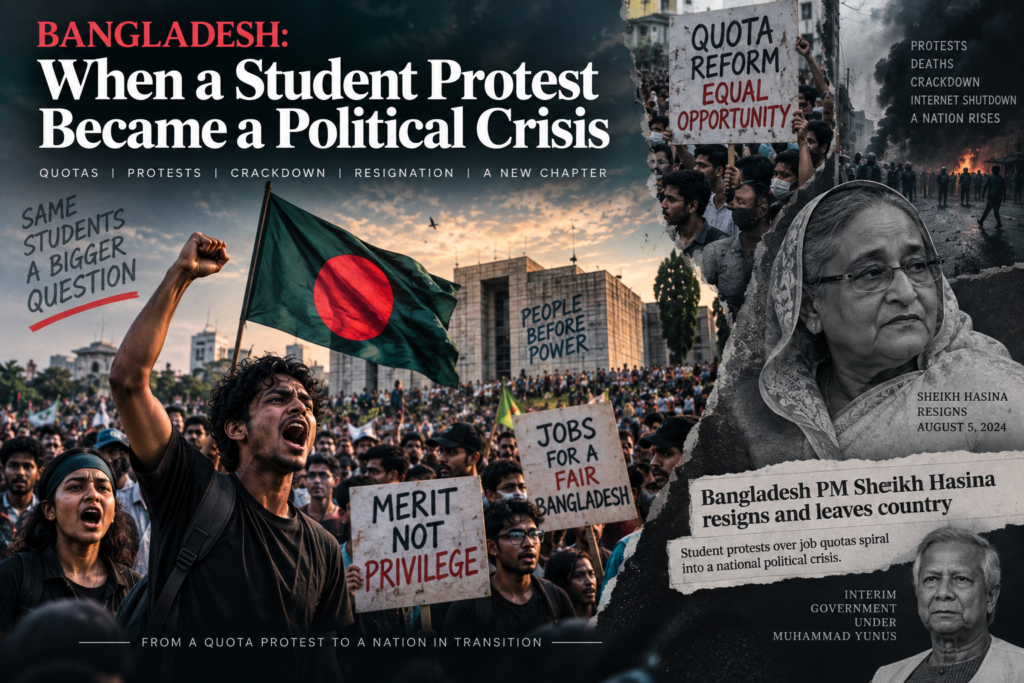
Violence, deaths, a government crackdown, communications restrictions and growing public anger transformed the movement. What began as a student campaign increasingly became a broader confrontation with Prime Minister Sheikh Hasina’s government. The movement’s demands expanded well beyond the original quota issue.
This transformation is perhaps more important than the original demand itself.
A government can often survive a policy disagreement. Governments regularly face protests over taxes, jobs, education or public services. But when protesters conclude that their government is unwilling to listen—or worse, is responding to peaceful demands through excessive force—the original issue can acquire an entirely different meaning.
The quota system became a symbol of something much larger: the question of whether the political system was fair.
That was the point at which a student protest stopped being merely a student protest.
On August 5, 2024, Sheikh Hasina resigned and left the country after weeks of demonstrations. An interim government was subsequently established under Muhammad Yunus.
Bangladesh therefore revealed another important feature of the new protest politics.
The original grievance does not necessarily determine the final outcome.
Sometimes the government’s response to the grievance becomes more politically important than the grievance itself.
Nepal would take this dynamic into an even more digital environment.
Nepal: When Social Media Became the Spark
Nepal’s Gen Z protests demonstrated how a relatively specific government decision can ignite much deeper frustration.
In 2025, the government moved to block major social-media platforms that had not complied with registration requirements. The authorities cited regulatory concerns and the misuse of social media. But for many young Nepalis, the decision was experienced as something much larger than a regulatory dispute.
The country already had accumulated frustration over corruption, political privilege, nepotism and limited economic opportunities. Social media was therefore not the entire cause of the uprising. It was the trigger that connected several existing grievances at once.

For a generation whose social, professional and political lives are deeply intertwined with digital platforms, restricting those platforms was itself interpreted as an attack on the space in which young people communicate.
The protests quickly became violent. Demonstrators attacked government and political buildings, and the government’s response further intensified the crisis. Prime Minister K.P. Sharma Oli eventually resigned.
The lesson from Nepal is particularly relevant beyond Nepal.
For previous generations, shutting down a newspaper, restricting a television station or banning a public gathering could create political anger.
For Gen Z, restricting the digital platforms where political identity is created can produce a similar reaction.
The screen has become part of the street.
And that brings us to India, where the relationship between the screen and the street would become one of the defining characteristics of a new youth movement.
India: The Story Was Different — Until CJP Appeared

India had already experienced major student and youth protests long before CJP appeared. But it did not experience a single national Gen Z uprising comparable to the political crises in Sri Lanka, Bangladesh or Nepal.
That difference is important.
India is not one political space in the same way that a smaller and more centralised state can be. It is a federation of states with different political cultures, different parties, different regional grievances and different social identities. A youth movement that becomes politically explosive in Ranchi may remain a regional issue. A protest in Delhi may become nationally visible but still fail to unite young people across the country.
India also has several institutional channels through which political pressure can travel. Elections provide one route. Courts provide another. Parliament provides another. State governments, political parties, civil-society organisations and the media provide additional avenues through which grievances can be expressed.
None of this means that India’s institutions always respond effectively.
It means that the country possesses more mechanisms through which conflict can be negotiated before it necessarily becomes a national regime crisis.
Yet beneath this institutional complexity, a major source of youth frustration had been building.
For millions of Indian students and graduates, education is not simply education. It is a competition for opportunity. Government examinations can represent years of preparation, family sacrifice and the possibility of economic security.
When examination systems are perceived to be compromised, the grievance therefore becomes deeply personal.
That was the environment in which CJP appeared.
And remarkably, it did not begin with a traditional political organisation.
It began with satire.
CJP: From an Online Joke to a Youth Movement
The Cockroach Janta Party traces its origin to a Supreme Court hearing on May 15, 2026. During the hearing, Chief Justice of India Surya Kant used the term “cockroaches” while referring to unemployed young Indians who criticised judges and institutions. The remark was quickly transformed online by Abhijeet Dipke, who asked, in effect, what might happen if all those “cockroaches” came together.
Within a remarkably short period, the joke became an identity.
The insult became a symbol.
And the symbol became a movement.
CJP’s growth was fuelled by real grievances surrounding examination irregularities, unemployment and the wider feeling among young Indians that their futures were being determined by systems they had little ability to influence. The movement was initially satirical and digital, but it soon moved into physical protest, with Jantar Mantar becoming the centre of a sustained mobilisation. The Associated Press reported that the movement had accumulated more than 22 million Instagram followers as it moved from online satire into street activism.
The speed of that transformation matters.
Traditional political organisations normally take years to build membership, leadership structures, slogans, communication networks and public recognition.
CJP appeared to compress that process into weeks.
Its language was deliberately different. It used humour, memes, irony and internet culture rather than traditional political vocabulary. It did not initially ask young people to identify with a complicated ideology. It gave them a symbol that was easy to understand and even easier to share.
But the satire worked because there was genuine frustration underneath it.
The movement’s protests focused heavily on examination irregularities and demanded accountability from the education system. As the mobilisation grew, the demand for the resignation of Union Education Minister Dharmendra Pradhan became one of its central political demands.
That demand was eventually met.
On July 25, 2026, Pradhan resigned after weeks of youth-led protests. Reuters described the resignation as a major political setback for the government, while CJP supporters celebrated the development at Jantar Mantar.
The significance of that moment was not simply that one minister left office.
It was that a movement born from internet satire had demonstrated that digital attention could be converted into physical mobilisation, political pressure and an institutional response.
But why did the movement resonate so strongly?
Because the examination controversy was only the visible surface of a much deeper anxiety.
Why Did CJP Resonate With Indian Gen Z?
For a student preparing for a competitive examination, an examination paper is not simply a piece of paper.
It can represent years of preparation, family expectations, financial sacrifice and the hope of changing one’s economic position.
That is why examination irregularities can create a particularly intense form of political anger.
The feeling is not merely that an examination was badly conducted. It is that the rules of the competition itself may have been compromised.
CJP therefore tapped into a much broader question: does hard work still guarantee opportunity?
That question reaches far beyond examination halls.
It touches unemployment, recruitment delays, intense competition for government jobs, the rising cost of education and uncertainty about what kind of employment will be available in the future. Reuters reported that analysts viewed the examination controversy as a trigger for deeper youth anxieties, including unemployment and fears about artificial intelligence affecting future jobs.
This is why the movement could resonate with people who were not directly affected by one particular examination.
The paper leak was the trigger.
The anxiety was the fuel.
The political meaning of CJP therefore cannot be understood simply as an education controversy. It was a generational argument about fairness, opportunity and trust.
And there was another reason the movement became so powerful.
Gen Z did not simply protest in the street.
It documented the street.
That distinction changed everything.
The Street and the Screen: A New Type of Protest
Older protest movements depended heavily on physical presence.
If ten thousand people appeared on the streets, the size of the crowd itself became the political message.
Gen Z has added another dimension.
The protest now exists simultaneously in physical space and digital space.
A student can stand at Jantar Mantar while another student thousands of kilometres away participates through Instagram. A confrontation can be recorded by dozens of phones and distributed before television cameras arrive. A slogan can become a meme within minutes. A photograph can become evidence, political propaganda or a mobilisation tool depending on how it is interpreted.
The smartphone has therefore become more than a communication device.
During CJP, it functioned as a camera, archive, broadcasting system, organising tool and political megaphone. NDTV’s reporting highlighted how protesters’ everyday habits of filming, photographing and sharing became part of the movement’s infrastructure.
This created a feedback loop.
The street created images.
The images created attention.
The attention brought more people into the conversation.
The larger conversation increased pressure on political institutions.
And the institutional response generated another wave of online discussion.
This is what makes contemporary youth movements different from many earlier protests.
The movement does not end when protesters leave the street.
It continues in the feed.
The political establishment eventually recognised this shift.
Prime Minister Narendra Modi posted a rare Instagram video addressing young protesters and the examination crisis, promising remedial action. Soon afterward, he told Cabinet colleagues that ministers should engage young people through Instagram Reels and interactive sessions.
Another Modi Instagram reel reportedly crossed 303 million views within 24 hours, according to NDTV.
The number itself is remarkable, but the political significance is even greater.
The government was no longer communicating with Gen Z only through rallies, television interviews or formal speeches.
It was entering Gen Z’s own communication environment.
That does not mean the Instagram intervention caused the Education Minister’s resignation. The resignation followed weeks of demonstrations, political pressure, negotiations and demands for accountability.
But it showed that the political establishment had recognised a fundamental change:
the battlefield of political communication had moved.
The government did not simply have to respond to the crowd.
It had to learn how to communicate with the generation that created the crowd.
And that brings us to the central comparison.
Nepal, Bangladesh, Sri Lanka and India: Similar Anger, Different Outcomes
At first glance, the four countries appear to tell the same story.
Young people became frustrated. They organised rapidly. Social media helped them communicate. The streets became crowded. Governments came under pressure.
Yet the political outcomes could hardly have been more different.
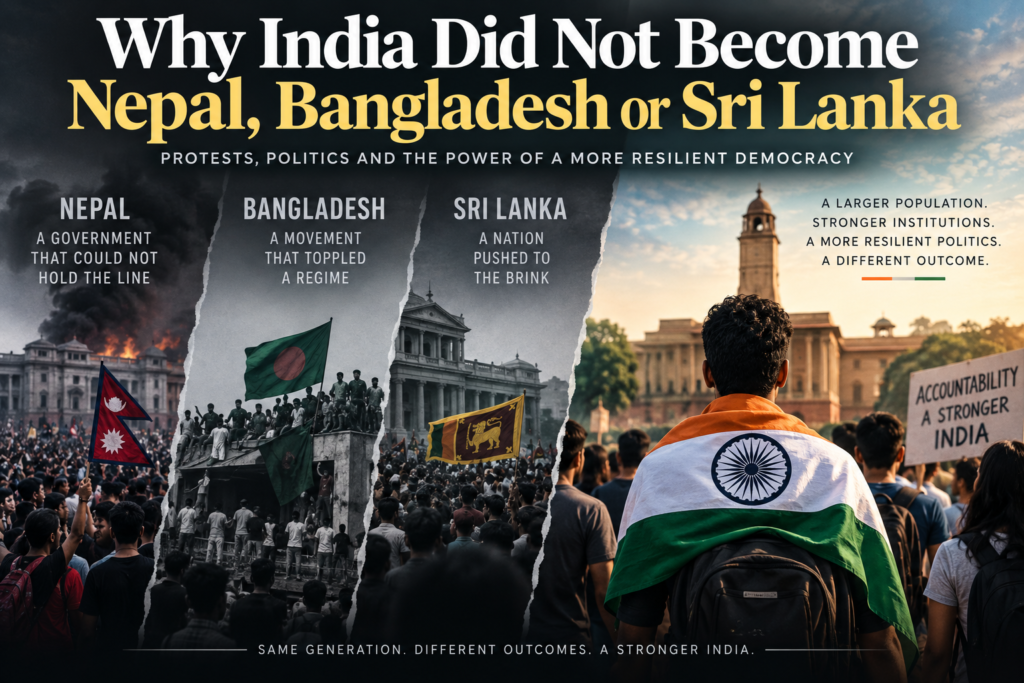
Sri Lanka experienced a national economic and political crisis that eventually forced the president from office. Bangladesh saw a student movement expand into a broader confrontation that ended Sheikh Hasina’s long tenure in power. Nepal experienced a youth uprising that followed a social-media restriction and culminated in the resignation of Prime Minister K.P. Sharma Oli.
India experienced a powerful youth movement, but not a comparable national regime crisis.
That difference should not be explained simply by saying that India had better policing, stronger crowd control or more effective government management.
Those explanations focus too narrowly on what happens on the street.
The deeper question is what happens after the street becomes politically significant.
Does the political system have mechanisms for absorbing the pressure?
Can an issue move from social media to Parliament, from Parliament to government, from government to courts, from courts back to public debate and eventually into an election?
Can the system make concessions without interpreting every concession as a threat to its survival?
This is where India’s institutional structure becomes central.
And it leads to perhaps the most important argument in the entire story.
Why India Did Not Become Nepal, Bangladesh or Sri Lanka
India’s difference was not simply “better crowd control”.
It was greater institutional absorption and political resilience.
That distinction is fundamental.
A politically resilient system does not necessarily prevent protests. In fact, democratic systems are expected to contain disagreement, dissent and public mobilisation. The real test is whether those conflicts can be processed without automatically turning into a crisis of the entire political order.
India has several layers through which public anger can travel.
A grievance can begin on Instagram. It can become a street protest. Political parties can attempt to support it. Courts can intervene. Parliament can debate it. Ministers can negotiate with protesters. State governments can respond where the issue falls within their jurisdiction. Eventually, voters can punish or reward political parties through elections.
This does not mean every grievance receives justice.
It does not mean every institution is equally effective.
And it certainly does not mean India is immune from political crisis.
It means the system has multiple pressure-release mechanisms.
That is what institutional absorption looks like.
In Sri Lanka, the economic crisis became so severe that the ordinary mechanisms of political management could no longer contain public anger. In Bangladesh, the government’s response to the student movement helped transform an employment dispute into a wider challenge to political legitimacy. In Nepal, the social-media ban collided with deeper grievances over corruption and political privilege, and the state’s response accelerated rather than contained the crisis.
India, by contrast, has so far shown a greater ability to allow a protest to produce a political concession without automatically producing regime change.
CJP is a powerful example.
The movement demanded accountability over examination irregularities. It demanded the Education Minister’s resignation. It generated national attention. The minister eventually resigned. The government entered negotiations with protest leaders and accepted a number of demands, including measures related to examination reforms and cases against protesters.
Yet the Indian political system continued functioning.
The Prime Minister remained in office.
The Union government remained in place.
Parliament continued.
The dispute moved into legal and institutional channels.
That last point is particularly revealing. In September 2026, CJP withdrew a planned Delhi march after the Centre and several state governments gave assurances to the Supreme Court concerning cases against protesters. The issue had therefore travelled from the street into the judiciary and back into political negotiation.
That is institutional absorption in practice.
The system bends.
It negotiates.
It sometimes concedes.
It sometimes resists.
But it does not necessarily break.
India’s federal structure adds another layer to this resilience.
A protest in Ranchi does not automatically become a national crisis in Delhi. A dispute over state recruitment examinations can remain primarily a Jharkhand issue. A movement in one region can demand accountability from a state government without immediately becoming a nationwide confrontation with the Union government.
That can sometimes weaken the ability of youth movements to create a single national political identity.
But it can also prevent local grievances from automatically becoming national regime crises.
Jharkhand provides an especially revealing example.
Jharkhand: A Different Kind of Youth Movement
The student and job-aspirant movement in Jharkhand developed around alleged irregularities in JPSC and JSSC recruitment examinations. Protesters demanded greater transparency, investigations, examination reforms and, in some cases, cancellation of disputed examinations. The movement continued for weeks in Ranchi and became one of the more significant youth-led recruitment protests in the state.
But the character of the movement was different from CJP.
The protesters repeatedly attempted to keep the movement focused on recruitment and examination reform rather than allowing it to become a platform for any political party. That does not mean the movement was completely apolitical. Political leaders and affiliated organisations attempted to participate, and as the confrontation continued, the political stakes increased. By August, protesters had even warned that they could demand Chief Minister Hemant Soren’s resignation if their demands were not met.
The distinction is important.
The protesters were not necessarily rejecting politics itself.
They were trying to prevent party politics from taking ownership of their immediate grievance.
That tells us something important about India’s Gen Z.
Young people can be deeply political without necessarily wanting to become part of conventional party politics.
They can challenge a government without automatically becoming an opposition movement.
They can demand accountability without initially demanding regime change.
The Jharkhand protest was eventually called off after 26 days following government decisions including the cancellation of the JSSC Combined Graduate Level examination and other measures.
But Jharkhand also reveals a second, more uncomfortable truth about digital politics.
Not every protest receives the same digital visibility.
NDTV’s analysis of Instagram activity found a striking difference between the Delhi CJP protest and the Jharkhand movement. It reported that posts associated with the Delhi protest reached roughly 1.8 crore people, while comparable posts around the Ranchi protest reached around six lakh.
That raises a major question for the future of democratic mobilisation.
If social media determines which protest becomes nationally visible, then political power is no longer shaped only by the size or legitimacy of a grievance.
It is also shaped by visibility.
And visibility can be influenced by algorithms, networks, influencers, geography and media attention.
This is one of the great unresolved questions of the Gen Z political era.
Social media can democratise political participation.
But it can also decide which voices become impossible to ignore.
The Instagram Moment Was More Than a Viral Moment
The Prime Minister’s decision to address young people through Instagram therefore deserves to be understood as more than a clever communication strategy.
It was an acknowledgement of a changing political environment.
For years, political communication in India revolved around rallies, television, newspapers, WhatsApp and platforms such as X. Instagram increasingly represents something different. It is not simply another place to distribute political messages. It is a space where younger citizens construct identity, humour, community and political meaning.
The government’s response showed that the political establishment understood this shift.
Modi urged ministers to use Reels and interactive sessions to engage young people. The extraordinary reach of his subsequent content demonstrated how quickly political communication can move when a major political leader enters the digital environment where Gen Z already spends its time.
But there is a deeper lesson here.
The government did not need to defeat Gen Z.
It needed to learn how to communicate with Gen Z.
That is an important difference.
Political resilience in the digital age may increasingly depend not only on controlling physical disorder but on understanding digital culture.
A government can control a road.
It cannot easily control a narrative once millions of young people are sharing it.
And that brings us to the central question surrounding the generation itself.
Are these young people actually anti-government?
Or are they asking for something different?
Is Gen Z Really Anti-Government — or Pro-Accountability?
t is tempting to describe every major youth protest as anti-government.
But that interpretation can be dangerously simplistic.
CJP challenged the government aggressively. Its supporters criticised political leaders, demanded a minister’s resignation and questioned the handling of examination irregularities. Yet that does not automatically mean every person involved wanted the opposition to take power.
In fact, Reuters reported that the movement initially presented itself as distinct from electoral politics, even as opposition parties attempted to support and associate themselves with the protests.
The same tension appeared in Jharkhand.
Students wanted their examination and recruitment grievances addressed, but there was an ongoing effort to prevent the movement from becoming simply another political campaign. As the protest continued and government negotiations stalled, the movement became more politically confrontational, but its original demand remained rooted in recruitment and examination reform.
This suggests a more complicated political identity.
Gen Z may be increasingly anti-establishment without necessarily being pro-opposition.
It may distrust a government without trusting the opposition.
It may reject political authority without wanting to become part of a political party.
It may demand accountability without demanding revolution.
That creates a difficult environment for traditional political organisations.
Older political politics often relied on loyalty. Political parties built long-term identities around ideology, caste, religion, class, region or leadership.
Gen Z may be more issue-driven.
The question can become brutally simple:
What have you delivered?
Why should we trust you?
Can you explain what happened?
What are you doing about our future?
This does not mean identity politics is disappearing. It clearly is not.
But it means political identity now competes with something else: immediate performance.
A government may win the support of young people on one issue and lose it on another.
That makes Gen Z harder to permanently capture.
And that could have profound consequences for Indian politics.
What This Means for Indian Politics
The long-term significance of these movements may not be the creation of a new political party.
It may be the creation of a new political expectation.
Young Indians increasingly expect institutions to explain themselves.
They expect information to move quickly.
They expect mistakes to be acknowledged.
They expect political leaders to communicate directly.
And increasingly, they expect the state to protect the fairness of the systems on which their future depends.
Education is central to that expectation.
Employment is central.
Recruitment is central.
Artificial intelligence and automation are increasingly part of it.
Political representation is part of it.
But beneath all of these issues lies one larger question:
Can the system give young people a credible future?
That question is bigger than any individual examination.
A student who spends years preparing for a competitive examination is not simply preparing for a test. They are competing for a limited number of opportunities in a country where millions of educated young people may be competing for the same positions.
When that competition appears unfair, the political consequences can be enormous.
This is why the CJP movement became larger than its original trigger. Reuters described the paper leak as a trigger for broader youth anxiety about unemployment, future opportunities and even the possibility that AI could disrupt established employment pathways.
The political challenge for Indian governments will therefore not simply be managing protests.
It will be managing expectations.
A government can perhaps contain one protest.
It cannot permanently contain an entire generation’s expectations.
And this is where the future becomes particularly interesting.
The next political divide may not simply be between government and opposition.
It may increasingly be between institutions that can adapt and institutions that cannot.
Political parties that understand this will attempt to speak to Gen Z in its own language.
Those that do not may discover that young voters are listening—but not necessarily believing.
The same generation that can make a political movement viral in days can also move on from it just as quickly.
That makes Gen Z both powerful and unpredictable.
Conclusion: The Generation That Learned to Protest Differently
Across South Asia, a new political language is emerging.
Sri Lanka demonstrated how economic collapse can turn youth frustration into a national political crisis. Bangladesh showed how a student demand over employment can become a much larger struggle over political legitimacy. Nepal demonstrated how restricting digital space can ignite accumulated anger about corruption, privilege and opportunity.
India has shown something different.
Its youth movements can become powerful without necessarily becoming regime-changing movements.
CJP transformed an online joke into a national youth mobilisation. It demonstrated that satire could become political identity, that Instagram could become an organising platform, and that a movement without a conventional party structure could nevertheless generate enough pressure to force a Union minister to resign.
Jharkhand demonstrated another side of the same generation: a regional, issue-specific movement focused on recruitment and examination reform, with protesters attempting to keep party politics from taking control of their platform even as political actors sought to participate.
Together, these movements reveal something larger about the political future of India.
Gen Z does not necessarily want to destroy institutions.
It wants institutions to work.
It does not necessarily want revolution.
It wants fairness.
It does not necessarily want to replace every government.
It wants governments to listen.
That distinction may prove crucial.
Because the political systems that survive the Gen Z era will not necessarily be the systems that suppress protest most effectively.
They will be the systems capable of absorbing protest, understanding its underlying causes and responding before frustration becomes a crisis of legitimacy.
That is why India’s experience cannot simply be described as a story of better crowd control.
Its deeper story is one of institutional absorption and political resilience.
A resilient democracy does not prevent people from coming into the streets.
It gives their anger somewhere to go.
It allows a protest to become a negotiation.
It allows a demand to become a policy change.
It allows a minister to resign without requiring the government to collapse.
It allows a dispute to move from the streets to Parliament, from Parliament to the courts and eventually back into democratic politics.
But resilience should never be confused with immunity.
India’s young population is too large, too connected and too politically aware for governments to assume that today’s grievances will remain isolated tomorrow.
The smartphone has changed the relationship between citizen and state.
The meme has changed political language.
Instagram has changed political visibility.
And Gen Z has changed the speed at which dissatisfaction can become mobilisation.
The political establishment has learned that it must enter the digital spaces where young people already live. Prime Minister Modi’s Instagram engagement during the CJP protests was an early demonstration of that adaptation.
But communication alone will not be enough.
A generation can be addressed through a Reel.
It cannot be permanently persuaded by one.
Eventually, the system has to deliver.
That is perhaps the most important geopolitical lesson emerging from South Asia’s Gen Z movements.
The future of political stability will depend not on whether young people stop protesting, but on whether institutions remain capable of giving them reasons to trust.
Gen Z is not necessarily coming for governments.
It is coming for systems that refuse to listen.
And in India, the future of politics may depend less on whether the state can control the crowd—and more on whether it can convince the generation creating that crowd that the system is still worth believing in.
Because the real danger is not the protest itself.
The real danger is losing the trust of the generation that creates it.