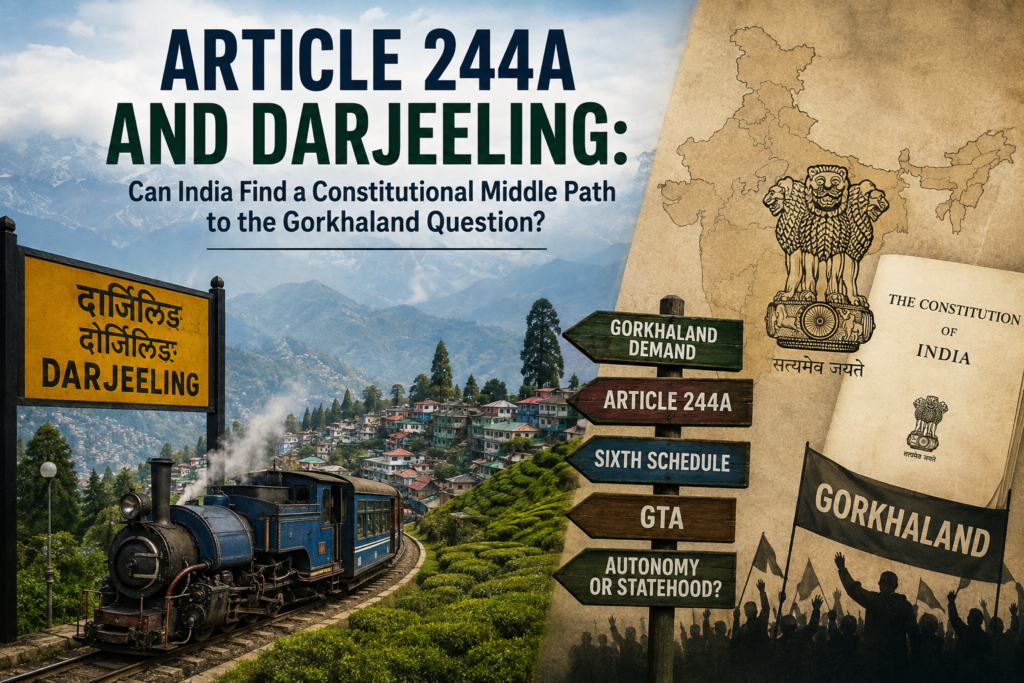

A few days ago, one of my friends asked me a very interesting question:
“I keep hearing about Article 244A in discussions about Darjeeling and Gorkhaland. What exactly is Article 244A? Can it really give Darjeeling more autonomy? And if it can, why are we still talking about Gorkhaland?”
It was a fair question. And honestly, it is a question that many people may have. The words Article 244A, Sixth Schedule, GTA, autonomy and Gorkhaland are increasingly appearing together in political discussions. But these are not the same thing, and it is easy to become confused. So I thought I would try to explain it in the simplest possible way. I am not writing this as a constitutional lawyer. I am looking at it as a political question:
What could Article 244A mean for Darjeeling, and could India find a middle path between the existing arrangement and a separate Gorkhaland state?
And before we go any further, there is one important clarification. Article 244A does not currently apply to Darjeeling. It was created specifically for Assam. So when we discuss Article 244A in the context of Darjeeling, we are not talking about simply applying the existing provision. We are talking about whether the idea behind Article 244A could help policymakers design a new constitutional arrangement for Darjeeling. That distinction is extremely important.
So, what exactly is Article 244A?
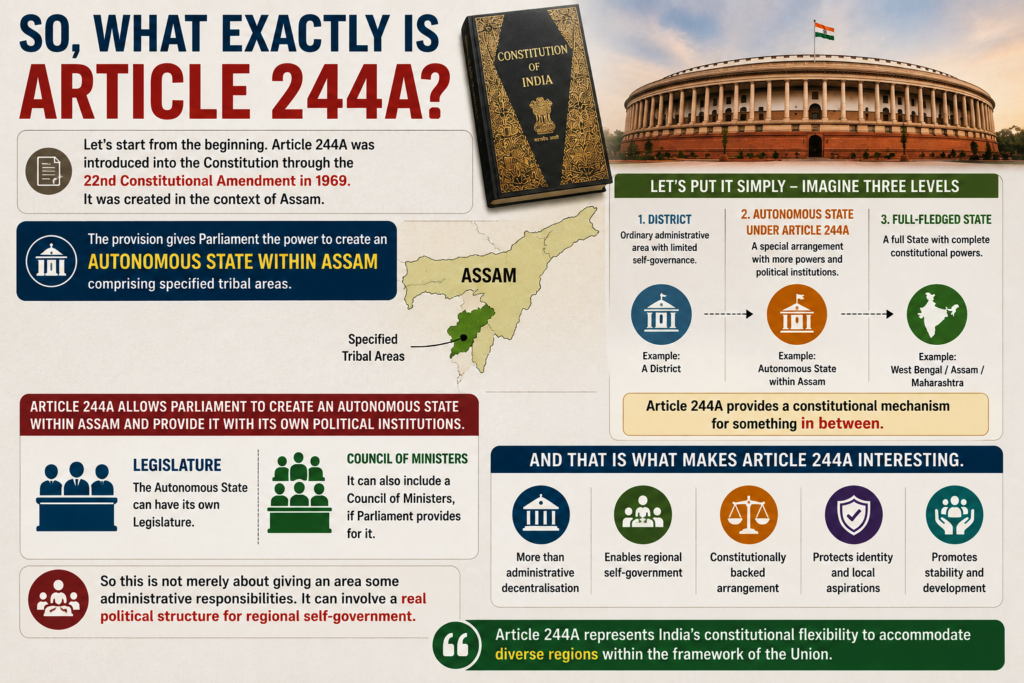
Let’s start from the beginning. Article 244A was introduced into the Constitution through the 22nd Constitutional Amendment in 1969. It was created in the context of Assam. The provision gives Parliament the power to create an autonomous State within Assam comprising specified tribal areas.
Now, the phrase “autonomous State” may sound confusing. So let’s put it simply. Imagine three levels. At one end, you have an ordinary administrative area, such as a district. At the other end, you have a full-fledged state like West Bengal, Assam or Maharashtra. Article 244A provides a constitutional mechanism for something in between. It allows Parliament to create an autonomous State within Assam and provide it with its own political institutions. That can include a legislature. It can also include a Council of Ministers, if Parliament provides for it.
So this is not merely about giving an area some administrative responsibilities. It can involve a real political structure for regional self-government. And that is what makes Article 244A interesting.
But wait—does that mean Darjeeling can become an autonomous State under Article 244A?
The answer is not under Article 244A as it currently stands. Why? Because Article 244A specifically deals with Assam. Darjeeling is in West Bengal. So we cannot simply take this provision and say, “Let’s apply Article 244A to Darjeeling.”
An ordinary law passed by the West Bengal government would not be enough to do that. If India wanted to create a similar constitutional arrangement for Darjeeling, the appropriate constitutional route would have to be worked out. Depending on the structure proposed, this could involve Parliament and potentially constitutional amendment.
So Article 244A should not be described as a ready-made legal solution to the Gorkhaland question. It is better understood as an example of India’s constitutional flexibility. And that is where things become interesting.
Why does this matter to Darjeeling?
Because Darjeeling has already tried the autonomy route. This is not a theoretical debate. We have already seen the Darjeeling Gorkha Hill Council. And later, we saw the creation of the Gorkhaland Territorial Administration, or GTA, in 2011. The idea behind the GTA was quite simple. Give the hills greater control over local administration and development while keeping Darjeeling within West Bengal. It was an attempt to find a compromise. But the Gorkhaland demand did not disappear. And that raises a very important question.
Why?
Perhaps the problem is not simply whether Darjeeling has an autonomous institution. Perhaps the real issue is how much power that institution has.
GTA and Article 244A are not the same.
The GTA is a statutory body. That means its legal authority comes from legislation passed by the West Bengal Legislature. Article 244A, on the other hand, is a constitutional provision. It provides a mechanism for creating an autonomous State within Assam through parliamentary legislation. So these are two very different legal arrangements.
The GTA can have important administrative and development responsibilities. But it is not a state government. It is not a Sixth Schedule council. And it is not an autonomous State under Article 244A. This difference matters because the Gorkhaland debate is ultimately about political power.
People are not simply asking:
“Can we administer some local subjects?”
The deeper question is:
“Can we have meaningful control over the decisions that affect our region?”
Then what is the Sixth Schedule?
Another term that frequently comes up in this debate is the Sixth Schedule. The Sixth Schedule is part of the Constitution. It provides special arrangements for autonomous administration in specified tribal areas of:
- Assam,
- Meghalaya,
- Tripura,
- and Mizoram.
Under the Sixth Schedule, Autonomous District Councils and, in certain situations, Regional Councils can exercise powers over specified matters. These may include areas such as land, forests other than reserved forests, village administration, social customs, inheritance, marriage and divorce and certain taxation and development matters.
The important point is that the Sixth Schedule provides constitutional protection to these autonomous institutions. But again, Darjeeling is not currently under the Sixth Schedule. If anyone proposes bringing Darjeeling under the Sixth Schedule, that would require the appropriate constitutional and parliamentary process. And even then, we would have to ask:
Would a Sixth Schedule council be enough for Darjeeling?
That is a political question, not simply a legal one.
So we now have three different ideas
This is where things can become confusing.Let’s simplify them.
The GTA
A statutory autonomous body created under West Bengal law.
The Sixth Schedule
A constitutional framework for autonomous councils in specified tribal areas.
Article 244A
A constitutional mechanism for creating an autonomous State within Assam.
And then there is a fourth option:
Full statehood
A separate Gorkhaland state within the Indian Union.
These four arrangements are not interchangeable. They represent different degrees and forms of political autonomy. That is why, whenever somebody says:
“Give Darjeeling autonomy,”
my next question would be:
“What kind of autonomy?”
Autonomy over what?
Who will make the laws?
Who will control the money?
Who will control land?
Who will run the administration?
Who will appoint officials?
Who will be accountable to the people?
These are the questions that actually determine how much autonomy a region has.
And this brings us back to Gorkhaland
My friend’s next question was quite natural:
“If greater autonomy can be given, why do people still demand Gorkhaland?”
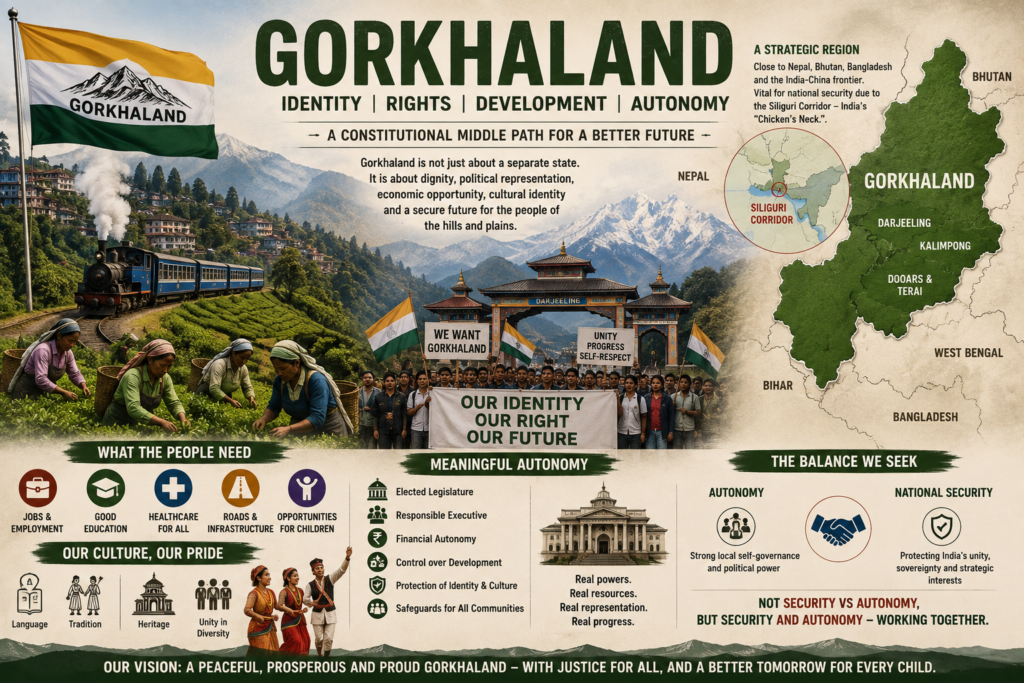
There is no single answer. For many people, Gorkhaland is about identity. It is about recognition of the Gorkha community’s distinct linguistic, cultural and historical identity. But it is not only about identity. It is also about political representation.
People want decisions affecting the hills to be made closer to the people who live there. There are also economic concerns.
Jobs.
Education.
Healthcare.
Roads.
Tourism.
Tea gardens.
Land rights.
Young people leaving the region in search of opportunities. All of these issues are part of the larger political conversation. So, if we want to understand Gorkhaland properly, we should not reduce it to a demand for a new state on a map. It is also a demand for greater control over one’s political and economic future.
Could there be a middle path?
This is where I think the discussion becomes interesting. For years, the debate has been presented as two opposite positions.
One side says:
We want Gorkhaland.
The other says:
We do not want West Bengal divided.
But perhaps there is another question we should ask.
Can Darjeeling receive meaningful self-government without immediately becoming a separate state?
This is what I would call the constitutional middle path. It could involve a stronger regional government with:
- an elected legislature,
- clearly defined legislative powers,
- a responsible political executive,
- predictable financial resources,
- greater control over local development,
- protection of language and culture,
- and safeguards for other communities.
The exact constitutional structure would have to be carefully designed. It could draw lessons from the GTA, Sixth Schedule arrangements and Article 244A. But it should not simply copy any of them. Darjeeling has its own history and circumstances. It may need its own model.
But there is a problem we cannot ignore: Other communities
There is an important reality here. Darjeeling is not inhabited by one community alone. The wider region includes Gorkhas, Adivasis, Rajvanshis, Bengalis and other communities. And they all have legitimate interests.
So imagine a new political arrangement is created. If one community feels empowered but another feels excluded, can we really call it a permanent solution? I don’t think so.
A successful settlement must protect the political and cultural interests of all communities. The principle should be very simple:
Protect Gorkha identity without creating insecurity for others.
That is perhaps one of the biggest tests of any future political arrangement.
Then comes the boundary question
Suppose we agree that Darjeeling should have greater autonomy. The next question is:
Which areas should be included?
Only the hills?
Darjeeling and Kalimpong?
What about the Terai?
What about the Dooars?
This is not just a question about geography. Boundaries determine political representation, access to resources and the rights of communities. That is why any future territorial arrangement will need careful study. There should be demographic analysis. There should be consultation with affected communities. And there should be transparency. A new boundary should not become the beginning of another political conflict.
And then there is the “Chicken’s Neck”
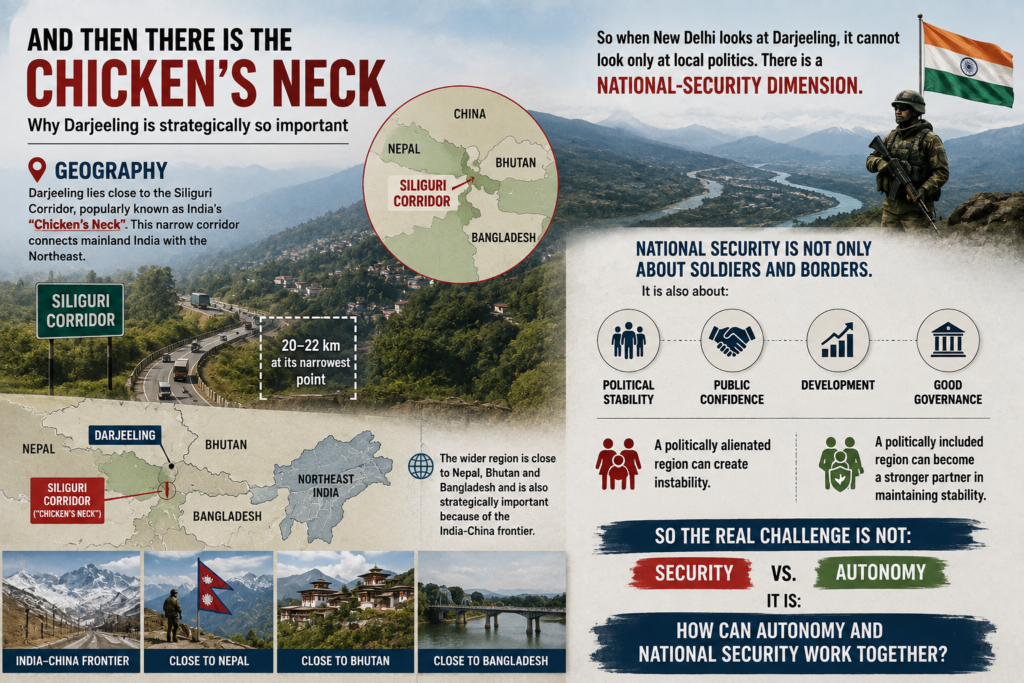
There is one factor that makes Darjeeling particularly sensitive.
Geography.
The region is close to the Siliguri Corridor, popularly known as India’s “Chicken’s Neck”. This narrow corridor connects mainland India with the Northeast. The wider region is close to Nepal, Bhutan and Bangladesh and is also strategically important because of the India-China frontier.
So when New Delhi looks at Darjeeling, it cannot look only at local politics. There is a national-security dimension. But there is another way to look at it. National security is not only about soldiers and borders.
It is also about political stability.
It is about public confidence.
It is about development.
It is about good governance.
A politically alienated region can create instability.
A politically included region can become a stronger partner in maintaining stability.
So the real challenge is not:
Security versus autonomy.
It is:
How can autonomy and national security work together?
What about the tea gardens?
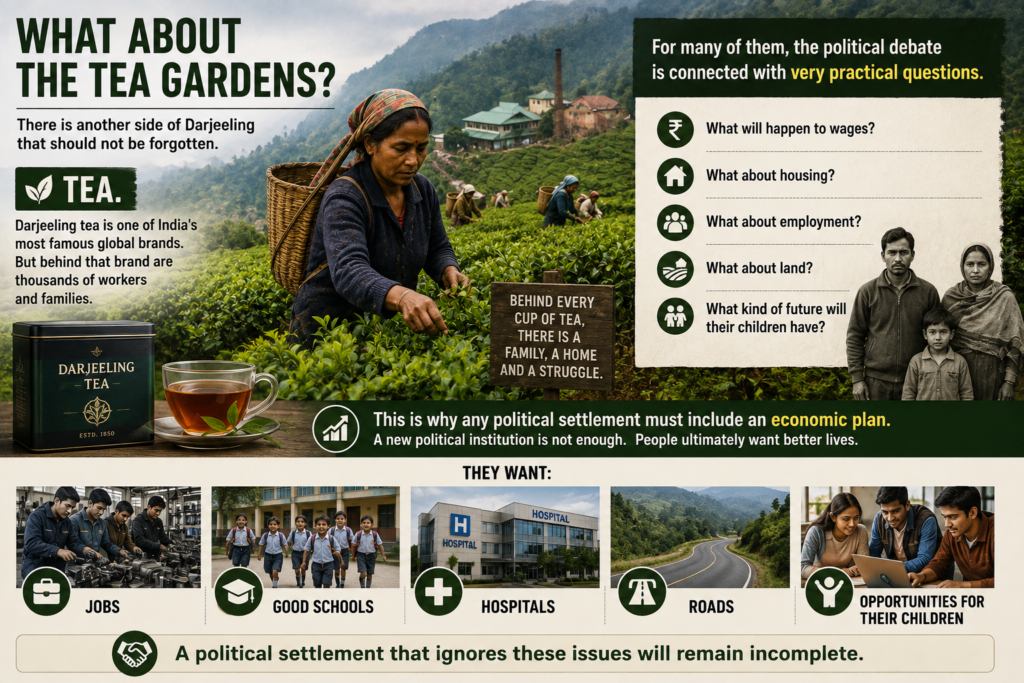
There is another side of Darjeeling that should not be forgotten.
Tea.
Darjeeling tea is one of India’s most famous global brands. But behind that brand are thousands of workers and families.
For many of them, the political debate is connected with very practical questions.
What will happen to wages?
What about housing?
What about employment?
What about land?
What kind of future will their children have?
This is why any political settlement must include an economic plan. A new political institution is not enough. People ultimately want better lives.
They want jobs.
They want good schools.
They want hospitals.
They want roads.
They want opportunities for their children.
A political settlement that ignores these issues will remain incomplete.
What about land?
Land could become one of the most difficult issues in any future settlement. There are questions surrounding tea estates, residential land, leases, development and the rights of people who have lived in the region for generations.
So the future debate should not only ask:
“Who will govern Darjeeling?”
It should also ask:
“Who will control land?”
“What rights will residents have?”
“How will development take place?”
“How will environmental concerns be protected?”
These are difficult questions. But they cannot be avoided.
So, what would I suggest?
If you ask me what a sensible political solution could look like, I would not begin by saying:
“Create Gorkhaland.”
Nor would I begin by saying:
“Forget the Gorkhaland demand.”
I would begin somewhere else.
I would ask:
What are the problems that the Gorkhaland demand is trying to solve?
If the problem is political representation, strengthen political representation.
If the problem is weak local administration, transfer real powers.
If the problem is financial dependence, create predictable financial arrangements.
If the problem is cultural insecurity, protect language and culture.
If the problem is land, address land rights.
If the problem is unemployment, create an economic strategy.
And if, after all these measures, people still overwhelmingly demand a separate state, then that demand should be discussed honestly within the constitutional framework.
In other words:
Don’t begin with the solution. Begin with the problem.
What could a “Darjeeling Model” look like?
Personally, I think India should at least explore the possibility of a special Darjeeling model of self-government. Again, this is a political and constitutional proposal for discussion—not an existing legal provision.
Such a model could have:
A strong elected regional legislature
People should elect representatives who have clearly defined powers over regional matters.
A responsible political executive
The regional government should be accountable to the elected legislature.
Financial autonomy
The region should have predictable resources instead of depending entirely on discretionary grants.
Cultural protection
Gorkha language, culture and heritage should receive meaningful protection.
Community safeguards
Adivasis, Rajvanshis, Bengalis and other communities must have representation and protection.
Development powers
The regional government should have a meaningful role in tourism, infrastructure, education, healthcare and local economic development.
National-security coordination
The Union should retain responsibility for defence and national security while working closely with regional institutions.
That, in my view, would be a serious attempt at a middle path.
But would autonomy satisfy everyone?
Probably not.
And we should be honest about that. For some Gorkhaland supporters, nothing short of a separate state will be acceptable. They may argue that only statehood can provide genuine political dignity and long-term security. That argument cannot simply be dismissed. At the same time, statehood has its own challenges.
Boundaries would have to be settled. Other communities would need protection. Financial viability would have to be examined. Administrative institutions would have to be created. And strategic concerns would have to be addressed. So the debate should not be emotional. It should be informed.
Why the present political process matters
The current political moment makes this discussion particularly relevant. In August 2026, the Centre, the West Bengal government and representatives of the hills returned to discussions on a possible permanent political solution.
A committee headed by Pankaj Kumar Singh, former Deputy National Security Adviser and the Centre’s interlocutor for the region, has been tasked with working on the issue.
Now, this process presents an opportunity. But it also raises expectations. Because Darjeeling has seen political agreements before. It has seen administrative arrangements before. It has seen promises of autonomy before.
So the next settlement will have to answer some very specific questions.
What powers will the region actually receive?
Who will control the money?
What will happen to the GTA?
What will happen to land rights?
Which areas will be covered?
How will other communities be represented?
And most importantly:
What makes this arrangement genuinely permanent?
My conclusion
So, coming back to the question my friend asked:
Can Article 244A solve the Gorkhaland issue?
My answer would be:
Not directly.
Article 244A is an Assam-specific constitutional provision. It cannot simply be transferred to Darjeeling. The Sixth Schedule also does not currently apply to Darjeeling. And the GTA is a statutory body, not a constitutional autonomous State.
But these constitutional models give us something valuable:
They show that Indian federalism is capable of accommodating different forms of regional autonomy.
That is the real lesson. Perhaps Darjeeling does not need another temporary administrative arrangement. Perhaps it needs a carefully designed system of self-government with:
real political power,
real financial resources,
real accountability,
protection of identity,
protection of minority communities,
and a clear constitutional foundation.
Whether that eventually leads to a separate Gorkhaland state or a stronger form of autonomy is a question that should be decided through democratic and constitutional processes.
But the conversation should no longer be limited to:
“Gorkhaland or no Gorkhaland?”
The better question is:
“What kind of political arrangement will give the people of Darjeeling a secure future while protecting the interests of every community and the strategic interests of India?”
That is the question worth debating. And perhaps, after decades of agitation and political uncertainty, Darjeeling deserves nothing less than an honest attempt to answer it.