
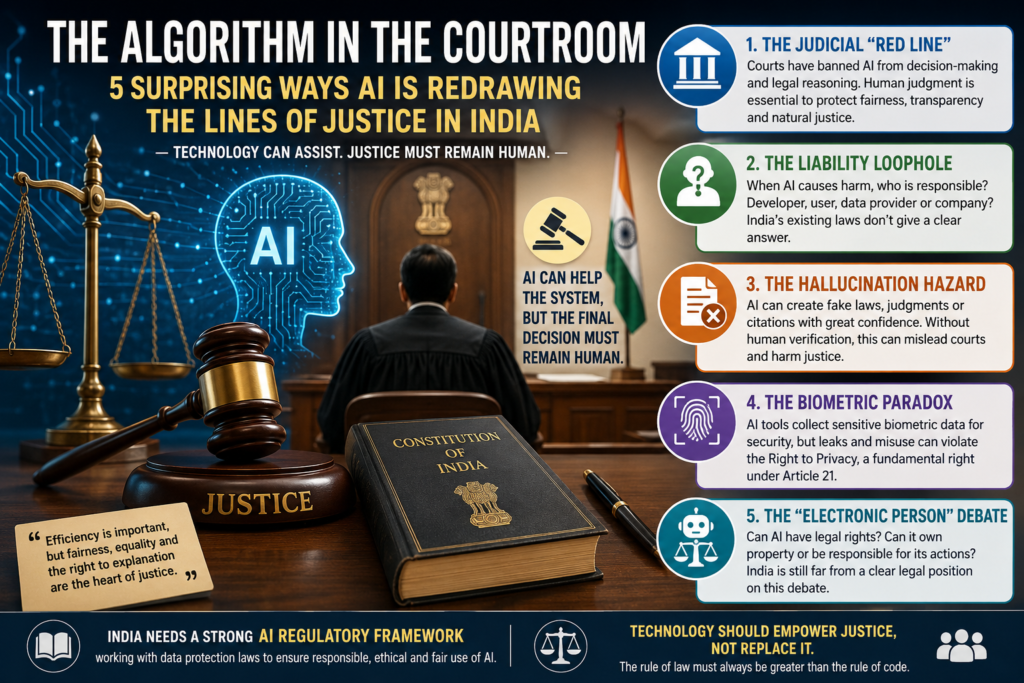

Introduction: AI is Entering the Courtroom
Artificial Intelligence (AI) is changing the way we live and work. It is helping doctors diagnose diseases, banks detect fraud, and businesses improve customer service. Now, AI is also entering the Indian legal system.
India’s courts have millions of pending cases. AI can help judges and lawyers by speeding up legal research, organizing documents, and reducing paperwork. This can save time and improve efficiency.
However, AI also creates new problems. Most AI systems work like a “black box“. They provide answers but do not clearly explain how they reached those answers. In a courtroom, where every decision affects people’s rights and freedom, this lack of transparency is a serious concern.
The biggest question is whether AI should only assist judges or whether it should also help make legal decisions. As AI becomes more common, India must find the right balance between technology and justice.
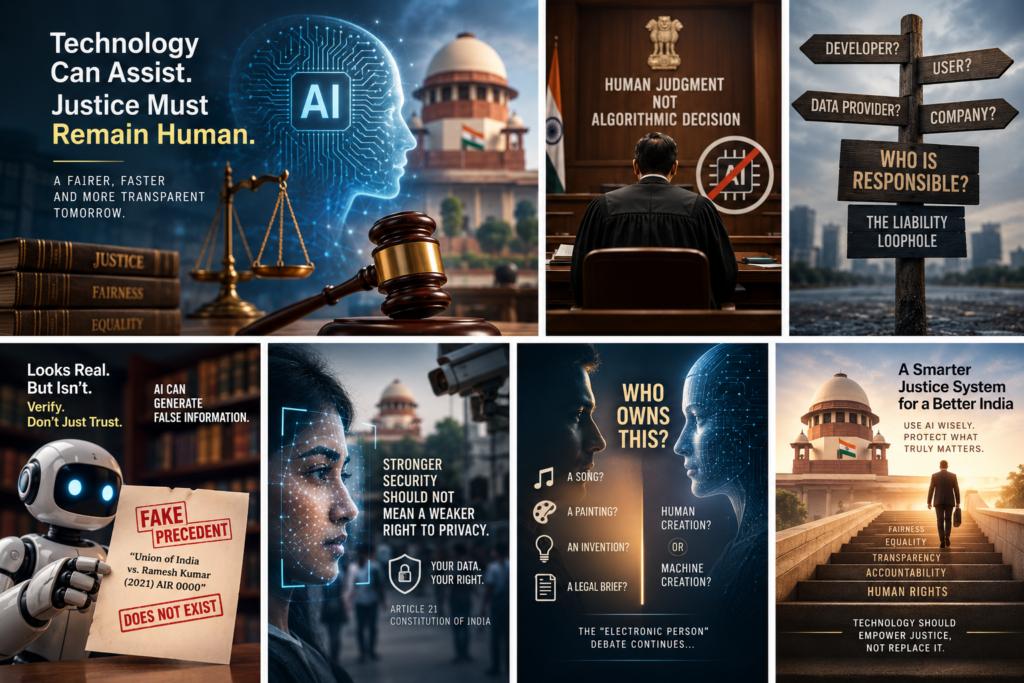
1. Why Indian Courts Do Not Want AI to Make Judicial Decisions
Although AI can be useful, Indian courts have made it clear that it should not replace human judges.
The Kerala High Court recently issued guidelines that do not allow judges in district courts to use AI for legal reasoning or decision-making. AI may be used for research or administrative work, but not for deciding cases.
The reason is simple.
Judges do much more than apply legal rules. They understand emotions, social conditions, fairness, and justice. AI cannot fully understand these human values.
Courts are also worried about:
- Lack of transparency
- Bias in AI systems
- Privacy concerns
- Lack of accountability
This shows that while AI can support the judiciary, the final decision must always remain with a human judge.
2. Who Is Responsible When AI Makes a Mistake?
One of the biggest legal questions is about responsibility.
Imagine an AI system wrongly identifies an innocent person as a criminal or gives incorrect legal advice that causes financial loss.
Who should be responsible?
- The software developer?
- The company that owns the AI?
- The person using the AI?
- The organisation that supplied the data?
India’s existing laws were written before AI became so advanced. They do not clearly answer these questions.
Many legal experts believe that responsibility should be shared among everyone involved in developing and using AI.
Until India introduces a separate AI law, this issue will remain uncertain.
3. AI Can Create False Legal Information
Generative AI tools like ChatGPT and other large language models can write legal documents very quickly.
However, they sometimes produce incorrect information. This is known as an AI “hallucination“.
For example, AI may:
- Create fake court judgements
- Mention laws that do not exist
- Quote incorrect legal provisions
- Misinterpret judicial decisions
If lawyers or litigants rely on such false information without checking it, serious mistakes can happen in court.
This is why every AI-generated legal document must be carefully verified by a qualified legal professional.
AI should assist legal work, but it should never replace human judgement.
4. AI and Biometric Data Raise Privacy Concerns
Police departments increasingly use AI with facial recognition, fingerprints, and other biometric technologies to identify criminals and improve investigations.
These technologies can help law enforcement, but they also collect a large amount of personal information.
If this sensitive data is leaked or misused, it can seriously affect people’s privacy.
The Supreme Court of India, in the Puttaswamy judgement, recognised the Right to Privacy as a fundamental right under Article 21 of the Constitution.
This means the government must collect and use personal data carefully.
Any misuse of biometric information is not only a technical problem but also a constitutional issue.
Strong data protection laws and proper security measures are necessary to protect citizens.
5. Can AI Ever Have Legal Rights?
As AI becomes more advanced, another interesting legal question arises.
If AI creates:
- a song,
- a painting,
- a new invention,
- or even a legal document,
Who owns it?
Current Indian intellectual property laws do not clearly answer this question.
Some experts suggest giving AI a limited legal status, similar to how companies are treated as legal persons.
Others strongly disagree.
They argue that AI cannot think, feel emotions, or understand morality. Therefore, only human beings should have legal rights and responsibilities.
Most legal experts believe that people who develop or use AI should remain responsible for everything AI creates.
Conclusion: Keeping Justice Human
Artificial intelligence has enormous potential to improve India’s justice system.
It can:
- speed up legal research,
- reduce paperwork,
- improve efficiency,
- and help courts manage pending cases.
However, AI also creates serious challenges, including:
- bias, privacy risks,
- lack of transparency,
- incorrect legal information,
- and uncertainty about legal responsibility.
India needs a comprehensive legal framework to regulate the use of AI in criminal justice and other legal fields. Such a framework should work together with the Digital Personal Data Protection (DPDP) Act and future AI regulations.
Technology should always support justice—not replace it.
The goal should not be to let algorithms decide people’s lives, but to use AI as a tool that helps judges, lawyers, and investigators deliver faster, fairer, and more transparent justice.
As India moves into the age of artificial intelligence, one principle must remain unchanged:
“Justice should always be guided by human values, fairness, and the rule of law…not by algorithms alone”.