
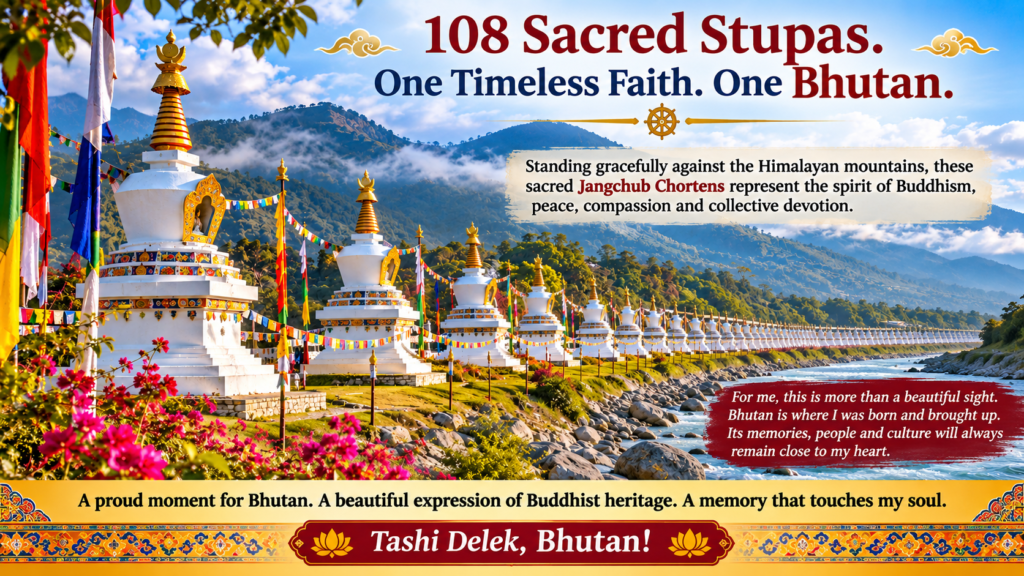

An extraordinary story of Buddhism, collective devotion, national identity and a personal connection with a Himalayan kingdom.
A Personal Note Before I Begin
Kuzu zangpo la Butan ,I know I am a little late in writing about this remarkable event. When I first came across the news of Bhutan raising 108 sacred stupas in a single day, I wanted to write about it immediately. However, I decided to take some time before putting my thoughts into words. There was a reason.
This subject is very close to my heart. Bhutan is not just another country that I read about in newspapers or on the internet. Although I am an Indian, my father worked in Bhutan, and I was born and brought up there. A significant part of my childhood, memories and personal identity is connected with that beautiful Himalayan kingdom.
Besides, I am a Buddhist myself. Therefore, the number 108 and the spiritual significance of these sacred stupas mean something special to me. I wanted to understand the story properly before writing. I spent time reading different reports, collecting historical facts, exploring the background of Project 108 and trying to understand the deeper meaning of Jangchub Chortens in Buddhist tradition.
I did not want to write merely another article repeating the news of a world record. I wanted to understand what happened, why it happened, what these stupas represent in Buddhism, and what this extraordinary undertaking means for Bhutan and its people. That research took some time, which explains my delay in publishing this article. Perhaps some stories deserve a little patience before they are put into words. This is one of them.
So, here is my attempt to look at Bhutan’s remarkable Project 108 through three perspectives: as someone with a personal connection to Bhutan, as an Indian who values the friendship between the two countries, and as a Buddhist who understands the spiritual significance of these sacred monuments.
1. A Himalayan Kingdom That Continues to Surprise the World
Bhutan is a small landlocked kingdom situated in the eastern Himalayas, between India and China. Its geographical position makes it an important country in South Asian geopolitics, but its identity is shaped by something beyond geography. Buddhism is deeply connected with Bhutanese society, culture, traditions and institutions. Monasteries, prayer flags, chortens, religious festivals and the teachings of Buddhist masters are part of everyday life.
Bhutan has also developed a distinctive philosophy of national development through the concept of Gross National Happiness (GNH). It places importance on psychological wellbeing, cultural preservation, environmental conservation and good governance alongside economic development. This does not mean Bhutan is without economic or social challenges. Like other countries, it faces questions of employment, migration, modernisation and opportunities for its younger generation.
Nevertheless, Bhutan has tried to preserve a relationship between economic progress and its spiritual and cultural foundations. Project 108 is an interesting example of this approach.
2. What Exactly Happened on 1 November 2026?
The event took place in Gelephu Mindfulness City, in southern Bhutan, near the Indian border. The initiative, known as Project 108, involved the simultaneous raising of 108 Jangchub Chortens, or Stupas of Enlightenment. Each stupa stands approximately 15 metres tall, and the structures are positioned 108 metres apart along an approximately 11.7-kilometre stretch beside the Aie (Mau) Chhu River. The scale of the undertaking is remarkable.
Around 40,000 volunteers participated in the construction effort. More than 200,000 people reportedly gathered to witness the event. Volunteers worked at 108 designated sites, with the coordinated raising taking approximately eight hours and 54 minutes. The achievement was recognised by Guinness World Records for the most stupas or chortens consecrated simultaneously at multiple venues.
However, it is important to understand that the entire project was not conceived and prepared overnight. The groundwork, foundations, materials, training and organisation had been undertaken over several months. What happened on that day was the coordinated raising and consecration of all 108 structures. The achievement was therefore both an engineering accomplishment and a remarkable exercise in public participation.
Think about it for a moment. A country brought together thousands of people, organised hundreds of construction teams and coordinated a religious undertaking across nearly 12 kilometres. It was an extraordinary demonstration of collective effort.
3. Why 108? Understanding the Buddhist Significance
For a Buddhist, the number 108 is far more than an ordinary numerical figure. It has a special place in Buddhist traditions, particularly in Tibetan and Vajrayana Buddhism, which has profoundly influenced Bhutanese religious life. The number is associated with several religious practices and teachings.
Consider a few examples.
The 108 beads of a Buddhist mala
A traditional Buddhist prayer mala generally contains 108 beads. Practitioners use these beads while reciting mantras, prayers and meditative practices. The repetition helps develop concentration, discipline and mindfulness.
The 108 volumes of the Kangyur
The Kangyur is the collection of texts recognised in Tibetan Buddhism as the translated words of the Buddha. Its traditional collection is commonly arranged in 108 volumes, although editions and arrangements can differ.
The 108 afflictive emotions
In Buddhist explanations, 108 is also associated with mental afflictions or disturbing emotions that obstruct spiritual development.
These are connected with the human experience of attachment, aversion, ignorance and the different ways in which the mind becomes entangled in suffering. The purpose of Buddhist practice is to understand the nature of these mental conditions and gradually overcome them. The number 108 is therefore associated with spiritual completeness, religious discipline and the path towards liberation.
It is worth mentioning that different Buddhist traditions explain the number in different ways. Its significance should not be reduced to one single interpretation. For Project 108, the number was incorporated into the physical design itself: 108 stupas, each separated by 108 metres. The result is a remarkable meeting of religious symbolism and architectural planning.
4. What Does a Stupa Actually Represent in Buddhism?
To understand Project 108 properly, we must first understand what a stupa means. A stupa, called a chorten in Tibetan Buddhist traditions, is a sacred Buddhist monument. Historically, stupas were associated with the preservation of relics of the Buddha and other enlightened beings. Over time, they developed into important objects of Buddhist devotion and pilgrimage.
But a stupa is much more than a structure containing sacred objects. It represents the enlightened mind of the Buddha and reminds practitioners of the possibility of overcoming ignorance and attaining enlightenment. The Jangchub Chorten is particularly significant because it represents the Buddha’s enlightenment. The word Jangchub is associated with enlightenment, while Chorten refers to a sacred Buddhist monument.
For Buddhists, constructing, offering prayers at, circumambulating and making offerings to a stupa are considered meritorious religious activities. A stupa also reminds us of the central teachings of Buddhism:
- The impermanent nature of existence.
- The importance of compassion towards all living beings.
- The need to overcome ignorance and attachment.
- The pursuit of wisdom and enlightenment.
- The importance of peace and harmony.
The architecture itself has religious meaning. The base, dome, spire and other elements represent different aspects of the Buddhist path towards enlightenment. This is why the construction of 108 stupas carries a significance that cannot be measured simply in terms of height, distance or the number of volunteers.
Each structure represents a religious aspiration. Together, they form a collective offering dedicated to peace, compassion and the wellbeing of all sentient beings.
5. Forty Thousand Volunteers: When Faith Becomes Collective Action
One of the most impressive aspects of Project 108 was the participation of ordinary people. Approximately 40,000 volunteers came together to contribute to the undertaking. Students, farmers, professionals, monks, community members and people from different walks of life participated in the initiative.
Bhutan has a tradition known as Zhabtog, referring to voluntary community service. It is a tradition through which people offer their time and labour for religious, social and community activities. Project 108 gave this tradition an extraordinary scale.
Think about what this means. A farmer, a student, a government employee and a religious practitioner may have very different lives and responsibilities. Yet, for this undertaking, they came together with a common purpose. The event demonstrated that a large national project can become a shared public experience when people feel connected to its purpose.
In modern societies, we often measure national achievement through economic growth, industrial output, infrastructure and technological advancement. Project 108 offers another way to look at achievement: the ability of a community to organise itself around a shared belief and work together towards a common goal. That is perhaps one of the most interesting lessons from this event.
6. The King’s Vision: Beyond a Religious Monument
Project 108 was a royal initiative envisioned by His Majesty King Jigme Khesar Namgyel Wangchuck, the Fifth King of Bhutan. The King announced the project on 21 February 2026, his birthday. It forms part of the wider vision associated with Gelephu Mindfulness City. This is an important point because the 108 stupas should not be viewed as an isolated religious construction project. They are part of a much larger vision for southern Bhutan.
The King has emphasised the need to create economic opportunities, strengthen the country’s future and preserve its identity and values. The idea behind Gelephu Mindfulness City is to develop a new economic centre that brings together modern economic activity, environmental responsibility, technological innovation and Bhutanese cultural and spiritual values.
The project seeks to respond to some of Bhutan’s pressing challenges, including youth unemployment and the migration of skilled Bhutanese citizens. The 108 stupas provide this emerging city with a distinctive spiritual landmark. There is also an important symbolic message here. Bhutan is attempting to imagine a future in which economic development does not require abandoning its cultural and religious identity.
Whether Gelephu Mindfulness City ultimately achieves all its ambitions will depend on its implementation over many years. It is too early to judge its long-term economic success. But Project 108 has already given the initiative an extraordinary public and spiritual beginning.
7. Why 1 November 2026 Was Special
The date chosen for Project 108 was also meaningful. 1 November 2026 marked the 18th anniversary of the coronation of King Jigme Khesar Namgyel Wangchuck. It also coincided with Lhabab Düchen, an important Buddhist holy day.
Lhabab Düchen commemorates the Buddha’s descent from the heavenly realm after teaching his mother, Queen Maya, in the Tushita heaven according to Buddhist tradition. It is regarded as an especially auspicious day for prayers, religious offerings and meritorious activities. The combination of these occasions gave Project 108 an additional spiritual and national significance.
The event was attended by distinguished religious figures and international visitors, including the 17th Karmapa, Ogyen Trinley Dorje, and other prominent Buddhist masters. India was represented by Union Minister Kiren Rijiju, whose participation reflected the shared Buddhist heritage and close cultural relationship between the two countries. This brings us to another interesting dimension of the story.
8. Bhutan and India: Two Countries, Shared Civilisational Connections
Bhutan and India share a long-standing relationship based on geography, diplomacy, trade, security and cultural connections. But there is another important connection: Buddhism. Although Buddhism developed in ancient India, it travelled across the Himalayan region and became deeply rooted in Bhutan.
The religious traditions of Bhutan developed through centuries of interaction with Buddhist teachers, scholars, monasteries and spiritual institutions. Today, Bhutan is one of the countries where Vajrayana Buddhism remains deeply connected with national and community life. For India, this shared heritage is an important part of its cultural relationship with Bhutan.
Project 108 also has a geographical dimension. Gelephu lies close to the Indian state of Assam. The Aie (Mau) Chhu river corridor, where the stupas stand, is part of a landscape that connects the Himalayan foothills with the plains of the Indian subcontinent.
The project therefore carries significance beyond Bhutan’s domestic religious and cultural life. It provides an opportunity for deeper cultural exchange, Buddhist pilgrimage and cooperation between neighbouring communities. The presence of an Indian minister at the ceremony was a visible reminder of this relationship.
From a geopolitical perspective, Gelephu is also interesting because of its location near India’s northeastern region. Its development could have implications for cross-border connectivity, trade, tourism, investment and regional economic cooperation. For India, a prosperous and stable Bhutan is an important neighbour and strategic partner.
At the same time, Bhutan’s relationship with India and its geographical position between India and China require careful diplomatic balancing. It would be premature to interpret Project 108 as a geopolitical statement directed against any country. Its primary character is religious and cultural. Nevertheless, the wider development of Gelephu deserves attention from anyone interested in Himalayan geopolitics.
9. My Personal Connection: Bhutan Will Always Have a Special Place in My Heart
I would like to return to the personal reason behind writing this article. As I mentioned at the beginning, I am Indian, but I was born and brought up in Bhutan. My father worked there, and much of my childhood was connected with that country. I was born in Cherang, Bhutan.
During my childhood, Gelephu was a familiar place for our family. There is another memory that makes this story even more special to me. I still remember how we used to travel to Gelephu with our whole family to watch Nepali movies. It was a family outing that we all looked forward to.
One particular film comes to my mind even today. I believe it was Samjhana (सम्झना), although the passage of time has made some details of that memory a little unclear. What I remember more clearly is the excitement of going to watch a Nepali movie with my whole family. Those were simple moments, but they became precious memories.
And now, years later, Gelephu is making headlines for something extraordinary: 108 sacred Buddhist stupas raised together in a single day. When I think about this transformation, I cannot help but feel emotional. The place that was once part of our ordinary childhood family outings has become the centre of an extraordinary national and spiritual undertaking.
For me, Gelephu is therefore much more than the location of Project 108. It is a place connected with my childhood, my family and some of the happiest memories of growing up in Bhutan. Perhaps this is another reason why I felt compelled to write about this event. Sometimes, history becomes more meaningful when it touches a place that already lives in your memories.
I have a natural emotional attachment to Bhutan. And as a Buddhist, the religious significance of Project 108 makes that connection even stronger. When I see photographs of the 108 white chortens rising along the Aie (Mau) Chhu River, I do not see only a remarkable construction project. I see a country preserving its spiritual heritage. I see ordinary people coming together in the name of faith. I see a reminder of the Buddhist teachings that have influenced generations of people across the Himalayan region. I also see a country trying to move towards the future without forgetting the values that shaped its past. Perhaps this is why the event made such a strong impression on me.
I am proud to see Bhutan receiving international attention for something rooted in its own cultural and spiritual traditions. My connection with Bhutan may have begun through my father’s work and my childhood, but it has remained with me through the years.
Some places become part of our lives in ways that cannot be explained through nationality alone. National borders may define political territories, but they cannot always define the boundaries of our memories, affection and belonging. For me, Bhutan is one of those places.
10. What Can the World Learn from Project 108?
There are several lessons that deserve attention.
First, the importance of collective participation.
A project involving tens of thousands of people requires organisation, discipline, preparation and a shared sense of responsibility. Project 108 demonstrates what can happen when a large community works towards one objective.
Second, cultural identity can remain relevant in a modern economy.
Bhutan is attempting to create new economic opportunities while preserving its Buddhist heritage and environmental values. Whether this model succeeds will be an important story to follow.
Third, religion can create a sense of shared responsibility.
The Buddhist concept of merit extends beyond personal benefit. Compassion, generosity and the wellbeing of other living beings are central to the tradition.
Fourth, national development can have a spiritual dimension.
Economic progress is important, but questions about the quality of life, social harmony, environmental protection and cultural continuity also deserve attention.
The 108 stupas provide a physical expression of these ideas. Of course, a successful ceremony does not automatically guarantee successful economic development. The real test for Gelephu Mindfulness City will be how the vision translates into opportunities and benefits for ordinary Bhutanese people. That is a question that deserves attention in the years ahead.
Conclusion: 108 Stupas, One Day, One Shared Aspiration
On 1 November 2026, Bhutan raised 108 Buddhist stupas in a single day. The event set a Guinness World Records achievement and brought thousands of volunteers together in an extraordinary exercise of collective participation. But records eventually become entries in history books. The deeper meaning of this undertaking lies in what the structures represent.
They represent faith, devotion, compassion, spiritual aspiration and the collective effort of a nation. For Buddhists, the Jangchub Chortens are reminders of the Buddha’s enlightenment and the possibility of liberation from suffering. For Bhutan, they are part of a larger national vision that seeks to connect its spiritual heritage with its future development. And for someone like me, who was born and brought up in Bhutan despite being an Indian, they carry an additional personal meaning. They remind me of a country that remains close to my heart.
Perhaps the most beautiful aspect of this achievement is that 108 individual structures now stand together as one spiritual corridor, each representing a shared aspiration for peace and the wellbeing of all living beings. I began this article by explaining why I took time to write about this event. Perhaps now the reason is clearer. This was never just another news story for me. It was a story about a country connected with my childhood, a place I remember through my family, and a spiritual tradition that continues to guide my life.
As a Buddhist, I would like to end with a simple aspiration:
May these 108 sacred chortens stand as symbols of peace, compassion and wisdom. May the people of Bhutan prosper in harmony, and may the blessings and aspirations associated with this sacred undertaking extend to all sentient beings.
Kadrinchey Bhutan.