

By Suman Moktan | Moktan Sir
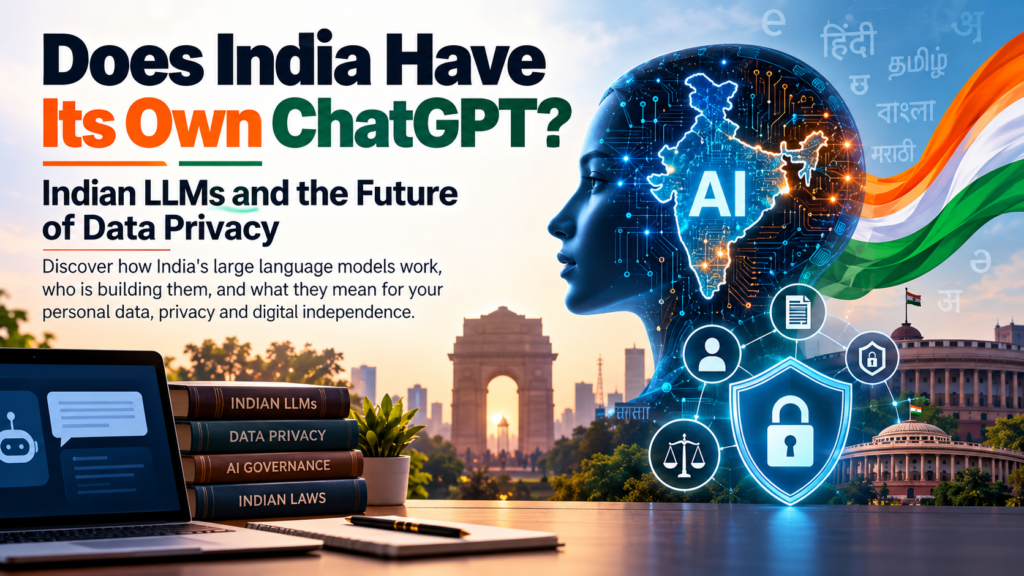
Indian LLMs (Large Language Models) are becoming an important part of India’s artificial intelligence journey. As India develops its own AI models, an important question arises: Can Indian LLMs provide a reliable alternative to ChatGPT while protecting users’ personal data and digital privacy?
India is investing in indigenous AI technologies to support Indian languages, strengthen technological independence and encourage innovation. Initiatives such as the IndiaAI Mission are helping researchers, startups and technology companies develop AI systems suited to India’s needs.
However, building an Indian AI model is only one part of the challenge. Users must also understand how these models work, who develops them, what happens to the personal information they process, and how Indian laws regulate data protection and artificial intelligence.
In this article, we explore Indian LLMs, India’s AI development initiatives, the role of the government, and the legal framework governing data privacy and responsible AI use.
Who Controls the Intelligence Behind Your Screen?
Imagine asking an artificial intelligence assistant to explain a legal provision, prepare a professional email or help you understand a complex document. Within seconds, it provides an answer that might otherwise take hours to prepare. Artificial intelligence is changing how people learn, work, communicate and access information.
But there is another question we should ask. When we share information with an AI assistant, where does that information go? Who processes it? Is it stored? Could it be used to improve an AI model? And what rights do we have if our personal information is mishandled?
These questions have become increasingly important as artificial intelligence expands across India. Students use AI to study, professionals use it to complete tasks, businesses use it to serve customers, and developers use it to build new applications. The technology offers many benefits, but it also raises questions about privacy, security, accountability and public trust.
This brings us to an important question: Does India have its own ChatGPT, and can Indian AI models give us greater control over our data and digital future?
The answer is yes, India is developing its own large language models. The Government of India is supporting this effort through the IndiaAI Mission and has also introduced a national framework for AI governance. At the same time, existing laws and data protection measures have an important role to play.
To understand what these developments mean, we need to examine three connected themes: India’s efforts to build its own LLMs, the protection of personal data, and the government’s role in regulating artificial intelligence.
1. What Is an LLM, and How Does It Work?
A Large Language Model, commonly known as an LLM, is a type of artificial intelligence trained on large amounts of data to understand and generate language. It can answer questions, summarise documents, translate text, explain difficult concepts and assist with computer programming.
ChatGPT, Google’s Gemini and Anthropic’s Claude are familiar AI assistants powered by language models. The assistant is the service people interact with, while the underlying model provides much of its ability to understand instructions and generate responses.
An LLM learns by processing large collections of text and, in some cases, other types of data. During training, it learns statistical patterns and adjusts numerical values known as weights. These weights help the model predict which words or parts of words are likely to come next in a particular context. Further training can help the model follow instructions and produce more useful responses.
For example, a model trained on legal material may learn how legislation is written, how judgments are structured and how legal terms are used. However, this does not guarantee that every legal answer will be correct. An AI model may misunderstand a provision, overlook an important exception or produce an answer that sounds convincing but is factually wrong.
It is also important to understand that a trained model is not simply a digital library containing a searchable copy of every document it has processed. Its weights encode learned patterns, although models can sometimes memorise and reproduce parts of their training data. An AI application can separately connect a model to a database or document collection to retrieve specific information. This distinction matters because learning from data, storing a conversation and retrieving a document are three different processes.
2. Does India Have Its Own ChatGPT?
India is developing AI models designed to address its linguistic, cultural and technological needs. Some projects focus on Indian languages, while others aim to strengthen domestic computing infrastructure and reduce dependence on external AI providers.
One of the most important government initiatives in this area is the IndiaAI Mission. In March 2024, the Union Cabinet approved the mission with a financial outlay of approximately ₹10,372 crore. Its objectives include expanding access to computing resources, supporting AI startups, developing indigenous AI capabilities, improving access to datasets and promoting safe and trusted AI.
In February 2026, the government reported that 12 teams had been shortlisted to develop indigenous foundational models or large language models under the IndiaAI Mission. The selected organisations and consortia included Sarvam AI, BharatGen, Gnani AI, Soket AI, Fractal Analytics and others.
Two initiatives are particularly worth understanding.
Sarvam AI
Sarvam AI is an Indian AI company selected under the IndiaAI Mission to develop a sovereign large language model. Its work focuses on building AI capabilities suited to Indian languages and local requirements. The company aims to make advanced AI more accessible through models and services designed for India’s needs.
BharatGen
BharatGen is a research initiative working on AI models that reflect India’s languages and cultural context. Its work includes multilingual and multimodal AI, with potential applications in areas such as education, agriculture, healthcare and public services.
These initiatives demonstrate that India is building its own AI capabilities. However, it would be inaccurate to assume that every Indian model already performs as well as ChatGPT on every task. Each model must be assessed for accuracy, reasoning, language support, reliability, cost and practical usefulness.
The real question is whether Indian AI models can provide useful services while giving individuals and organisations meaningful choices about how their information is processed.
3. Why Does India Need Its Own AI Models?
Developing Indian AI models is about more than creating another chatbot. It is also about building technical expertise, supporting Indian languages and giving businesses, public institutions and individuals more choices.
Supporting Indian languages
India’s linguistic diversity creates both a challenge and an opportunity for AI development. A person who is comfortable speaking Bengali, Hindi, Tamil or Marathi may find it easier to use an AI assistant in their preferred language than to communicate in English.
Indian language models can support translation, speech recognition, document understanding and conversational services. For example, an AI assistant could explain an educational topic in Bengali or help a citizen understand a government form in a familiar language.
The quality of these services depends on how well each model handles the language, its regional variations and the subject being discussed. Developing a model in India does not automatically make it more accurate in every Indian language.
Greater control over technology
AI services require computing power, servers, software, skilled researchers and secure infrastructure. When Indian organisations develop and operate more of these systems domestically, they may gain greater control over their technology and reduce dependence on external providers for certain services.
This is connected to the idea of sovereign AI. Broadly, it refers to a country’s ability to develop, operate and govern important parts of its AI ecosystem according to its own priorities.
However, an Indian-developed model does not automatically mean that every component, dataset, processor or cloud service is Indian-owned. Genuine technological independence depends on the extent to which the underlying systems can be controlled, maintained and secured.
Education, law and public services
Indian AI models could support education, legal learning, agriculture, healthcare administration and public services. Consider a law student who wants to understand Article 21 of the Constitution. An AI assistant could explain the provision in simple language, summarise relevant judgments and prepare revision notes. A similar tool could help citizens understand government procedures or access information in their preferred language.
These applications could improve access to information, provided their answers are accurate and their limitations are clearly explained. In law and healthcare, important information must be checked against authoritative sources and qualified professional advice where necessary. The real value of AI will depend on whether people can use it safely and effectively to solve practical problems.
4. What Happens to Your Personal Data When You Use AI?
This is where the discussion becomes particularly important. When you enter a question into an AI assistant, the service processes that information to generate a response. Depending on the provider and the product, the conversation may also be stored, reviewed for safety or used to improve the service.
Suppose you ask an AI assistant to draft a legal complaint and include your full name, home address, telephone number and details of a dispute. The system may use those details to prepare the draft. But what happens to that information afterwards depends on the service’s privacy policy, account settings and data-handling arrangements.
There are four separate questions to consider.
First, is the conversation stored? A service may retain chats in the user’s account or keep certain records for operational, security or legal reasons.
Second, is the conversation used to improve the model? This depends on the provider, product, applicable policies and settings. Sharing a message does not mean that the model immediately learns it permanently.
Third, does the AI remember the information? Some services offer memory features that save selected details for future conversations. This is different from ordinary chat history and from the model’s training weights.
Fourth, where is the information processed and stored? A service may use cloud infrastructure located in another country. The nationality of the company or the model does not, by itself, establish where all information is processed.
These distinctions explain why the statement that an AI service “uses your data” can have several meanings. Sending a message to an AI model does not necessarily mean the model is retrained on that message. Similarly, using an Indian model does not automatically guarantee that personal information remains in India.
5. Can an Indian LLM Protect Your Data Better?
An Indian LLM may offer greater control over data handling when it is deployed through infrastructure and policies that meet the user’s privacy requirements. For example, an organisation might choose a model hosted in an Indian data centre or deploy an open-weight model on servers it controls.
But the location of the model is only one part of the answer. Imagine two services. The first uses an Indian-developed model but sends conversations to an overseas cloud provider. The second uses a model developed abroad but operates it on infrastructure controlled by an Indian organisation. Their data-handling arrangements could be very different.
To assess privacy properly, users and organisations should ask:
- Where are prompts, uploaded files, logs and backups stored?
- Which organisations can access the information?
- Is user content used to train or improve the model?
- How long is information retained, and how can it be deleted?
- Is information shared with other service providers?
- What security measures and contractual protections apply?
The answers should come from the provider’s actual documentation and agreements, not assumptions based on its nationality.
A locally hosted model can reduce the need to send information to an external AI service. It can also give an organisation more control over access and retention. However, local hosting is not automatically secure. Weak passwords, excessive employee access, insecure servers and poorly managed backups can still expose sensitive information.
Privacy depends on how an AI system is built, deployed and managed, not merely on where its developers are based.
6. The Role of the Indian Government in AI Development
The government has an important role in building India’s AI capabilities, supporting research, improving access to computing resources and helping ensure that AI is used responsibly.
The challenge is to encourage innovation while addressing risks such as misuse of personal data, online fraud, deepfakes, discrimination and misleading information. Excessive restrictions could make it harder for researchers and startups to develop new products. Weak safeguards, on the other hand, could leave citizens exposed to harm.
India’s approach needs to balance technological progress with safety, accountability and the protection of individual rights.
The IndiaAI Mission
The IndiaAI Mission is a major part of the government’s strategy to develop domestic AI capabilities. Its work includes computing infrastructure, support for indigenous foundational models, access to datasets, startup funding, skills development and safe and trusted AI initiatives. These efforts can help Indian researchers and startups develop models suited to local needs. They may also improve access to computing resources that would otherwise be too expensive for smaller organisations.
However, government support for AI development should not be confused with legal regulation. Funding a model or providing computing infrastructure does not automatically guarantee that the resulting product will be accurate, secure or respectful of privacy.
India’s AI Governance Guidelines
On 5 November 2025, the Ministry of Electronics and Information Technology (MeitY) introduced the India AI Governance Guidelines under the IndiaAI Mission. The framework promotes the safe, responsible and inclusive development and use of AI. It addresses principles such as accountability, transparency, safety, inclusion and the management of AI-related risks.
The guidelines recognise that AI can affect decisions in education, employment, financial services, public administration and other areas of daily life. A system that produces incorrect information or treats people unfairly can cause harm even when it was developed with good intentions. The framework seeks to encourage innovation while promoting safeguards and cooperation between government institutions, technical experts, businesses and other stakeholders.
An important legal distinction must be kept in mind: AI governance guidelines are not the same as a comprehensive Act of Parliament. They provide a policy framework. Binding legal obligations must be identified in the applicable legislation, rules, notifications and other legal instruments.
The introduction of these guidelines also means that it would be incorrect to say that India has no AI governance framework. India has established a national policy framework, even though questions about the regulation of particular AI risks may continue to require clarification and further legal development.
7. What Laws Apply to Artificial Intelligence in India?
India does not have one comprehensive, standalone Act that governs every aspect of artificial intelligence. Instead, different laws and regulatory frameworks may apply depending on how an AI system is developed or used.
This does not mean AI operates outside the law. An organisation may have legal responsibilities when its system processes personal data, facilitates unlawful activity, distributes prohibited content or causes harm covered by existing legislation. The scope of each law matters. The following frameworks are particularly relevant.
The Information Technology Act, 2000
The Information Technology Act provides an important part of India’s legal framework for electronic records, digital activity and certain computer-related offences. Its provisions may become relevant when AI is used in connection with unauthorised access, identity-related offences or other unlawful conduct covered by the Act.
For example, if someone uses AI-generated material as part of an online impersonation or fraud scheme, the legal consequences depend on the facts and the applicable provisions. The mere use of AI does not automatically establish a particular offence.
The Information Technology Rules, 2021
The Information Technology (Intermediary Guidelines and Digital Media Ethics Code) Rules, 2021, as amended, establish certain obligations for online intermediaries and other entities covered by the framework.
AI-generated deepfakes and synthetic media can raise difficult questions about impersonation, privacy, misinformation and the circulation of harmful content. Existing IT laws and applicable rules may provide mechanisms for addressing such material, depending on the circumstances and the obligations of the platform concerned.
The legal position must be assessed by examining the relevant provisions and amendments rather than assuming that every AI-generated image or video is unlawful.
The Digital Personal Data Protection Act, 2023
The Digital Personal Data Protection (DPDP) Act, 2023, is particularly relevant to the privacy concerns discussed in this article. It establishes a framework for processing digital personal data and sets out responsibilities for entities covered by the law.
The Government of India notified the Digital Personal Data Protection Rules, 2025, on 14 November 2025. However, the Act and Rules provide for phased commencement. Some provisions took effect upon notification, while others are scheduled to commence after specified periods. Therefore, the notification of the Rules should not be interpreted to mean that every substantive obligation became operative immediately. The applicable commencement provisions must be checked for the relevant date and situation. For an AI service, important questions include what personal data is collected, why it is processed, how it is protected, how long it is retained and whether it is shared with other entities.
The Act’s application depends on the circumstances, including its statutory provisions, commencement and applicable exceptions. It should not be described as a law that automatically guarantees complete privacy for every interaction with AI.
The official MeitY website provides access to the Act and related rules and notifications.
Copyright and intellectual property law
AI systems also raise questions about the use of copyrighted material in training datasets and the ownership or protection of AI-generated outputs. India’s Copyright Act, 1957, and other applicable intellectual property laws may be relevant to particular disputes. It would be inaccurate to assume that all publicly accessible material is automatically free to use for AI training.
The legal position depends on the material involved, the use made of it, permissions, applicable exceptions and other relevant facts. These questions require careful legal analysis rather than a general assumption that all AI training is lawful or unlawful.
Together, these frameworks demonstrate that India’s existing laws already address several issues connected with AI. At the same time, emerging questions about training data, synthetic media, accountability and new forms of harm may require further clarification, updated rules or additional legal measures.
8. Who Should Be Responsible When AI Causes Harm?
A central question in AI regulation is accountability. If an AI system generates a false statement about a person, provides misleading legal information or is used to create a fraudulent video, who should be held responsible?
There is no single answer for every situation. Responsibility may depend on who developed the system, who deployed it, who supplied the information, how the tool was used and whether an applicable legal duty was breached.
For example, a person who deliberately uses AI to impersonate another individual for financial gain may face legal consequences under the provisions applicable to the conduct. A company operating an AI service may have separate obligations under data protection or intermediary rules where those provisions apply.
The government must therefore consider whether existing laws can be enforced effectively, whether regulators have the necessary technical expertise and whether citizens have practical ways to report harm and seek remedies.
Clear rules should protect individuals without treating every error made by an AI system as the same legal offence. A technical mistake, deliberate fraud and unlawful disclosure of personal information may involve different facts and different legal consequences.
Responsible AI requires more than technical safeguards. It requires clear duties, effective enforcement, informed users and a legal system capable of addressing new forms of harm.
9. How Can Ordinary Users Protect Their Personal Data?
People do not need to stop using AI to protect their privacy. They need to understand what information they are sharing and choose services carefully. Before uploading a document, consider whether the AI needs every detail in it. If you want help drafting a legal application, for example, you can replace actual names, addresses and phone numbers with generic descriptions. This allows you to receive assistance without unnecessarily exposing identifying information.
Avoid entering passwords, one-time passwords, banking credentials or confidential investigation records into general-purpose AI tools. If you use AI for work, check your organisation’s rules before uploading internal documents or personal information belonging to clients, colleagues or members of the public.
Review the service’s privacy policy and data controls. Check whether conversations may be used for model improvement, whether temporary or private modes are available, and how deletion requests are handled.
Businesses and developers should consider privacy before an AI application is launched. A responsible system should collect only the information it needs, restrict access, protect stored data and establish clear retention and deletion procedures. Developers should also review the terms of any external model API they use.
These precautions are especially important when building AI applications for legal education, healthcare, finance or public services, where the information shared by users may be sensitive.
10. The Road Ahead: India’s AI Future
India’s AI ambitions raise a wider question about the relationship between technological progress and individual rights. A country may develop powerful models, build data centres and train skilled engineers, but the success of its AI ecosystem will also depend on whether people can use these systems with confidence.
Indian language models could help more people access information. Domestic AI infrastructure could give organisations additional choices about where and how their systems operate. Government investment and policy guidance could support research while helping address safety and privacy risks.
There will also be practical challenges. Developing and maintaining competitive models requires computing resources, skilled researchers, quality datasets and continuous testing. Models must be evaluated for their ability to handle different Indian languages, regional expressions and specialised subjects.
Legal applications, in particular, require careful verification because a small error in a statutory provision or judgment can change the meaning of an answer. The same principle applies to healthcare, public administration and other areas where people may rely on AI-generated information.
India’s objective should therefore be to develop AI that is useful, accessible and trustworthy. National capability matters, but so does the way technology treats the people who use it.
Conclusion: The Future of AI Must Include Privacy and Accountability
India does have its own large language models, and its efforts to develop domestic AI capabilities are opening new possibilities for education, business, public services and Indian-language technology. The IndiaAI Mission is supporting this work, while the India AI Governance Guidelines provide a national policy framework for responsible AI development and deployment.
At the same time, personal data protection remains a separate and essential concern. An Indian-developed model does not automatically guarantee that data stays in India or that every privacy risk has been addressed. Those questions depend on the system’s infrastructure, policies, security arrangements and applicable law.
India’s legal framework includes the Information Technology Act, the applicable IT Rules, the Digital Personal Data Protection Act and other laws relevant to particular uses of AI. Their scope and commencement must be examined carefully. The existence of AI governance guidelines should also be acknowledged without treating them as equivalent to a comprehensive AI statute.
As users, we should understand how AI systems work and share personal information thoughtfully. As developers and organisations, we should build applications with appropriate privacy and security safeguards. As a country, India should continue to develop its AI capabilities while protecting the rights and interests of individuals.
The real question is not simply whether India can build its own ChatGPT. It is whether India can build AI that people can use with confidence, knowing how their information is handled, who is accountable when something goes wrong and what legal protections apply.
Disclaimer: This article is for general educational and informational purposes. It does not constitute legal advice. Laws, rules and commencement notifications may change; readers should consult official sources and qualified professionals when assessing a specific legal issue.