


Suman Moktan
The NDPS Act 1985 (Narcotic Drugs and Psychotropic Substances Act, 1985) is one of India’s most stringent criminal laws. It regulates offences involving narcotic drugs and psychotropic substances and provides a detailed framework covering possession, trafficking, punishment, bail, confiscation and, in appropriate cases, forfeiture of illegally acquired property.
An NDPS Act 1985 case can begin with the recovery of a small quantity of a prohibited substance, but its legal consequences can extend much further. Depending on the substance and its quantity, an accused may face imprisonment, a substantial fine, stringent bail conditions and, in appropriate cases, proceedings concerning property believed to have been illegally acquired through illicit drug activity.
For anyone dealing with an NDPS case, one question becomes particularly important at the beginning: what is the quantity of the substance involved? The answer can significantly affect the legal consequences of the case.
The NDPS Act classifies substances according to small quantity and commercial quantity, while the quantity falling between these two thresholds is commonly described as intermediate quantity. These classifications can influence the applicable punishment and, in commercial-quantity cases, the stringent bail requirements under Section 37.
The law also goes beyond punishment for the drug offence itself. In appropriate cases, the NDPS Act provides mechanisms concerning confiscation, seizure or freezing of property and forfeiture of illegally acquired property. This makes the financial dimension of an NDPS investigation an important part of understanding the law.
Why quantity matters under the NDPS Act
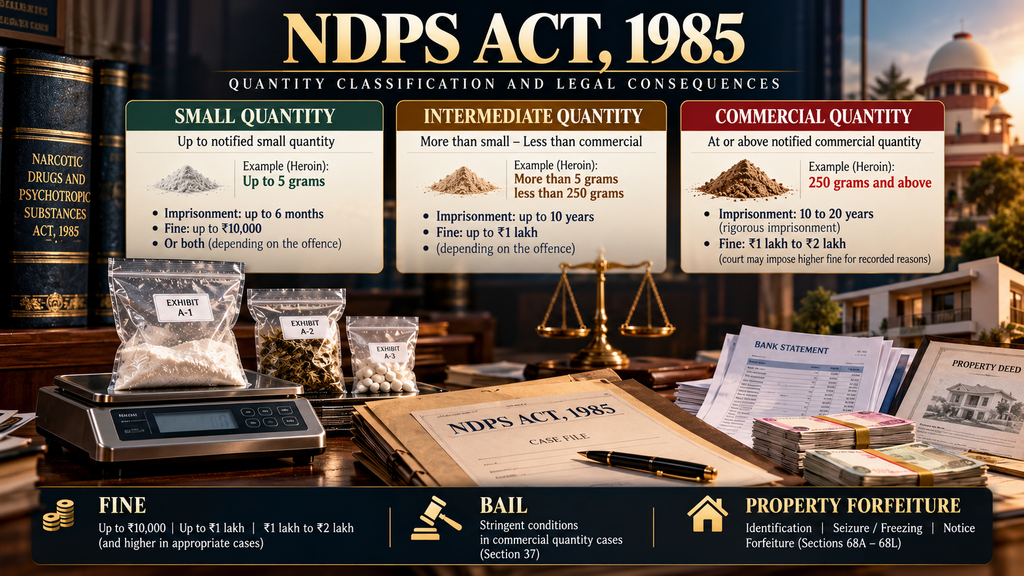
The NDPS Act follows a graded system of punishment for several offences involving narcotic drugs and psychotropic substances. The law distinguishes between small quantity, more than small but less than commercial quantity, and commercial quantity.
Sections 2(viia) and 2(xxiiia) connect the definitions of commercial quantity and small quantity to quantities notified by the Central Government. The quantity between these two limits is commonly described as an intermediate quantity.
This means that there is no single weight that can be called “small quantity” or “commercial quantity” for every drug. Each substance has its own notified threshold.
For example, the notified limits for some commonly encountered substances include 5 grams and 250 grams for heroin, 1 kilogram and 20 kilograms for ganja, 100 grams and 1 kilogram for charas/hashish, 25 grams and 2.5 kilograms for opium, and 2 grams and 50 grams for methamphetamine, respectively, for small and commercial quantities.
The exact notification applicable to the substance should always be checked when dealing with an actual case because the Central Government has amended the notified list from time to time.
Small quantity: the lower statutory threshold
A small quantity is the quantity notified by the Central Government for a particular narcotic drug or psychotropic substance. Take heroin as an example. The notified small quantity is 5 grams. If the quantity involved is within that threshold, the offence falls within the small-quantity category for the relevant provision.
For several major quantity-based offences, the Department of Revenue explains that the punishment for small quantities is imprisonment that may extend to six months, or a fine up to ₹10,000, or both. The exact punishment, however, depends on the particular offence and section invoked.
It is important to understand that “small quantity” does not mean that possession or other prohibited conduct becomes lawful. It simply places the case within a different statutory punishment category.
Intermediate quantity: between the two thresholds
The expression intermediate quantity is commonly used for a quantity that is greater than the notified small quantity but less than the notified commercial quantity. Consider heroin once again. The small quantity is 5 grams, and the commercial quantity is 250 grams. Therefore, a recovery of 4 grams is below the small-quantity threshold, while a recovery of 50 grams falls between the two notified limits. A recovery of 250 grams reaches the commercial-quantity threshold.
For several offences under the NDPS Act, a quantity greater than a small quantity but less than a commercial quantity can attract imprisonment of up to 10 years and a fine of up to ₹1 lakh. The distinction is therefore not merely descriptive. It has a direct effect on the potential punishment.
Commercial quantity: where the consequences become much more serious
Commercial quantity represents the higher threshold notified for the particular substance. For several important offences, commercial quantity attracts rigorous imprisonment of not less than 10 years, which may extend to 20 years, together with a fine of not less than ₹1 lakh, which may extend to ₹2 lakh.
The commercial-quantity classification can also become particularly important at the stage of bail because Section 37 of the NDPS Act imposes stringent conditions for bail in specified cases, including offences involving commercial quantity.
The Department of Revenue itself describes the NDPS Act as following a graded punishment system in which commercial quantity carries a minimum sentence of ten years’ rigorous imprisonment for the relevant offences. Thus, the difference between 249 grams and 250 grams of a particular substance can have significant legal consequences, provided the substance and quantity are properly established according to law.
The Financial Consequences of an NDPS Case
The consequences of an NDPS case are not limited to imprisonment. The fine prescribed under the Act also changes according to the nature of the offence and, for several offences, according to the quantity involved.
For the relevant quantity-based offences, a small-quantity case may carry a fine of up to ₹10,000. Where the quantity is more than small but less than commercial, the fine may extend to ₹1 lakh. For commercial quantity, the fine is generally ₹1 lakh to ₹2 lakh, along with the prescribed imprisonment. But this is only one part of the financial consequences.
The NDPS Act also contains provisions dealing with the confiscation of drugs, articles, conveyances and sale proceeds, as well as a separate legal framework for the forfeiture of illegally acquired property. This distinction is important because a criminal fine and property forfeiture are legally different concepts.
When the Investigation Reaches the Property
An NDPS investigation can sometimes move beyond the drugs themselves. Chapter VA of the NDPS Act is specifically titled “Forfeiture of Illegally Acquired Property.” It contains Sections 68A to 68L dealing with matters such as identification, seizure or freezing, notice, forfeiture, management of property and the burden of proof.
The basic idea is that the law provides a mechanism to deal with property that falls within the statutory definition of illegally acquired property. This can bring a financial investigation into the picture.
If an investigation into illicit drug trafficking reveals substantial assets, authorities may examine how those assets were acquired and whether they fall within the provisions of Chapter VA.
The questions may therefore move beyond:
Where did the drugs come from? They may also include:
Where did the money come from?
How were the proceeds transferred?
What assets were purchased?
Were bank accounts or businesses used to hold or move the proceeds?
Are particular properties connected with the alleged illicit activity?
These questions become particularly relevant in serious trafficking and financing cases.
Identification of Illegally Acquired Property
Section 68E provides for the identification of illegally acquired property. The statutory scheme allows the competent authorities to investigate and trace property falling within the Chapter VA framework. This may require examination of financial records, property documents, accounts and other material relevant to the source and acquisition of the assets.
The financial investigation is therefore not necessarily limited to cash found during a search. Property, bank accounts and other assets may become relevant where the statutory conditions are satisfied.
Seizure or Freezing of Property
Section 68F deals with the seizure or freezing of illegally acquired property. Where the statutory requirements are met and the authority has reason to believe that property may be dealt with in a manner that could frustrate the forfeiture proceedings, the law provides a mechanism for seizure or freezing. This is an important distinction from ordinary criminal punishment.
The purpose at this stage is to preserve the property while the statutory process concerning its status is undertaken. The NDPS Act also provides procedural safeguards concerning confirmation and continuation of such orders. The relevant provisions should therefore be followed carefully in every case.
Property Forfeiture Is Not Automatic
One common misunderstanding is that the property of every person arrested in an NDPS case can automatically be taken by the authorities. That is not how Chapter VA is structured. The Act provides a separate statutory process.
Under Section 68H, where the competent authority has reason to believe, after considering the relevant material, that property is illegally acquired, it may issue a notice of forfeiture.
The person affected is given a period specified in the notice, ordinarily 30 days, to explain the source of income, earnings or assets through which the property was acquired and to produce supporting evidence. This gives the affected person an opportunity to explain the legitimate source of the property.
The competent authority must then consider the explanation and the available material and provide a reasonable opportunity to be heard before determining whether the property is illegally acquired. If the statutory requirements are satisfied, an order of forfeiture may follow under Section 68-I.
Property Held in Another Person’s Name
Another important aspect is that the inquiry cannot always be answered simply by looking at whose name appears on a property document. Chapter VA contains provisions dealing with property held by or through another person and provides a statutory framework for cases involving relatives, associates and other persons covered by the Act.
Therefore, in an appropriate case, investigators may need to examine the actual source of funds, financial transactions, ownership arrangements and circumstances surrounding the acquisition of property.
At the same time, the statutory protections and exceptions must be respected. The mere fact that a property is connected to a person accused in an NDPS case does not automatically establish that the property is illegally acquired. The evidence and the statutory requirements remain important.
Confiscation Is Different From Forfeiture
The words confiscation and forfeiture are sometimes used interchangeably in ordinary conversation, but they refer to different statutory mechanisms under the NDPS Act. Sections 60 to 63 deal with the confiscation of certain illicit drugs, substances, plants, articles, conveyances, goods used for concealment and sale proceeds. Chapter VA, on the other hand, deals specifically with the forfeiture of illegally acquired property.
For example, a vehicle allegedly used for transporting narcotic drugs raises questions concerning confiscation under the relevant provisions. A property allegedly acquired from illicit trafficking proceeds may raise a different question under Chapter VA. The legal provision applicable to the particular property and circumstances must therefore be carefully identified.
A Practical Example
Consider a hypothetical case involving the recovery of 300 grams of heroin. The notified commercial quantity for heroin is 250 grams. Therefore, if the substance and quantity are properly established, the alleged offence falls within the commercial-quantity category for the relevant quantity-based provision.
The accused may consequently face the enhanced punishment applicable to commercial quantity and the stringent bail requirements under Section 37, depending on the precise offence alleged. Now suppose the investigation also reveals several properties, bank transactions and other assets that appear inconsistent with the person’s known legitimate sources of income. The investigation may then have a financial dimension.
The authorities may examine whether the assets fall within the statutory framework concerning illegally acquired property. Where the requirements of Chapter VA are satisfied, the law provides mechanisms for identifying the property, freezing or seizing it, issuing a notice and ultimately determining whether it should be forfeited. This is why serious NDPS investigations can extend beyond the physical recovery of narcotic drugs.
The Importance of a Proper Investigation
An NDPS investigation must begin with the substance itself. The investigating officer must establish what was seized, from whom, in what circumstances and in what quantity. The applicable notification must be correctly identified. Sampling, sealing, forwarding, chemical examination and the chain of custody must be properly documented. When the investigation also involves financial assets, the same discipline is required.
Property records, bank transactions, income documents, business records and other financial material must be examined carefully. A conclusion about illegally acquired property should be based on evidence and the statutory framework rather than on suspicion alone. This is particularly important because property proceedings can have consequences that continue beyond the immediate criminal investigation.
Quantity Is Important, But It Is Not the Whole Case
It is tempting to look at an NDPS case simply through the number of grams recovered. The law requires a broader approach. The substance must be identified. The quantity must be established. The prosecution must prove the relevant ingredients of the offence. Issues relating to search and seizure, possession, sampling, chemical analysis, chain of custody and statutory safeguards may become important. In commercial-quantity cases, the bail restrictions under Section 37 may become a major issue.
And where the facts justify a financial investigation, the case may also involve confiscation, seizure or freezing of assets and proceedings for forfeiture of illegally acquired property. The result is that an NDPS investigation can have criminal, financial and property consequences at the same time.
Conclusion
The NDPS Act, 1985 creates a carefully structured system in which the quantity of the drug can influence the punishment and, in appropriate cases, the bail position. Small quantity, intermediate quantity and commercial quantity are therefore not merely classifications written in a seizure memo. They can determine the statutory consequences that follow from the alleged offence. But the legal consequences of serious NDPS offences may go further.
The Act contains provisions dealing with fines, confiscation, seizure or freezing of property and forfeiture of illegally acquired assets. Chapter VA provides a separate statutory mechanism through which property believed to be illegally acquired can be identified, examined, and, where the legal requirements are satisfied, forfeited to the Central Government.
For a law-enforcement officer, lawyer or law student, the important lesson is simple:
An NDPS case is not always only about the drug that was seized. In appropriate cases, it can also be about the money, assets and property connected with the alleged illicit activity.
That is why a proper NDPS investigation must look at the substance, quantity, offence, evidence, financial trail and property consequences, while ensuring that every statutory safeguard and procedural requirement is followed.
Legal Disclaimer
This article is intended for educational purposes. The application of the NDPS Act depends on the particular substance, quantity, offence, evidence and circumstances of each case. Quantity thresholds and statutory provisions should be verified against the latest applicable Central Government notifications and the current text of the Act before being relied upon in an actual investigation or legal proceeding. This article does not constitute legal advice.