

By Suman Moktan | Moktan Sir
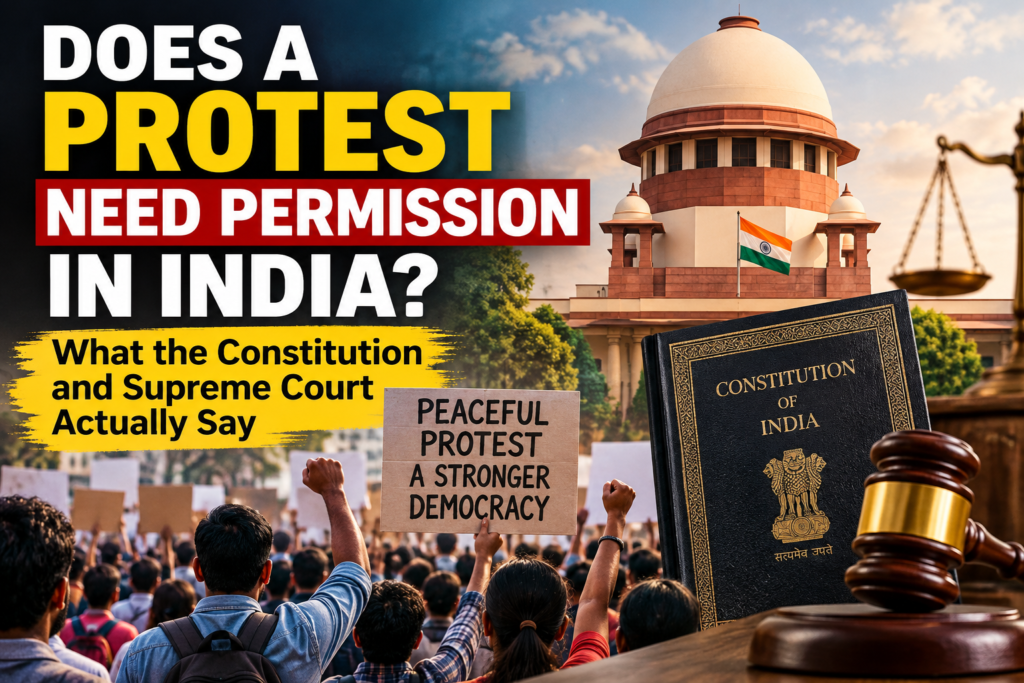
Recently, while scrolling through Facebook, I came across a statement that caught my attention. A person participating in a protest, who identified himself as a lawyer, was claiming that no permission is required to hold a protest in India.
I paused for a moment and thought about that statement. As someone who has spent years observing public administration, law enforcement and the practical challenges of maintaining public order, I believe that such a claim deserves a closer look. It raises an important question about the relationship between constitutional rights and the legal responsibilities that come with exercising them.
I do not question the right of a lawyer, a political activist or an ordinary citizen to express an opinion. Nor do I question the importance of peaceful protest in a democracy. In fact, the right to disagree with the government is one of the features that separates a democracy from an authoritarian system. My concern is different. When a legal proposition is presented to the public as an absolute fact, should we not examine what the Constitution and the courts actually say?
The statement that no permission is needed for a protest may sound simple and convincing. The law, however, requires a more careful answer.
The Constitution Protects the Right to Protest
The starting point of this discussion is Article 19 of the Constitution of India. Article 19(1)(a) guarantees citizens the freedom of speech and expression. Article 19(1)(b) guarantees citizens the right to assemble peacefully and without arms. These provisions protect the ability of people to organise demonstrations, express disagreement with public policies, demand justice and question those in power.
This protection is essential. Governments must be open to criticism, and citizens must be able to express their concerns without fear of arbitrary punishment. A peaceful protest against a government decision cannot be treated as unlawful merely because the government finds the criticism uncomfortable.
But there is another part of the Constitution that deserves equal attention. Article 19(3) allows reasonable restrictions on the right to assemble peacefully in the interests of the sovereignty and integrity of India and public order.
In other words, the Constitution itself recognises that the right to protest exists within a legal framework. It protects peaceful assembly while allowing lawful and reasonable regulation in appropriate circumstances. That is why I find it difficult to accept a sweeping statement that permission is never required for a protest in India.
Is Prior Permission Always Necessary?
The opposite claim would also be incorrect. The Constitution does not say that every peaceful gathering must obtain police permission. There is no universal rule under which every protest, regardless of its nature or location, automatically requires prior permission. The actual position depends on the applicable law, local regulations, the nature of the gathering, the place where it is proposed and any valid restrictions in force.
A small peaceful gathering in a permitted area may raise different legal questions from a large procession through busy roads, a demonstration outside a sensitive installation or a public meeting in a place governed by specific regulations. Certain public meetings and processions may be subject to permission requirements under applicable laws or local rules. A valid prohibitory order may also restrict gatherings in a particular area.
Therefore, the proper legal question is not whether every protest requires permission or whether no protest ever requires permission. It is whether the law applicable to that particular protest requires permission and whether any restriction imposed by the authorities is legally valid. This distinction may appear technical, but it matters. Legal accuracy should not be sacrificed for the sake of a powerful social media statement.
What Has the Supreme Court Said?
When discussing constitutional rights, I believe we should look beyond social media claims and examine judicial decisions. In Himat Lal K. Shah v. Commissioner of Police (1973), the Supreme Court considered the regulation of public meetings on streets. The Court recognised that public meetings may be regulated, but the power to regulate cannot become an arbitrary power to deny the right to assemble.
The judgment supports an important principle: the government cannot use administrative control as an excuse to silence peaceful dissent. At the same time, the right to assemble does not eliminate the State’s legitimate authority to regulate the use of public streets.
A similar balance can be seen in In Re: Ramlila Maidan Incident (2012), in which the Supreme Court examined police action against people participating in a gathering at Ramlila Maidan in Delhi. The judgment discussed the importance of peaceful assembly and the constitutional limits on the exercise of State power.
Then there is Amit Sahni v. Commissioner of Police (2020), the case associated with the Shaheen Bagh protest. The Supreme Court made clear that public roads and public spaces cannot be occupied indefinitely in a manner that prevents others from using them.
These decisions do not establish that police permission is always mandatory. Neither do they establish that permission can never be required. They demonstrate that the right to protest and the regulation of public gatherings must be understood together. For me, that is the central point of this debate.
The Practical Side of Public Order
There is also a practical dimension to this issue that is sometimes missing from online discussions. A protest takes place in a real public space. It may involve a handful of people or thousands of participants. It may be held in a designated area or move through busy roads. Police may have to manage traffic, protect the demonstrators, prevent clashes between opposing groups and ensure that emergency services can continue to operate.
These responsibilities do not automatically justify every restriction imposed by the authorities. Police powers must have a legal basis, and restrictions on fundamental rights must satisfy constitutional requirements. However, it is equally unrealistic to suggest that the management of a large public gathering has no legal or administrative requirements.
For instance, where applicable rules require permission for a procession, organisers cannot simply disregard those rules by invoking Article 19. On the other hand, if an authority refuses permission arbitrarily or merely because the proposed demonstration criticises the government, that decision may be open to legal challenge. Both propositions can be true at the same time. Constitutional rights must be respected, and lawful public-order requirements must also be followed.
What About Section 163 of the BNSS?
Another relevant provision is Section 163 of the Bharatiya Nagarik Suraksha Sanhita, 2023. This provision empowers an Executive Magistrate or another Magistrate authorised by law to issue orders in urgent cases of nuisance or apprehended danger, subject to the statutory conditions. Such orders may restrict particular activities or gatherings where the legal requirements are satisfied.
It is important not to misunderstand this power. Section 163 does not give the authorities an unlimited right to prohibit every protest. Any order must be supported by the law and remain subject to constitutional scrutiny. At the same time, where a valid order applies to a particular gathering, organisers cannot assume that their constitutional right to protest automatically allows them to ignore it. The existence, scope and validity of an order must be examined in each case.
A Lawyer’s Opinion Should Encourage Legal Clarity
What struck me about the Facebook statement was not the fact that a lawyer was participating in a protest. Lawyers, like other citizens, have the right to participate in public life and express their political opinions. My concern is with presenting a broad legal claim without explaining its qualifications. A lawyer’s professional knowledge can help citizens understand their rights. But a legal statement should make clear where the law is settled, where its application depends on circumstances and what limitations apply.
Saying that peaceful protest is a constitutional right is correct. Saying that no protest in India ever requires permission is an overgeneralisation. There is a difference between explaining a constitutional right and suggesting that the exercise of that right is free from every legal restriction.
I would make the same argument regardless of whether the lawyer supported the government or opposed it. The constitutional position should not change according to political preference.
My Conclusion: Rights and Responsibilities Must Go Together
After watching that Facebook statement, I felt that the issue deserved a more careful explanation. Social media allows legal claims to reach thousands of people within minutes. That makes accuracy especially important when the subject concerns fundamental rights, police powers and the rule of law.
The recent CJP protest also brings this discussion into focus. Whatever our political views or opinions about the demands raised by protesters, the legal principles governing peaceful assembly must be applied fairly and consistently. The right to protest does not depend on whether we agree with the cause or support the people participating in it.
My position is straightforward. I firmly believe that peaceful protest must be protected in India. Citizens should be able to question government policies, demand accountability and express dissent without facing arbitrary restrictions.
But the right to protest does not mean that every gathering can be held anywhere, at any time and without regard to applicable law. Whether prior permission is required depends on the relevant legal provisions, local rules, location, nature of the event and any valid order in force.
Equally, the police cannot use the requirement of permission as an arbitrary tool to suppress peaceful criticism. Their decisions must remain within the limits of the Constitution and the law.
A mature democracy requires both principles to be respected. Citizens must be able to exercise their fundamental rights, and public authorities must exercise their powers lawfully. The same standards must apply to every protest, regardless of its political affiliation, its organisers or the cause it represents. The next time we encounter a strong legal claim on Facebook, we should ask a simple question: What does the law actually say?
In a constitutional democracy, our rights deserve to be defended with facts, sound legal reasoning and an accurate understanding of the Constitution.
The right to peaceful protest is constitutionally protected. Whether a particular protest requires prior permission is a separate legal question. Confusing the two does not strengthen democracy; understanding the difference does.
Disclaimer: This article expresses the author’s observations and is intended for general educational purposes. The legal requirements for a particular protest depend on the applicable laws, local regulations, valid orders and specific circumstances. The article does not provide legal advice for any particular event.