
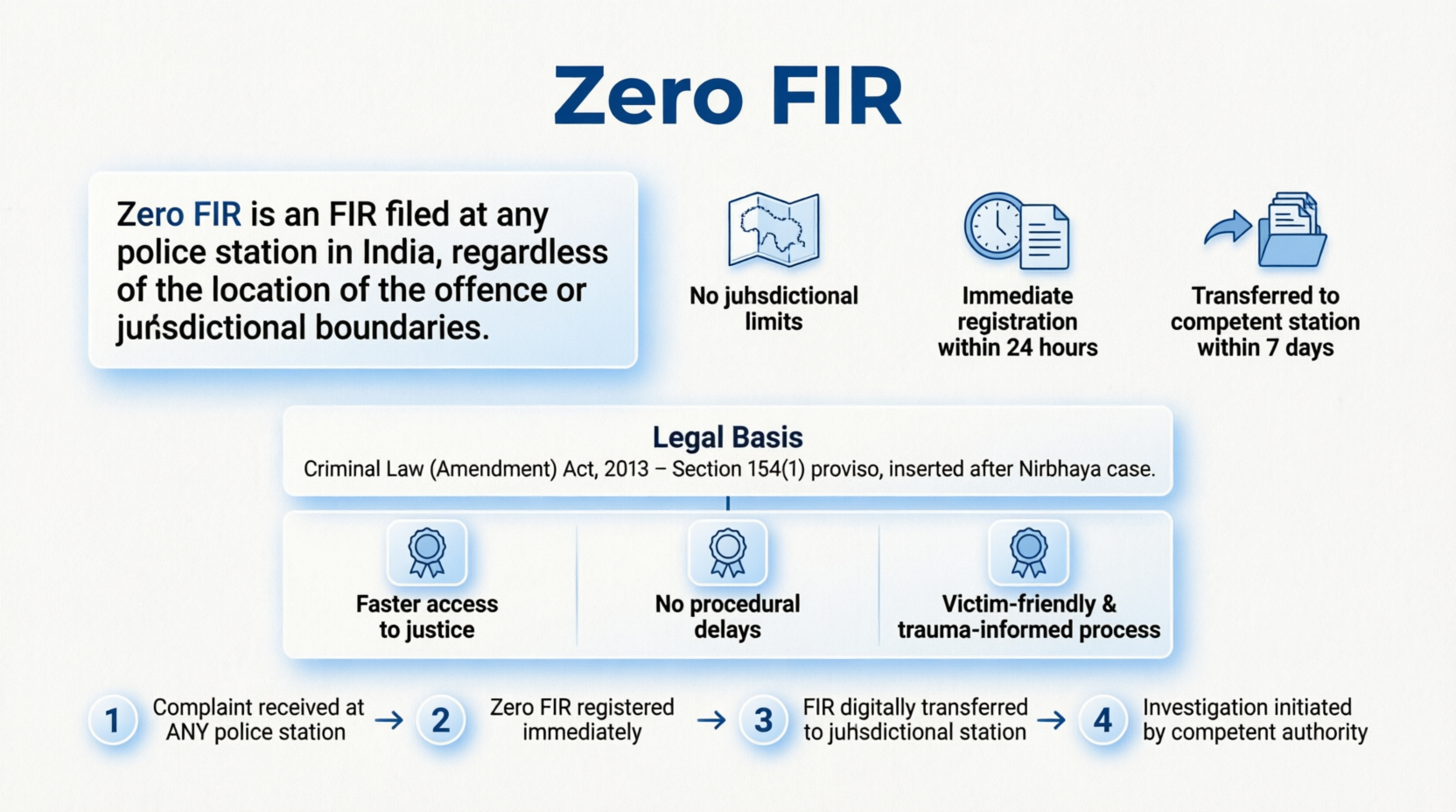

For decades, many victims of crime in India faced a secondary trauma at the police station: the “jurisdictional shuffle.” You would attempt to report a serious crime, only to be told by an officer that because the incident occurred a few kilometers away—outside that specific station’s territorial boundary—they could not help. This bureaucratic excuse often led to critical delays in evidence collection and the loss of the “golden hour” for justice.
The transition from the Criminal Procedure Code (CrPC) of 1973 to the new Bharatiya Nagarik Suraksha Sanhita (BNSS) marks a seismic shift in this landscape. By codifying the concept of the “Zero FIR,” the new legal framework finally dismantles these territorial barriers, prioritizing the immediate protection of citizens over precinct maps.
1. Beyond Boundaries: Understanding the “Zero” in Zero FIR
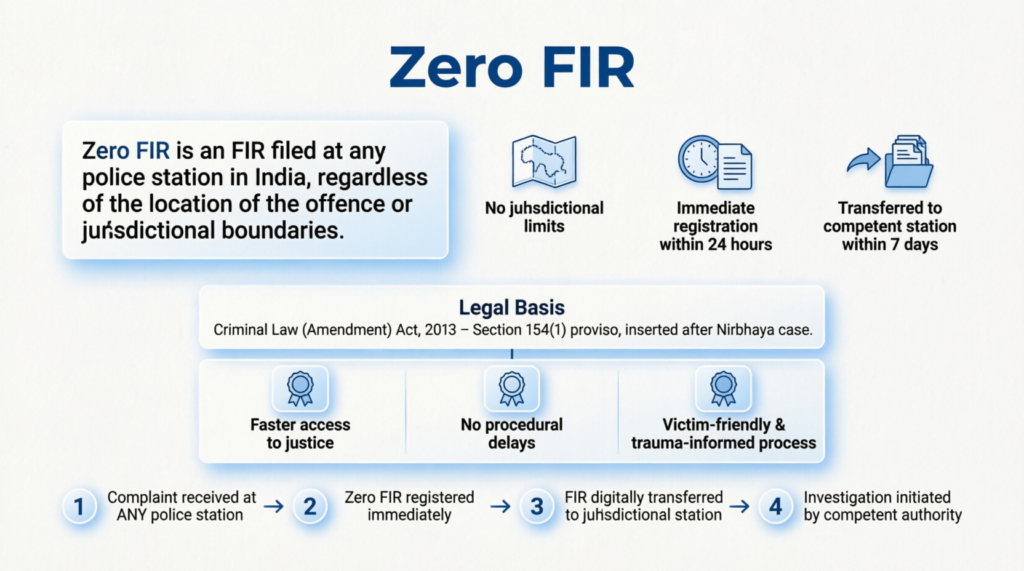
The core of this reform is the formalization of the Zero FIR. But why is it called “Zero”? Under the BNSS, if you report a cognizable offense (a serious crime where police can arrest without a warrant) at a station that lacks territorial jurisdiction, the police must register it immediately. Because they do not have a serial number for that jurisdiction in their local ledger, they register it under the serial number ‘0’.
This ensures that the state’s duty to record a crime begins the moment a victim speaks up. It is only after this initial registration and immediate action that the FIR is transferred to the jurisdictional station, which then assigns a permanent case number. For non-cognizable offenses, a simple complaint or NCR is filed, but for serious crimes, the “Zero” ensures no time is wasted.
The registration of an FIR is mandatory where information discloses the commission of a cognizable offense, as established by the Supreme Court in the Lalita Kumari v. Government of UP case. Police cannot prevent the registration of an FIR based on jurisdiction.”
2. The Power of the New Number: Farewell Section 154, Hello Section 173
For the average citizen, legal section numbers often feel like a foreign language. However, as a public rights educator, I cannot stress this enough: knowing the specific section is your shield. The BNSS has renumbered the foundation of criminal reporting.
- Old Provision: Section 154 of the CrPC (1973)
- New Provision: Section 173 of the BNSS
When you walk into a police station today, you are no longer citing Section 154. You are invoking Section 173 of the BNSS. This section is the “New 154” and the centerpiece of citizen empowerment, explicitly providing the legal basis for registering an FIR regardless of where the crime occurred.
3. From Advisory to Law: The Justice Verma Legacy
While the BNSS is a modern enactment—receiving assent from President Droupadi Murmu on December 25th—the struggle for the Zero FIR is a decade old. It is rooted in the recommendations of the Justice Verma Committee following the 2012 Nirbhaya case.
For years, the concept existed in a legal limbo of “advisories” and “recommendations.” In 2015, the Ministry of Home Affairs issued an advisory suggesting that Zero FIRs be mandatory, particularly for offenses against women. This was supported by judicial precedents like Satvinder Kaur v. State, which specifically established the right of a woman to lodge a complaint from any place, regardless of the scene of the crime.
The BNSS finally moves this from a discretionary advisory to a statutory mandate. What was once a “suggested practice” that police could ignore is now a written, binding law of the land.
4. Decoding the Digital Shift: E-FIRs and Inquiries
The BNSS modernizes how we report crimes, moving beyond the traditional paper trail. Two significant shifts under Section 173 include:
- The E-FIR: Citizens can now file FIRs electronically, making the process more accessible and reducing the initial friction of entering a police station.
- Preliminary Inquiries: In certain specified cases, the law now allows for a preliminary inquiry before the official registration to verify the validity of the claims.
While digitization is a win for efficiency, the public must remain vigilant. Preliminary inquiries are designed for modernization, but they must never be used as a loophole to bypass the mandatory registration mandate established in the Lalita Kumari case.
5. The “No-Refusal” Policy: Holding Constables Accountable
The BNSS places a strict, non-negotiable obligation on law enforcement. The process is now a streamlined chain of accountability: the receiving station records the information (orally or in writing), registers the Zero FIR, and then must transfer all relevant documents to the concerned station.
This creates a “no-refusal” environment. Based on the logic found in State of AP v. Punati Ramulu, the law makes it clear that even the constable at the front desk or the duty officer has no legal ground to turn you away. If a cognizable offense is disclosed, they are legally bound to act.
“Regardless of territorial jurisdiction, if a cognizable offense has been committed, a Zero FIR must be lodged. The police—including constables—are not permitted to prevent this registration based on location, and must transfer the record to the concerned station for a formal case number.”
Conclusion: A New Era of Legal Accessibility
The implementation of the BNSS represents a major step toward a more citizen-centric justice system. By making the Zero FIR an explicit part of the law under Section 173, we are moving toward a “borderless” model of reporting. You are no longer at the mercy of a police officer’s discretion regarding a map; you are protected by a statutory mandate.
This shift raises a vital question for our future: If every police station is now a mandatory gateway to the entire legal system, will this finally force local officers to treat every citizen with the urgency and dignity the law demands? The “jurisdictional nightmare” is legally over; now, it is up to an informed public to ensure it stays that way.