
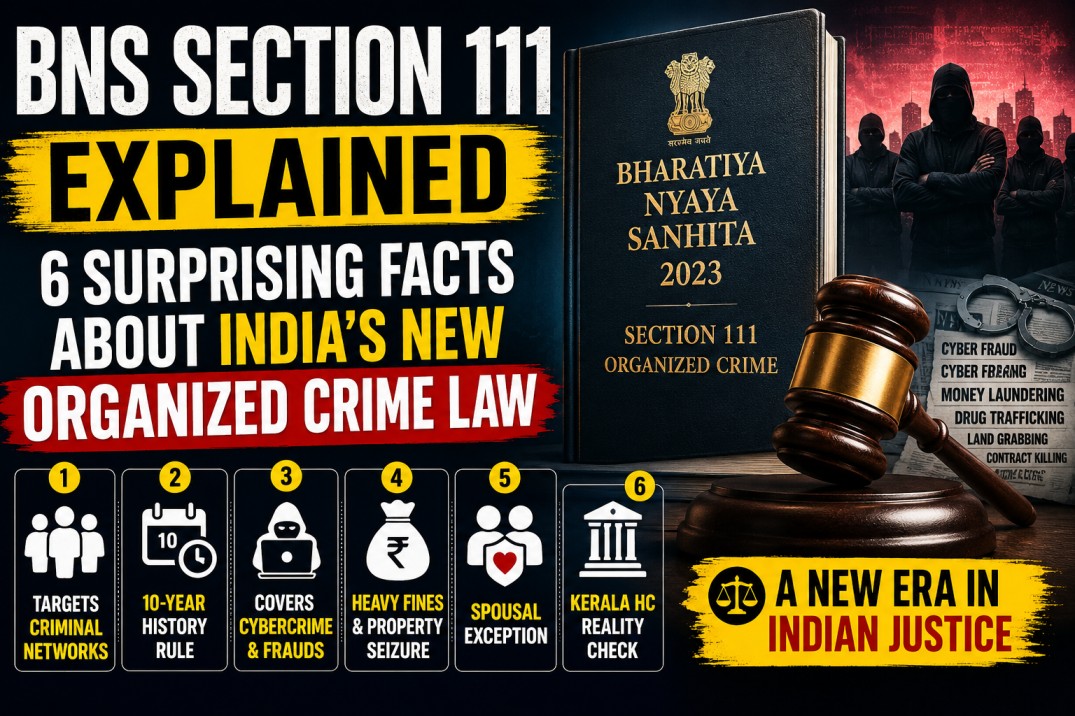

1. Introduction: A New Era for Indian Justice
For more than 164 years, the Indian Penal Code (IPC) of 1860 has served as the foundation of the Indian criminal justice system. However, it suffered from a significant policy “blind spot”: it was fundamentally designed to address individual liability, the person who pulled the trigger or stole the purse. In today’s modern era, this left a vacuum regarding the sophisticated, multi-layered organisations that drive large-scale crime. While cinematic blockbusters like Money Heist or Dhoom have long glamorised high-stakes “syndicates” performing meticulously planned heists, Indian law lacked a unified provision to dismantle these corporate-style structures.
With the transition to the Bharatiya Nyaya Sanhita (BNS) 2023, Section 111 officially brings these real-world syndicates under the hammer of national law. This represents a paradigm shift from punishing the “hand” of the criminal to targeting the “head” of the organisation. As a legal policy analyst, I see that this move marks the end of the IPC’s focus on isolated incidents and the beginning of an era targeting “organisational liability”. This post distils the six most impactful and surprising aspects of this new provision.
2. The “Syndicate” Factor: It’s Not Just About the Act
The most fundamental shift in BNS Section 111 is its focus on the structure of crime rather than just the incident. The law recognises that crime becomes exponentially more dangerous when it operates like a “business union” with a shared intent.
Legal Definition: Section 111 defines an “organised crime syndicate” as “a group of two or more persons… acting either singly or jointly as a syndicate or gang”, engaging in continuing unlawful activity.
Crucially, the legal net is wider than it appears. The provision includes individuals acting “on behalf of such a syndicate“. From a policy perspective, this is a massive tactical advantage for law enforcement; it allows the state to catch “solo” operatives, facilitators, or low-level runners who might not be core “members” but are functioning as vital cogs in the syndicate’s machinery.
3. The “10-Year History” Rule: A Counter-Intuitive Twist
Perhaps the most surprising element of Section 111 is that a person cannot be charged with ‘organised crime’ based solely on a single, high-profile arrest. To qualify as “Continuing Unlawful Activity“, the BNS requires a specific, proven track record of career criminality.
For Section 111 to apply, the following criteria must be met:
- History of Charge Sheets: There must be more than one charge sheet filed against the individual (or the syndicate they belong to) within the preceding 10 years.
- The 3-Year Threshold: These prior offences must be recognisable offences punishable by at least 3 years of imprisonment.
- Competent Court Notice: It is not enough for the police to file a report; a competent court must have officially taken cognisance of these charge sheets.
This rule represents a deliberate policy trade-off. While it provides a necessary safeguard against police overreach for first-time offenders, it creates a legal “waiting period“. A new, highly violent gang cannot be prosecuted under the “organised crime” label until they have been caught and charge-sheeted at least twice.
4. Modern Crimes for a Modern Era
As a tech journalist, I find the BNS’s modernisation of the “crime list” particularly notable. Section 111 of the BNS acknowledges that financial “mass damage” in the digital age is as severe as physical violence. The law now groups sophisticated scams with traditional “mafia” activities.
Economic and Tech-Driven Offenses
- Cybercrime: For the first time, tech-driven crimes are explicitly integrated into the organised crime framework.
- Mass Marketing Fraud: Targets digital-age scams designed to defraud large numbers of people simultaneously.
- Economic Offences: Includes Hawala transactions, currency counterfeiting (currency notes, bank notes, or stamps), and large-scale laundering.
Violent and Illicit Operations
- Violent Contracts: Land grabbing and “Contract Killing” (supari).
- Trafficking: Illegal trade in drugs, weapons, and human trafficking for prostitution.
- Kidnapping: Abduction for ransom or extortion.
By grouping “Mass Marketing Fraud” with “Contract Killing,” the BNS signals that syndicates stealing life savings via digital links are viewed with the same legal gravity as those dealing in physical violence.
5. The Staggering “Million Rupee” Fines and Property Seizure
The IPC was often criticised for its negligible fines, which syndicates viewed as a mere “cost of doing business”. Section 111 adopts an aggressive “follow the money” strategy, introducing staggering financial penalties and targeting the fruits of the crime.
The punishment tiers are strictly codified:
- If the crime results in death: The perpetrator faces the death penalty or life imprisonment, plus a fine that “shall not be less than 10 lakh rupees”.
- In other cases: Participation in organised crime carries a minimum of 5 years (extending to life) and a fine of at least 5 lakh rupees.
- Possession of Property: Under Section 111(6), merely possessing property derived from organised crime carries a punishment of 3 years to life and a minimum fine of 2 lakh rupees.
- Unaccounted Assets: Under Section 111(7), if a member holds property (movable or immovable) for which they cannot provide a “satisfactory account”, they face 3 to 10 years of imprisonment.
These mandatory minimums are designed to dismantle the financial benefit that serves as the primary motivator for these syndicates.
6. The Surprising Spousal Exception
Section 111 of BNS is notably draconian, except in one specific area. Generally, Section 111(5) states that any person who intentionally “harbours or conceals” a member of an organised crime syndicate faces between 3 years and life imprisonment. This is a severe penalty for being a “facilitator”.
However, the law carves out a rare exception: A husband or wife cannot be punished for harbouring their spouse who has committed an organised crime.
As a policy analyst, I see this as the BNS’s attempt to balance state power with social stability. The exception exists to protect the “Institution of Marriage” and the inherent bond of trust between partners. In a section that treats every associate as a potential felon, this exception is a solitary nod to the privacy and sanctity of the domestic sphere.
7. The First Reality Check: The Kerala High Court Ruling
The practical application of Section 111 was recently tested in the landmark case of Mohammad Shiyad vs. State of Kerala.
The case involved a man apprehended at an international airport with gold capsules hidden in his body, a clear case of smuggling. The police attempted to invoke Section 111, arguing he was part of a gold-smuggling syndicate. However, the Kerala High Court granted the man bail.
The Key Takeaway: The court ruled that regardless of the immediate act (smuggling gold), the statutory requirement of prior charge sheets was absent. Because the man had a clean record over the previous 10 years, Section 111 could not be applied. This case proves that the “10-year rule” is a “hard floor” for prosecution. Section 111 is a “Shield” meant to dismantle habitual criminal structures, not a “Sword” to be used against every individual caught in a first-time offence.
8. Conclusion: Beyond the Law Books
The introduction of Section 111 in the Bharatiya Nyaya Sanhita marks a sophisticated turn in Indian jurisprudence, finally acknowledging the organised nature of 21st-century threats like cybercrime and mass marketing fraud.
However, a provocative policy question remains: does the “10-year rule” create a strategic loophole? One can imagine a syndicate that rotates “clean” members—individuals with no prior record—to carry out high-stakes operations like the gold smuggling seen in Kerala, knowing they cannot be charged under the harsher Organized Crime provisions.
Is the 10-year criminal history requirement a necessary safeguard for civil liberties or a loophole that modern gangs will learn to exploit?