

By Suman Moktan
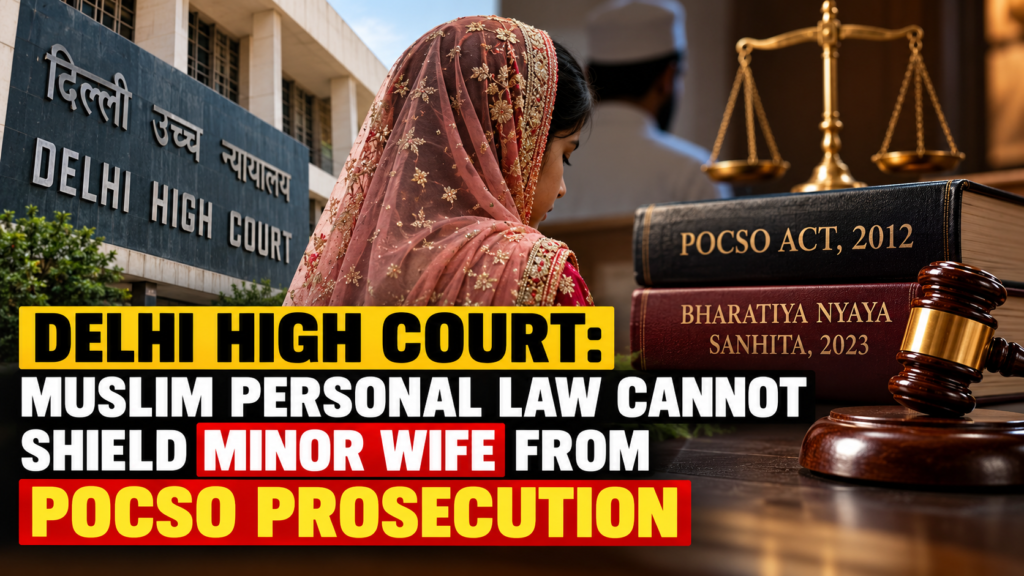
A recent Delhi High Court ruling has clarified that a marriage recognised under Muslim personal law does not, by itself, protect an adult from prosecution under the POCSO Act or the Bharatiya Nyaya Sanhita when the wife was below 18 years of age. The judgment, delivered by Justice Sanjeev Narula on September 23, 2026, addresses an important question at the intersection of personal law, marriage, and child-protection legislation.
The Court refused to quash a criminal case against a man who had married a girl when she was 16 years and three months old. The man was 28 at the time. The couple argued that their marriage was valid under Muslim personal law and that the relationship had been voluntary. The Court, however, held that the existence of a marriage cannot create an exception to criminal laws that Parliament has specifically enacted to protect children.
The POSCO Case Before the Delhi High Court
The case, Bilal & Anr. v. The State Govt. of NCT of Delhi through SHO & Ors., arose when the woman’s age came to light after she visited a government hospital during pregnancy. According to the case record reported by legal publications, the woman was 16 years and three months old when she married the petitioner, who was 28. The couple subsequently lived together, and she became pregnant.
The woman stated that the marriage had been voluntary and that she had not been forced into the relationship. The couple therefore approached the Delhi High Court seeking, among other reliefs, quashing of the criminal case. The criminal case included charges under Section 64(1) of the Bharatiya Nyaya Sanhita, 2023 (BNS) and Section 6 of the Protection of Children from Sexual Offences Act, 2012 (POCSO).
The central argument was based on Muslim personal law. The petitioners contended that a Muslim girl who had attained puberty could be competent to marry under Muslim personal law and that the validity of the marriage should therefore have consequences for the criminal case. The High Court rejected that argument.
What Did the Delhi High Court Hold?
The Court made an important distinction between the validity or civil consequences of a marriage and criminal liability under statutory law. Even if a marriage is assumed to be valid under personal law, the Court held that this does not automatically create an exception to the POCSO Act or the BNS.
In simple terms, a personal law may determine certain questions concerning marriage and family relationships. It cannot, by itself, create an exemption from a criminal offence where Parliament has not provided such an exemption. The Court therefore refused to quash the criminal proceedings.
“Marriage Does Not Advance a Child’s Age”
One of the clearest points in the judgment concerns the age of the child. The Court observed, in substance, that marriage does not change a person’s age. A person who is 16 before marriage remains 16 after the marriage. This matters because POCSO uses 18 years as the threshold for determining who a child is. The Court noted that the statutory framework does not make criminal protection dependent on whether the child is married. The Court also rejected the argument that the girl’s consent could remove the alleged offence under POCSO. The statutory framework treats a person below 18 differently from an adult when it comes to sexual consent.
What Does POCSO Say?
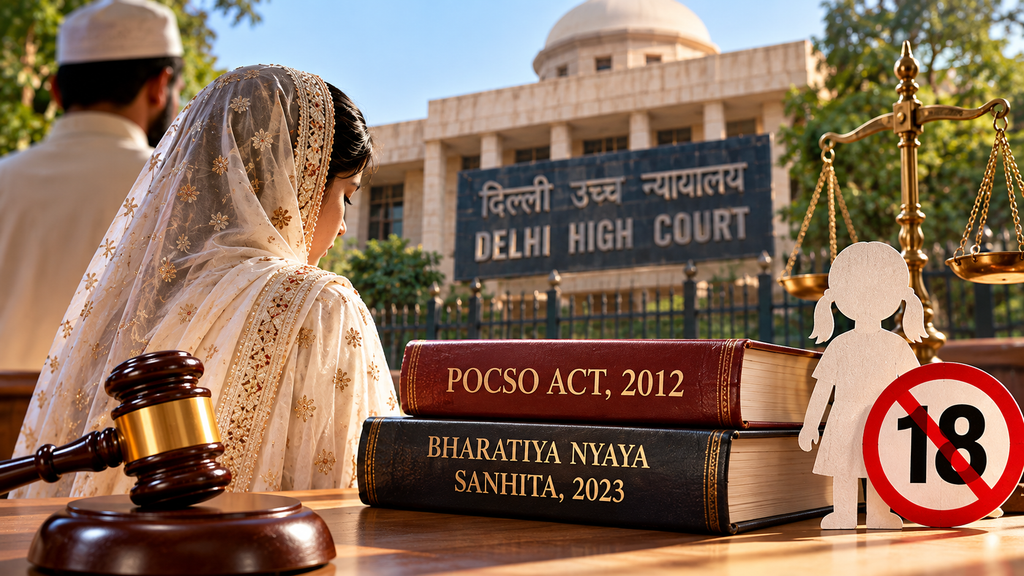
The Protection of Children from Sexual Offences Act, 2012 was enacted specifically to protect children from sexual assault, sexual harassment and exploitation. Under the Act, a child means a person below 18 years of age. Section 6 provides punishment for aggravated penetrative sexual assault. In cases involving a child, the question of whether the child agreed to the sexual relationship does not operate in the same way as adult consent. That is why the Court treated the girl’s age as legally significant.
The reasoning is straightforward: if the person was below 18 when the alleged sexual act occurred, the fact that the person was married does not automatically remove the protection provided by POCSO.
What Does the BNS Say?
The judgment also considered the Bharatiya Nyaya Sanhita, 2023. Section 63 of the BNS deals with rape. The provision treats sexual intercourse with a woman under 18 as rape, irrespective of consent. The BNS contains a marital exception, but that exception does not apply where the wife is under 18 years of age. This creates an important legal distinction.
Marriage may have consequences under personal law and other areas of family law. But when the alleged conduct falls within a criminal provision that expressly protects persons below 18, the marital relationship does not automatically provide immunity.
Personal Law and Criminal Law Are Not the Same Question
This is perhaps the most important part of the judgment. The Court did not simply ask whether the marriage could be recognised under Muslim personal law. Instead, it considered a different question: Can recognition of the marriage under personal law create immunity from a criminal statute? The answer given by the Court was no. The Court held that personal law cannot be used to create an exception to POCSO or the BNS where Parliament has not created one. This distinction is important because the legal validity of a marriage and criminal liability for conduct within that marriage can involve different statutory questions.
Consent Was Not Enough to End the Case
Another argument before the Court was that the relationship had been voluntary. The woman had stated that she had not been forced and that the marriage had taken place with the consent of both families. The Court nevertheless held that such circumstances could not, at this stage, remove the statutory protection given to a child under POCSO. The reasoning follows the statutory age threshold. When the law treats a person below 18 as a child for POCSO, the existence of an apparently voluntary relationship does not itself create a defence to prosecution.
Why the Court Refused to Quash the FIR
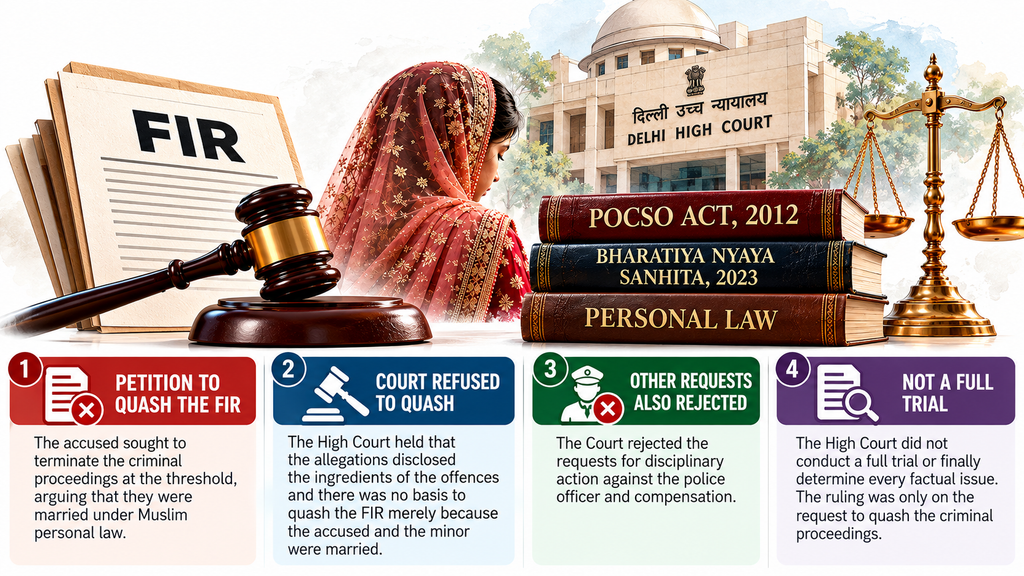
The High Court was dealing with a request to terminate the criminal proceedings at the threshold. It concluded that the allegations disclosed the ingredients of the offences and that there was no basis to use its jurisdiction to quash the proceedings merely because the accused and the minor were married. The Court also rejected the accompanying requests for disciplinary action against the police officer and compensation. This does not mean that the High Court conducted a full criminal trial or finally determined every factual issue. The ruling concerned the request to quash the criminal proceedings. That distinction is important when discussing the judgment.
A Change From Earlier Delhi High Court Views
The legal position surrounding minor marriages and POCSO has not always been expressed uniformly by different courts. A 2022 Delhi High Court decision took a different approach in a case involving a Muslim marriage and sexual relations with a minor wife. The Punjab and Haryana High Court had also considered the marriageability of Muslim girls under Muslim personal law in a separate 2022 decision.
The present judgment therefore forms part of a developing line of judicial decisions concerning the relationship between personal law, child marriage and statutory child-protection laws. Earlier Delhi High Court decisions have also emphasised that, under POCSO, the age of the child is central and that an allegation of consensual sexual activity does not by itself remove the statutory framework.
What This Means in Simple Words
The practical message from the judgment can be stated simply:
If a wife was below 18 years of age at the relevant time, the fact that she was married does not by itself prevent prosecution under POCSO or the BNS.
The Court has drawn a clear line between personal law and criminal statutes.
A marriage may have legal consequences in one area of law. That does not automatically mean that conduct occurring within that marriage is protected from prosecution under another statute.
Why This Judgment Matters
The judgment is important because it addresses a difficult legal question involving three areas of law:
- Personal law, which governs aspects of marriage and family relationships;
- Child marriage law, which places legal restrictions on marriage involving persons below the prescribed age; and
- Criminal law, including POCSO and the BNS, which provides protection to children from sexual offences.
The Delhi High Court’s approach places the statutory protection of a person below 18 at the centre of the criminal-law analysis. It also makes clear that courts cannot create a criminal-law exception merely because a marriage may be recognised under a personal law.
A Simple Legal Takeaway
The judgment can be reduced to one principle:
Marriage does not make a minor an adult for the purposes of POCSO or the BNS.
For a person below 18, the statutory protections available under child-protection laws continue to apply. The Delhi High Court’s decision in Bilal & Anr. v. State Govt. of NCT of Delhi therefore reinforces the distinction between the civil consequences of marriage and criminal liability under statutory law.
Final Thoughts
The case shows why the interaction between personal laws and modern child-protection legislation can raise difficult legal questions. The Court’s approach was to begin with the statutory age of protection and then examine whether any legal exception existed. It found that neither Muslim personal law nor the circumstances of the marriage could create immunity from POCSO or the BNS.
For students of criminal law, family law and the BNS, the judgment is a useful example of how courts deal with a conflict between a personal-law argument and a statutory criminal prohibition.
The broader legal question may continue to receive attention as courts consider similar cases. For now, the Delhi High Court has made its position clear in this case: a marriage recognised under Muslim personal law does not, by itself, shield an adult from prosecution under POCSO or the BNS when the wife was below 18 at the relevant time.
Legal note: This article is for educational purposes and summarises the reported judgment. It is not legal advice. The precise application of the law depends on the facts and the provisions applicable to each case.
Sources
- Bilal & Anr. v. The State Govt. of NCT of Delhi through SHO & Ors., Delhi High Court, judgment dated September 23, 2026.
- Reporting on the judgment by Bar & Bench.
- Reporting on the judgment by Hindustan Times.