
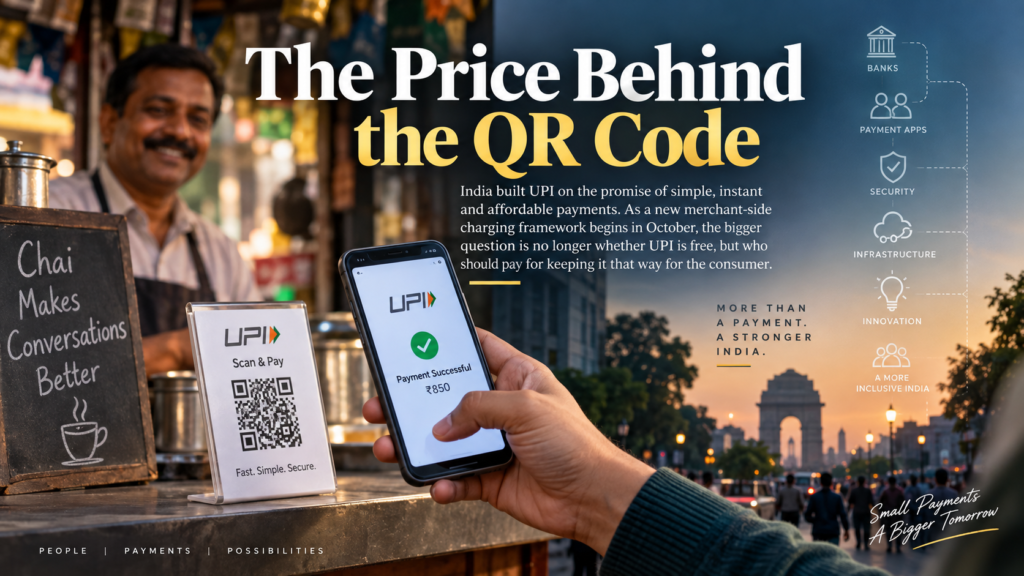

India built UPI on the promise of simple, instant and affordable payments. As a new merchant-side charging framework begins in October, the bigger question is no longer whether UPI is free, but who should pay for keeping it that way for the consumer.
By Suman Moktan
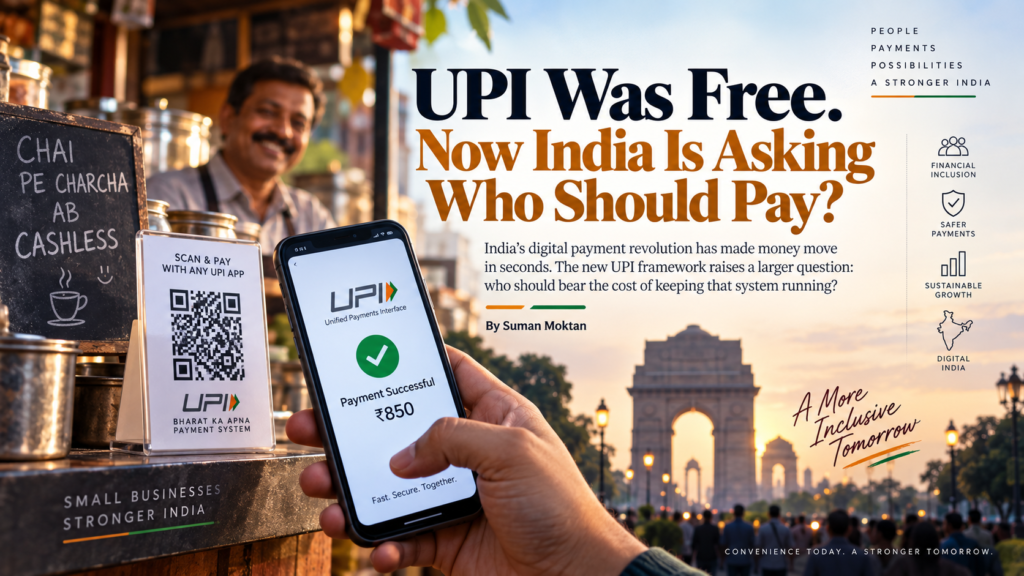
There was a time when paying for a cup of tea meant reaching into your pocket for a ₹10 or ₹20 note. Today the scenario is different; the tea seller may simply point to a small QR code. Then you take out your phone, scan it, enter the amount and press pay. Within a few seconds, the transaction is complete. There is no need to pay cash or search for change, and neither the card machine.
For the customer, it is so easy to make a payment, and it is automatic, so they barely notice the payment process anymore. It would not be wrong to say that UPI has become a normal part of everyday life in India.
Behind this tiny QR code there is an enormous financial and technological institutions like banks provide payment services, technology platforms and the National Payments Corporation of India (NPCI) work together to move billons of transactions across the country. Though the payment may feel free to the person making it but the infrastructure behind it certainly is not. That is where the real debate in India’s latest UPI begins.
A Revolution Built on Zero Cost
When UPI was launched in 2016, it was set up to make bank-to-bank payments easier, faster and more accessible. The system grew rapidly because it solves the friction associated with the digital payments. A customer did not need any card nor merchant need an expensive card terminal, a person could send money easily and directly from one bank account to another using a mobile phone. The QR Code mark the symbol of this change. From a small road side vendor to a large retailers, digital payments have become the part of their daily transactional commercial life. The data is enormous, according to NPCI’s official statistics, UPI processed 24.51 billion transactions worth approximately ₹29.82 lakh crore in August 2026 alone. Now at this stage when UPI has become this large and is being used by billons of people, we can no longer debate on who pays for running and maintaining the system.
The Change Coming in October
It has been more than six years; UPI merchant transactions operated under a zero-MDR framework or merchants are not charged a fee for accepting the payment. But the senior is changing and the government and the NPCI have announced a new Merchant Discount Rate or MDR, form 15 October 2026 onwards some specified person to merchant (P2M) transaction above ₹2,000 will come under a new system. But this doesn’t mean that the customer will automatically be charged, it is part of the merchant payment processing arrangement.
That arrangement is now changing. The government and NPCI have announced a new Merchant Discount Rate, or MDR, framework for specified person-to-merchant (P2M) transactions above ₹2,000. The framework will come into effect on October 15, 2026. As per the headlines, for eligible merchant UPI payments, the fee is .04% of the transaction amount, but it cannot exceed more than ₹300 for one payment. There are special provisions for certain sectors like railways, telecommunications, insurance and fuel will have a fixed fee of ₹ 5 instead of the general 0.4% MDR rate for qualifying UPI merchant payments above ₹2,000.
But one point is more important than all these numbers, the customer who makes payment is not directly charged with MDR fee. Person to person payments remain free even if the amount is large. Payment to merchant (P2M) up to ₹2,000 through UPI remains free under the described rules. Certain small business that falls under the rules will continue to be protected for the MDR charges. The government estimated that around 96 % UPI transaction will not be affected by the new MDR framework.
Therefore, it is not about suddenly putting a fee on every UPI payment but it is definitely about changing the economics behind some merchant transactions.
What Exactly Is MDR?
MDR, or Merchant Discount Rate is a fee charged for processing certain merchant payments. When a customer pays a shopkeeper through UPI, different parties may be involved during the process of the transaction or payment, such as banks and payment service providers.MDR is a charge associated with processing the payment. Here it is to be noted that MDR is generally a cost associated with the merchant transaction which does not means that the customer pays the charge directly.
To understand it better way let us consider a simple example. Suppose a customer makes an eligible merchant payment of ₹50,000 through UPI.
The applicable MDR is 0.4%.
Calculation:
₹50,000 × 0.4 ÷ 100 = ₹200
So, the MDR is ₹200.
If the transaction is ₹75,000
₹75,000 × 0.4 ÷ 100 = ₹300
Here, the MDR reaches ₹300.
The rule says that ₹300 is the maximum charge (cap). A cap means the charge cannot increase beyond that limit. In short, MDR is a fee associated with processing certain merchant payments. The customer does not have to pay the MDR separately when making the payment.
The Money Is Not a Government Tax
One misconception that is worth clearing up: MDR should not be confused with a new tax collected by the government. According to the government’s explanation, the revenue is to be distributed among the participants in the UPI ecosystem, including banks and the payment application providers.
But the large questions is about sustainability. UPI processes billions of transactions, and maintaining its infrastructure, preventing fraud, improving cybersecurity, and customer support requires ongoing investment.
The new framework attempts to create a revenue mechanism for that ecosystem while keeping UPI payments free for customers.
The Cost Behind “Free”
UPI may be free for customers, but to make it operational, the system involves high costs. Banks and payment platforms need to maintain technology, strengthen cybersecurity, detect fraud, and manage rising transaction volumes.
For several years, the government supported zero-MDR payments through incentive schemes. In March 2025, the Union Cabinet approved a ₹1,500 crore incentive scheme to promote low-value BHIM-UPI transactions involving small merchants. However, as UPI continues to expand, a key question remains: How can the system remain affordable for users while generating enough revenue to support its long-term operation? This is the economic challenge behind the new MDR framework.
Who Really Pays?
If the consumer does not pay MDR, who bears the cost?
The immediate cost falls within the merchant-payment ecosystem. However, its broader economic impact may vary depending on the size of the business and its profit margins. A large corporation may be able to absorb processing costs more easily, while a small retailer operating on tight margins may face greater pressure.
The government has stated that merchants must not pass MDR directly to consumers. However, businesses still need to manage their operating expenses. This raises an important question: Will merchants absorb the cost, or could it eventually influence the broader cost of doing business? The answer may differ across businesses, depending on their margins, transaction volumes, and competitive pressures.
Why the Small Merchant Matters
Small merchants played a major role in UPI’s growth. A roadside vendor, taxi driver, or neighbourhood shopkeeper can accept digital payments without expensive card terminals or handling large amounts of cash. For these businesses, UPI offers a simple way to participate in the digital economy.
Recognising their importance, the announced framework provides special protection for qualifying small merchants. Merchants with UPI QR collections of up to ₹1 lakh per month will continue to receive zero-MDR treatment under the framework. This means the new MDR system is designed to distinguish between different categories of merchants, rather than applying the same approach to everyone.
The ₹5 Question
The proposed flat ₹5 MDR for certain sectors has raised the eyebrows of many. Under the announced framework, qualifying merchant transactions above ₹2,000 in sectors such as railways, telecommunications, insurance, and fuel will attract a ₹5 MDR instead of the standard 0.4% rate.
This is a merchant-side payment processing charge, not a separate ₹5 fee that should be added to the customer’s UPI payment. The distinction matters because it helps clarify whether consumers are actually being charged for using UPI or whether the cost is being handled within the merchant-payment ecosystem.
Not Every Large Payment Is Treated the Same Way
The new framework introduces different MDR rates for different types of transactions. Capital-market payments, including certain transactions involving mutual funds, securities, stockbrokers, and dealers, will attract an MDR of 0.02%, capped at ₹300, according to the Ministry of Finance. The framework also includes special provisions for certain sectors and protections for qualifying small merchants.
This means the new UPI payment structure is more complex than the zero-MDR model many users are familiar with. Instead of applying a single charge across all transactions, it distinguishes between different parts of the digital-payment ecosystem.
Where Does the Money Go?
The government has stated that 5% of total MDR collections will be allocated to a dedicated fund to expand UPI acceptance among small merchants. This means a portion of the revenue generated from selected merchant transactions is intended to support the expansion of the digital payment network.
The idea is that higher-value transactions can contribute to system costs, while part of the revenue helps more small businesses adopt UPI. The effectiveness of this approach will depend on how the funds are used and whether the intended benefits reach the small merchants the policy aims to support.
Could This Bring Cash Back?
It is too early to assume whether the new MDR framework could encourage some merchants to return to cash payments. But it is a question worth asking. UPI became popular because it made even small payments effortless. A customer buying tea for ₹30 can simply scan a QR code and pay. If digital payments become more expensive or complicated, some merchants may reconsider their preferred payment methods. This is why protecting low-value transactions matters.
The government says payments up to ₹2,000 will remain free and that approximately 96% of P2M transactions will remain unaffected. The stated aim is to preserve the everyday convenience of UPI while creating a revenue mechanism to support the long-term sustainability of the payment ecosystem.
The Bigger Digital India Question
The UPI debate is about more than a few rupees. It raises a larger question: How should India finance its digital public infrastructure? India has built a payment network capable of transferring money almost instantly on a massive scale. However, maintaining and improving this infrastructure requires continuous investment. Who should bear that cost?
Should the government continue providing financial support? Should banks and payment companies contribute more? Should larger merchants bear some costs while small businesses remain protected? The new MDR framework offers one approach. It places some processing costs within the merchant-payment ecosystem while keeping ordinary consumers outside the charging mechanism. Whether this balance works will depend on how the framework is implemented and how its costs and benefits are distributed.
October 15 Will Be the Real Test
The new system is scheduled to begin on October 15, 2026. After that date, the debate will move from policy announcements to real-world transactions.
Several questions will matter:
- Will merchants absorb the MDR?
- Will payment companies use the additional revenue to improve infrastructure and security?
- Will small merchants remain protected?
- Will consumers continue to experience UPI as a free payment system?
- Will the framework preserve the simplicity that made UPI popular?
The answers will depend on how the framework is implemented and how it affects merchants, payment providers, and consumers in practice.
The Price Behind the QR Code
Go back to that small neighbourhood shop. A customer buys groceries worth ₹850, scans the QR code, and completes the payment in seconds. That simplicity is what made UPI part of everyday life in India. But behind every transaction is digital infrastructure that requires maintenance, security, and investment. For years, India supported eligible merchant payments through a zero-MDR model to encourage digital adoption.
The new framework attempts to create a more sustainable financial structure while protecting consumers and qualifying small merchants. The central question is not simply whether UPI is free. It is: Who should pay for the infrastructure that allows UPI to remain free for ordinary users?
The new MDR framework offers one approach. Its success will depend on how it works in practice and whether it preserves the convenience that made UPI so widely adopted. Digital India should make everyday payments simpler. The challenge is to sustain that simplicity without turning the cost of the system into a burden for the people who use it.
Who should pay for the infrastructure that allows it to remain free for the ordinary user?
India has answered part of that question through the new MDR framework. The rest will be answered by what happens on the ground. Because ultimately, the success of Digital India will not be measured only by how many transactions the system can process. It will also be measured by whether an ordinary Indian can continue to stand at a small shop, scan a QR code and pay without having to worry about what it costs to make that payment. Digital India should make everyday life simpler. The challenge now is to make that simplicity financially sustainable without turning the cost of the system into a burden on the people who use it.