
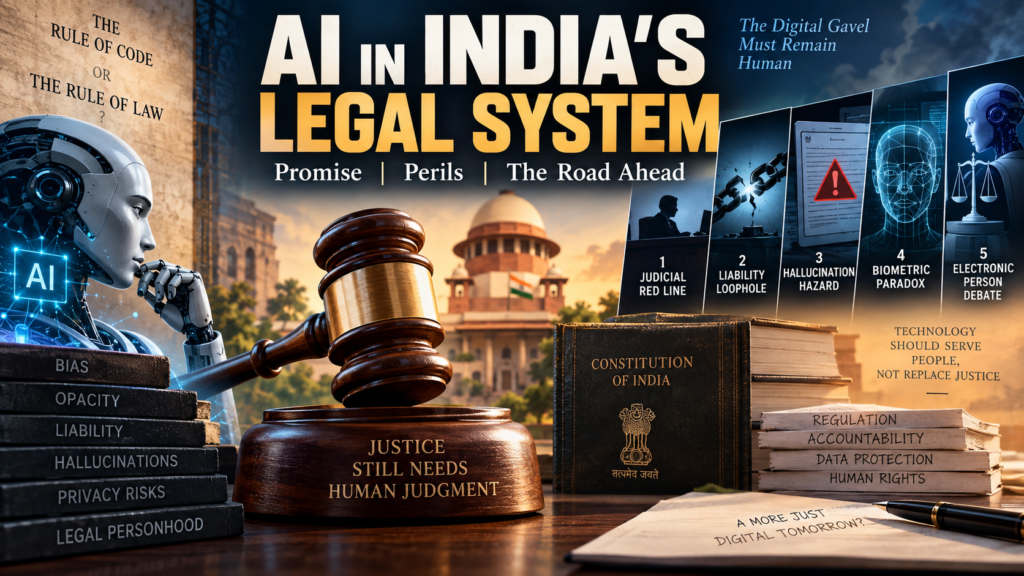

1. Introduction: The Digital Gavel
The promise of the digital era is one of surgical efficiency, a tempting prospect for an Indian legal system burdened by staggering caseloads and labyrinthine procedural requirements. Artificial Intelligence (AI) arrives not just as a tool, but as a potential savior, promising to automate legal research and streamline document review through the lens of computational jurisprudence. Yet, as these algorithms migrate from our pockets to the courtroom, we are confronting a startling reality: the entry of AI is creating an “algorithmic opacity”—a black box that judges and lawmakers are struggling to decrypt.
While AI has already revolutionised the frictionless worlds of healthcare and finance, its application within the halls of justice is a higher-stakes endeavour. Here, we are not merely optimising a workflow; we are re-engineering the constitutionalisation of code. As the convenience of automated assistants meets the rigid demands of criminal justice, a profound tension emerges. The “rule of code” is beginning to clash with the established “rule of law”, exposing gaps in our statutes that were never designed for autonomous reasoning.
Way 1: The Judicial “Red Line”—Why Courts are Banning Algorithmic Reasoning
At a time of peak global hype, the Indian judiciary has begun drawing a definitive “red line” to protect the sanctity of the bench. In a move that highlights the friction between innovation and due process, the Kerala High Court recently issued landmark guidelines acting as a precautionary interim measure. These guidelines explicitly prohibit the use of AI tools for decision-making or legal reasoning within the district judiciary.
This prohibition is a calculated defense of “natural justice.” The court recognizes that judicial reasoning is not a mere data-processing exercise; it requires a level of transparency and human empathy that current black-box models cannot simulate. Human oversight remains non-negotiable because the stakes of judicial decisions involve fundamental liberties. As Source 2 identifies:
“The judiciary is acknowledging its dual roles of user and regulator of AI tools, especially in rights influencing decisions… pointing to risks in transparency, accountability, [and] data security.”
By restricting AI from the core cognitive tasks of judging, the courts are signaling that while technology can assist the periphery, the “digital gavel” must remain firmly in human hands to ensure the system remains explainable to the citizens it serves.
Way 2: The Liability Loophole—Navigating the Accountability Deficit
As AI systems evolve from static tools into autonomous agents, they create a “Liability Loophole” that threatens to leave victims of algorithmic error without recourse. When a self-learning system causes harm—whether through a discriminatory credit score or an error in a predictive policing model—traditional Indian tort and contract laws find themselves fundamentally inadequate.
We are currently navigating a “shared liability” dilemma. If an algorithm commits an error, does the fault lie with the developer, the user, or the data provider who supplied the biased training set? Academic discourse, notably from experts like Prof. Rattan Singh, suggests that “joint liability” among all stakeholders may be the only viable path forward. Without a dedicated statute to clarify these responsibilities, accountability is often lost in technical complexity, allowing corporations to hide behind the “autonomy” of their code.
Way 3: The Hallucination Hazard—When Generative Code Fabricates Law
Generative AI introduces a unique jurisprudential risk: the “Hallucination Hazard.” These systems are designed to be statistically probable, not factually certain. In a legal context, an AI might fabricate a precedent or cite a non-existent statute with such authoritative confidence that it appears legitimate—a phenomenon that constitutes an “unauthorized practice of law.”
This is not a mere glitch; it is a systemic threat to the integrity of evidence. If litigants rely on these fabrications, the evidentiary process collapses. Legal analysis into AI practice suggests a worrying trend:
“The review critically evaluates key ethical concerns such as… the diminishing role of human oversight… [including the] potential for fabricated evidence.”
When AI fabricates the law, the role of human verification becomes the final bulkhead against chaos. Without robust validation mechanisms, the sheer speed of generative AI becomes a liability, threatening to flood the courts with sophisticated but entirely fictional legal arguments.
Way 4: The Biometric Paradox—Security Tools as Constitutional Breaches
India’s drive toward high-tech law enforcement has birthed a “Biometric Paradox.” While tools like facial recognition and fingerprint scanning are deployed to enhance public safety, the centralization of this sensitive data creates a new, systemic vulnerability. This was starkly illustrated by the recent leak of biometric data involving police recruits in India.
This irony—that data collected to protect the law became a tool for identity theft—shifts AI governance from a technical hurdle to a constitutional crisis. Under the Puttaswamy ruling, the “Right to Privacy” is a fundamental right under Article 21. This mandate includes the principles of data minimization and purpose limitation, both of which are directly violated when mass biometric data is leaked or repurposed. In this era, a technical leak is not just a security failure; it is a breach of the constitutional contract between the state and the citizen.
Way 5: The “Electronic Person” Debate—Could Your Code Claim Rights?
As machines achieve higher levels of autonomy, we face the “Ownership Paradox.” If an AI generates a piece of music, a patentable invention, or a legal brief, who owns the Intellectual Property? Current Indian IP laws offer no satisfactory answer, leading to a provocative debate about granting “Legal Personhood” to autonomous systems.
As discussed in recent academic reviews by Prof. Rattan Singh, the “pro-personhood” stance argues that treating AI as an “electronic person”—much like a corporation—could simplify the attribution of liability and the management of IP rights. However, the “anti-personhood” stance remains a powerful deterrent, arguing that machines lack the moral agency and consciousness required for rights. Granting personhood to code risks shielding the human developers and corporations from the consequences of their creations, potentially allowing the “creator” to evade the very laws they programmed the machine to navigate.
Conclusion: Navigating the New Era
India stands at a critical juncture in its legal evolution. To harness the transformative power of AI without sacrificing the essence of justice, we require a comprehensive “AI Regulatory Framework” that operates in tandem with the Digital Personal Data Protection (DPDP) Act. It is vital to note that as of late 2025, the DPDP Act remains in a state of transition and is not yet fully operational; its rules are still being calibrated to meet the unique challenges of algorithmic bias and black-box opacity.
As we move forward, the ultimate question remains: can “the rule of code” ever truly replace “the rule of law”? Efficiency is a virtue, but fairness, equality, and the right to an explanation are the bedrock of our civilization. In our rush to innovate, we must ensure that the digital gavel never falls at the expense of the human rights it was designed to protect.