
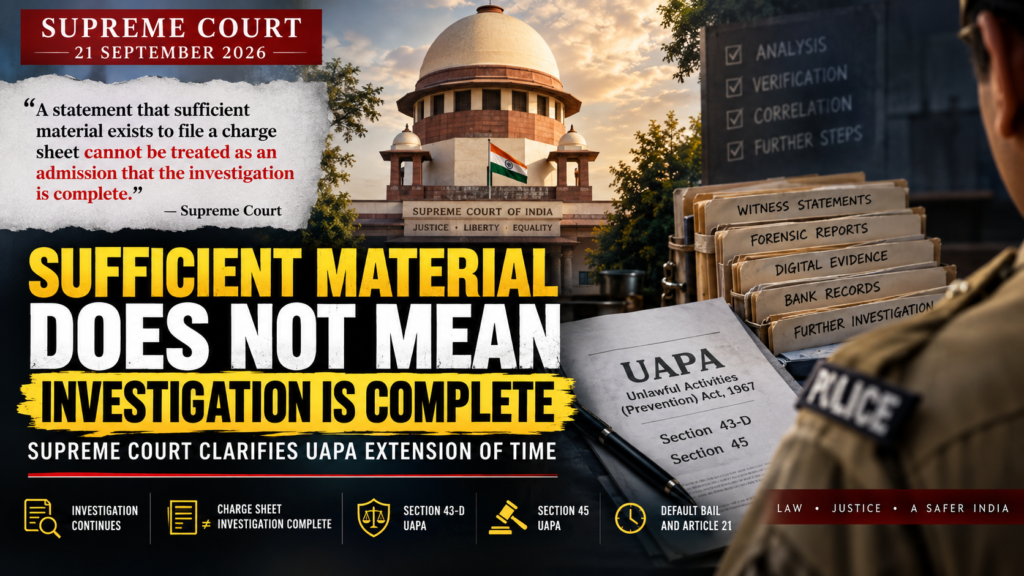

Supreme Court | The State of Maharashtra & Anr. v. Momin Moiuddin Gulam Hasan @ Moin Mistri & Anr. | 21 September 2026 | 2026 INSC 1021
A prosecution statement that there is “sufficient material” to file a charge sheet does not, by itself, amount to an admission that the investigation has been completed. The Supreme Court has made it clear in a significant judgment concerning Section 43-D of the Unlawful Activities (Prevention) Act, 1967 (UAPA) and the accused’s right to default bail.
The Court held that an extension application must be read as a whole. A sentence stating that sufficient material exists to file a charge sheet cannot be isolated from the rest of the application when the investigating agency has explained that further work, such as analysis and collation of witness statements, bank records, electronic evidence and forensic material, remains pending.
The judgment is particularly relevant to investigating officers, prosecutors and Special Courts dealing with investigations where the statutory period for completing the investigation is approaching its end.
The UAPA case before the Supreme Court
The case arose from an investigation conducted by the Maharashtra Anti-Terrorism Squad. An FIR was registered in September 2022 concerning alleged offences under various provisions of the Indian Penal Code and the UAPA. The accused were arrested and the investigation continued. Since the statutory period was approaching its end, the prosecution sought extensions of time for filing the charge sheet.
The Special Court granted an extension. A further application was subsequently filed seeking another 15 days. The prosecution explained that several investigative tasks were still being undertaken, including analysis and collation of available information, witness statements, bank statements, electronic evidence and forensic material. However, the application also contained a sentence stating that there was enough evidence to file a charge sheet. That sentence later became central to the litigation.
What did the Bombay High Court hold?
The Bombay High Court treated the statement that sufficient evidence existed to file a charge sheet as indicating that the investigation was complete. It therefore concluded that the extension could not properly be granted merely because sanction for prosecution under Section 45 of the UAPA was awaited.
The High Court consequently held that the extension order was invalid and that the accused had acquired a right to default bail. The State challenged that decision before the Supreme Court.
What did the Supreme Court say?
The Supreme Court disagreed with the High Court’s approach. The central point was simple: Having sufficient material to file a charge sheet is not the same thing as having completed the investigation. The Court emphasised that a document must be read as a whole. A particular sentence in an extension application should not be taken out of its factual and procedural context. The prosecution had not stated that the investigation was complete and that the charge sheet was being withheld only because sanction was awaited.
Instead, the application indicated that further investigative work was still being undertaken. The Supreme Court therefore held that the statement regarding sufficient material could not be interpreted as an admission that the investigation had ended.
“Sufficient material” and “completed investigation” are different concepts
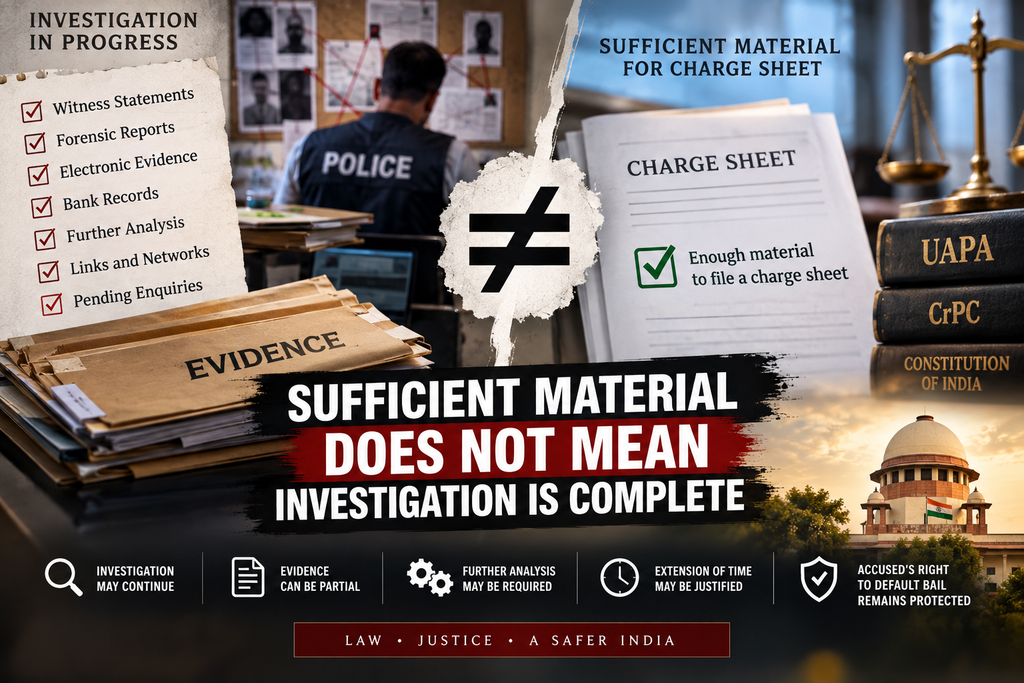
This distinction is important. An investigation may have already produced substantial evidence against an accused while still requiring further investigative steps.
For example, an investigating agency may have:
- recorded important witness statements;
- obtained bank account records;
- collected electronic evidence;
- received some forensic material;
- identified the principal evidentiary links; and
- prepared substantial portions of the proposed charge sheet.
At the same time, investigators may still need to analyse financial transactions, examine electronic data, obtain forensic reports, verify additional evidence, record further statements or connect different pieces of evidence.
Therefore: Evidence sufficient to support a charge sheet does not necessarily mean that every investigative step has been completed. The Supreme Court’s reasoning prevents one sentence in an application from being treated as a conclusive admission about the entire state of the investigation.
Section 43-D of UAPA and the extended investigation period
This issue becomes especially important in UAPA cases because Section 43-D modifies the ordinary procedure relating to detention during investigation. Ordinarily, Section 167 of the Code of Criminal Procedure provides the statutory framework governing detention during investigation and the consequences of failure to complete the investigation within the prescribed period.
Section 43-D of the UAPA permits the period to be extended, subject to the statutory requirements, up to the specified maximum period. The purpose is to recognise that investigations involving terrorism, unlawful activities, organised networks, financial trails and electronic evidence can require substantial investigative work.
But the extension is not automatic. The investigating agency must provide legally sustainable reasons, and the Court must apply its mind to the request. The accused’s right to default bail remains an important safeguard. The Supreme Court reiterated that default bail is connected with the constitutional protection of personal liberty under Article 21.
What about Section 45 UAPA sanction?
Another important aspect of the judgment concerns Section 45 of the UAPA. The Supreme Court distinguished between: completion and filing of the charge sheet and taking cognizance of the offences requiring sanction. The Court noted that sanction is relevant to the stage of taking cognizance. It is not a prerequisite for the investigating agency to physically file the charge sheet.
This means that an investigating agency cannot simply say: “Investigation is complete, but sanction has not arrived, therefore we need an extension to file the charge sheet.” That would present a different legal question. The Supreme Court’s decision turned on the fact that the investigation was not actually complete, because further investigative work remained to be done. This distinction is critical.
In simple terms
Pending sanction alone is not the same as pending investigation. If investigation has genuinely been completed and only sanction is awaited, Section 43-D cannot automatically be used as a device to extend the investigation period. But where substantive investigative work is still continuing, the existence of sufficient material to frame or support a charge sheet does not by itself establish that the investigation has ended.
A practical lesson for Investigating Officers
This judgment also carries an important drafting lesson. An extension application should clearly explain what remains to be investigated and why additional time is necessary. Instead of relying on a general statement such as: “Sufficient evidence is available to file the charge sheet.” the application should clearly set out the outstanding investigative steps.
For example:
- forensic analysis still pending;
- electronic data under examination;
- financial transactions being verified;
- statements of relevant witnesses yet to be completed;
- voice samples awaiting forensic comparison;
- additional documents awaited from a competent authority;
- links between accused persons and other suspected participants being verified; or
- evidence already collected requiring further analysis and correlation.
The Supreme Court’s judgment shows why precision in such applications matters. The Court will examine the substance of the investigation rather than simply counting individual sentences in the application.
Investigation is not the same as preparation of the charge sheet
This is perhaps the most useful conceptual distinction arising from the judgment. A charge sheet is the product of an investigation, but the existence of sufficient material for preparing a charge sheet does not necessarily establish that the investigative process has reached its legal conclusion.
Consider a simple example. An investigating agency has collected CCTV footage, bank records and witness statements. These materials appear sufficient to establish a prima facie case. However, investigators are still examining electronic devices, waiting for forensic comparison and verifying financial transactions involving other persons.
In such circumstances, saying that “sufficient material exists” does not necessarily mean: “Investigation is complete.” The Supreme Court’s reasoning requires the Court to examine the entire factual context.
What the judgment does not mean
The judgment should not be understood as giving investigating agencies unlimited time. It does not mean that an investigating agency can obtain an extension simply by stating that more investigation is required. The statutory safeguards remain. The Court has to examine whether the investigation is genuinely continuing and whether the reasons advanced justify the extension under the applicable law.
The accused also retains the statutory and constitutional protection associated with default bail when the investigating agency fails to comply with the applicable time limits. The Supreme Court itself recognised the importance of default bail as part of the legal protection of personal liberty.
The Supreme Court’s broader message
The judgment also contains an important observation about the role of the Court during an ongoing investigation. The Court stated that it is not ordinarily for the Court to decide when an investigation should stop. The course of an investigation is primarily for the investigating agency, subject to legal and judicial controls. This does not remove judicial oversight. Rather, it recognises the difference between judicial supervision of legality and taking over the investigative function.
The Court must decide whether the statutory conditions for an extension have been satisfied. It should not, however, substitute its own view of what investigative steps are necessary for that of the investigating agency merely because substantial evidence has already been collected.
Why this judgment matters for police investigations
For police officers and investigating agencies, the judgment offers a practical lesson under UAPA: The quality of an extension application can be as important as the evidence already collected. If additional time is required, the application should make the investigative position clear.
It should identify:
- what investigation has already been completed;
- what investigative steps remain;
- why those steps are necessary;
- what material has already been collected;
- what material is awaited;
- why the remaining work cannot reasonably be completed within the existing period; and
- how the requested extension relates to the statutory requirements.
At the same time, investigators should avoid language that creates unnecessary ambiguity. A sentence such as “there is sufficient evidence to file the charge sheet” should be read in its proper context, but a carefully drafted application can prevent precisely the kind of interpretative dispute that occurred in this case.
The key distinction
The Supreme Court’s decision can be reduced to one simple proposition:
“Sufficient material to file a charge sheet” does not automatically mean “investigation completed.”
The real question is whether substantive investigative work remains pending.
If it does, an application under the applicable statutory provision must explain that work clearly and demonstrate why additional time is legally justified.
If the investigation is actually complete and the only outstanding issue is sanction for prosecution, that is a different situation.
That distinction between evidence collected, investigation completed, charge sheet filed and cognizance taken is essential to understanding the judgment.
Conclusion
The Supreme Court’s judgment in State of Maharashtra & Anr. v. Momin Moiuddin Gulam Hasan @ Moin Mistri & Anr. provides an important clarification on the relationship between investigation, charge sheets, extension of time and default bail in UAPA cases.
The Court rejected the approach of treating a single statement about the availability of sufficient material as a conclusive admission that the investigation was complete. At the same time, the judgment does not dilute the statutory protection available to an accused when the investigation is not completed within the legally permitted period.
The practical message is therefore balanced: Investigating agencies must demonstrate genuine continuing investigation. Courts must examine the substance of the extension request. And the accused’s right to default bail remains protected by law.