
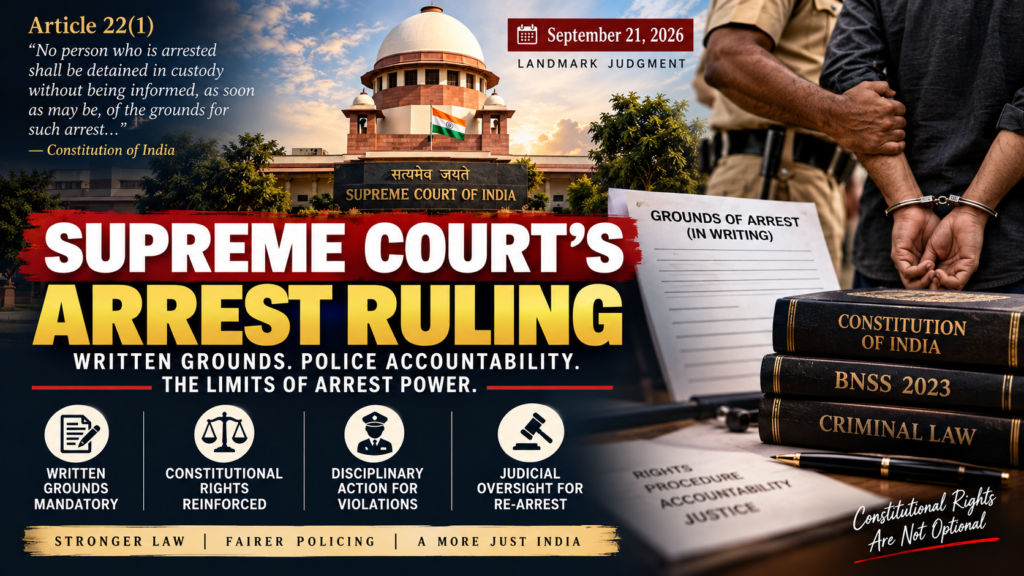

The Supreme Court has directed disciplinary inquiry against a police officer for failing to furnish written grounds of arrest, reinforcing that constitutional safeguards cannot be treated as optional procedures.
Introduction: When an Arrest Becomes a Constitutional Question
An arrest is one of the strongest powers exercised by the police. It affects a person’s liberty, interrupts their daily life and places them under the control of the criminal justice system. Because of this, the Constitution places specific limits on how that power may be used.
On September 21, 2026, the Supreme Court of India delivered an important judgment concerning the arrest of an accused without furnishing written grounds of arrest. The Court held that failure to comply with Article 22(1) can make the arrest unconstitutional and directed that disciplinary inquiry be initiated against the police officer responsible for the violation.The judgment also addressed a related question: Can the police re-arrest a person whose earlier arrest was declared illegal?
The Court laid down a procedure requiring judicial oversight before re-arrest and directed that further investigation be assigned to another officer in the circumstances covered by its directions. The ruling has implications for the protection of individual liberty, the conduct of criminal investigations and the responsibility of police officers to follow constitutional requirements.
1. Article 22(1): The Constitutional Foundation
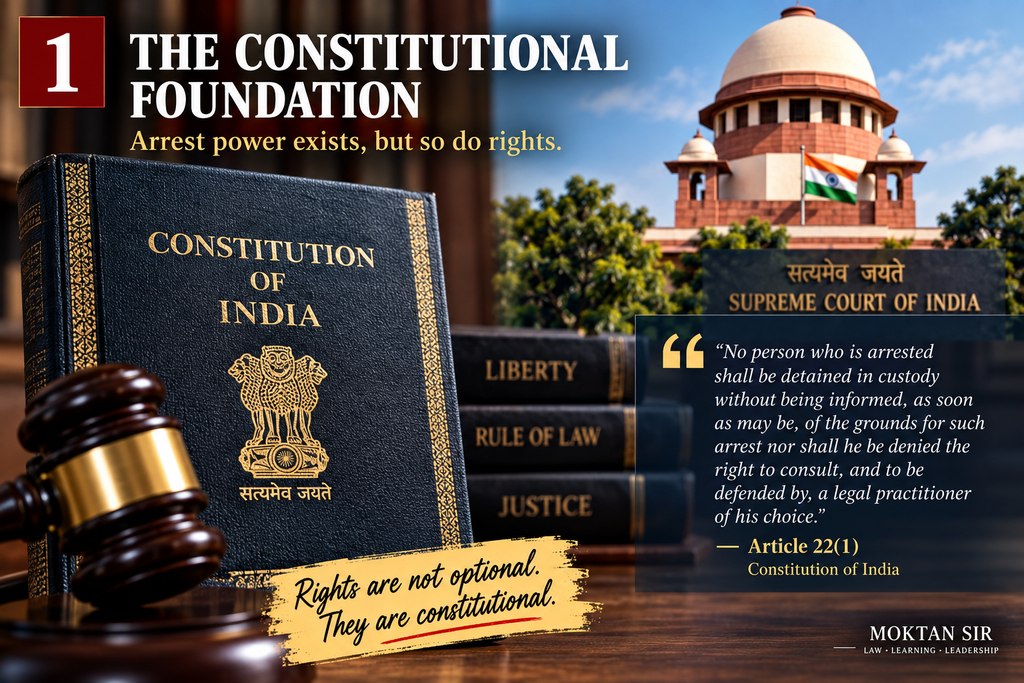
Article 22(1) of the Constitution of India provides:
“No person who is arrested shall be detained in custody without being informed, as soon as may be, of the grounds for such arrest nor shall he be denied the right to consult, and to be defended by, a legal practitioner of his choice.”
This provision contains two important protections. First, the arrested person must be informed of the grounds of arrest. Second, the person has the right to consult and be defended by a legal practitioner of their choice. The Supreme Court’s September 21 ruling addressed the first safeguard, emphasizing that the grounds of arrest must be furnished in writing and in a language understood by the accused. The purpose of this requirement is to ensure that an arrested person knows why their liberty has been restricted and can take appropriate legal steps to challenge the detention or seek legal assistance.
What does this mean for the police?
An investigating officer should not treat communication of the grounds of arrest as a formality to be completed later. The Court’s directions require written grounds to be supplied at the time of arrest, as a matter of course and without exception. This places a responsibility on the officer and the investigating agency to maintain proper documentation and ensure that the arrested person receives the required information.
2. Why Written Grounds of Arrest Matter
Consider a practical example. A police team arrests a person in connection with a criminal investigation. The officer informs the person that they are being arrested but does not provide the grounds of arrest in writing. The arrested person is taken into custody and later produced before a Magistrate. The question is whether the constitutional requirement has been satisfied merely because the officer verbally explained the arrest.
According to the Supreme Court’s reported directions, the answer is no. The grounds must be furnished in writing and in a language understood by the accused. The Court treated this as a fundamental constitutional safeguard rather than an ordinary procedural requirement. This distinction matters because the grounds of arrest allow the person to understand the basis of the State’s action and exercise their legal rights.
A practical police example
Suppose an officer arrests a suspect in a case involving allegations of assault.
The officer should ensure that:
- The grounds of arrest are recorded in writing.
- The written grounds are furnished to the arrested person.
- The language used is understandable to the person.
- The relevant arrest documentation is properly maintained.
The precise paperwork and operational process should follow the applicable law, court directions and departmental instructions. The central legal requirement is that the arrested person receives the grounds of arrest in the manner directed by the Constitution and the Supreme Court.
3. An Illegal Arrest Is Not the Same as Bail
One of the important aspects of the judgment concerns the legal effect of releasing a person whose arrest violated constitutional safeguards. The Supreme Court clarified that when an accused is released because their arrest breached fundamental rights, that release is not equivalent to being granted bail. The person is released from illegal and unconstitutional detention.
This distinction has practical consequences. Bail generally concerns the release of an accused subject to the applicable legal framework. Release following an unconstitutional arrest addresses the legality of the detention itself. The Court also rejected the argument that the seriousness of the alleged offence permits the constitutional safeguard to be ignored. Its reported reasoning states that compliance with Article 22 is not dependent on the nature or gravity of the offence.
Why this matters in criminal investigation
Police officers may investigate serious offences and may have legitimate grounds to seek custody. However, the seriousness of an allegation does not remove the constitutional requirements governing arrest. An investigation must proceed within the legal framework, including the safeguards applicable to the accused.
4. Can Police Re-Arrest a Person After an Illegal Arrest?

This was another central issue before the Supreme Court. The question was whether an investigating agency could simply arrest the person again after the earlier arrest had been declared illegal. The Court held that re-arrest cannot be left to the discretion of the same authority that violated the constitutional safeguard. It established a procedure requiring judicial consideration before re-arrest in the circumstances covered by the judgment.
The procedure laid down by the Court
According to the reported judgment:
Step 1: Furnishing the grounds of arrest
The investigating agency must first provide the grounds of arrest in writing to the accused.
Step 2: Application before the Magistrate
If the agency believes that further custodial interrogation is necessary, it must submit an application before the concerned Judicial Magistrate.
Step 3: Explanation for the earlier failure
The application must explain why the grounds of arrest were not furnished at the first instance.
Step 4: Superior officer’s endorsement
The application must carry the endorsement of the immediate superior of the officer who made the initial arrest.
Step 5: Judicial decision
The Magistrate must consider the application expeditiously. Re-arrest may be permitted if the Magistrate is satisfied that the relevant conditions are met, including bona fide reasons for the earlier failure and the need for re-arrest.
Step 6: Different investigating officer
The further investigation must be assigned to another officer, rather than leaving it with the officer responsible for the initial constitutional violation. These directions establish a distinction between the investigative agency’s request for custody and the Magistrate’s role in deciding whether re-arrest is permissible.
5. Disciplinary Inquiry Against the Police Officer
The most significant administrative aspect of the judgment is the direction concerning departmental proceedings. The Supreme Court directed that a departmental inquiry be initiated against the police officer responsible for the serious lapse in furnishing the grounds of arrest.
If the inquiry results in adverse findings, the Court directed that departmental action should follow, along with an entry in the officer’s service book. This direction is important because it connects constitutional compliance with professional responsibility. A police officer exercises statutory powers on behalf of the State. When those powers affect a person’s liberty, the officer must follow the constitutional safeguards governing their exercise.
Does every procedural mistake automatically result in dismissal?
The reported direction concerns the initiation of a departmental inquiry and the consequences of adverse findings. It should not be read as an automatic direction that every officer must be dismissed whenever an arrest-related error occurs. The disciplinary process must be understood in accordance with the Court’s directions and the applicable service rules. The judgment specifically refers to an inquiry, adverse findings, departmental action and an entry in the service book. This distinction matters for both accountability and procedural fairness.
6. What Should Investigating Officers Learn From the Judgment?
The ruling offers practical lessons for police officers involved in arrest and investigation.
A. Prepare written grounds of arrest
The grounds should be prepared in accordance with the applicable legal requirements and furnished to the arrested person.
B. Use an understandable language
The grounds must be provided in a language understood by the accused. Officers should take care to ensure that the person can understand the information supplied.
C. Maintain proper records
The investigating agency should maintain accurate records of the grounds of arrest and their communication to the arrested person.
D. Follow judicial directions in cases of illegal arrest
Where a court declares an arrest unconstitutional, the investigating agency should not assume that it can automatically re-arrest the person. The procedure laid down by the Supreme Court requires judicial consideration and compliance with the specified safeguards.
E. Understand personal responsibility
Arrest-related duties are part of professional police work. Officers should understand the constitutional requirements applicable to their actions and seek appropriate supervisory or legal guidance when necessary.
These are practical compliance lessons drawn from the Court’s reported directions. The exact operational procedure should be aligned with the full judgment and applicable departmental instructions.
7. The Police Perspective: Balancing Investigation and Individual Liberty
Criminal investigation requires police officers to collect evidence, identify suspects, question witnesses and take lawful steps to prevent interference with the investigation. At the same time, the Constitution limits the manner in which the State may restrict an individual’s liberty.
The Supreme Court’s ruling demonstrates that these responsibilities operate together. The issue is not whether police should have the power to arrest when the law permits it. The issue is whether that power is exercised in compliance with constitutional safeguards.
For an investigating officer, the grounds of arrest are part of the legal process surrounding the arrest. The Court’s directions make clear that failure to furnish those grounds can have consequences for the legality of detention, the possibility of re-arrest and departmental accountability.
8. A Simple Example for Police Training
Imagine the following situation. An investigating officer arrests a person in a serious criminal case. The officer does not provide written grounds of arrest. A court subsequently declares the arrest unconstitutional and orders the person’s release.
The investigating agency still believes that custodial interrogation is necessary. Under the procedure reported from the Supreme Court’s judgment, the agency must:
- Furnish written grounds of arrest.
- Prepare an application explaining the need for re-arrest.
- Explain why the grounds were not provided during the initial arrest.
- Obtain the required endorsement from the immediate superior.
- Approach the concerned Judicial Magistrate.
- Follow the Magistrate’s decision.
- Ensure that further investigation is assigned to another officer as directed.
Separately, the officer responsible for the initial lapse must face the departmental inquiry directed by the Court. This example illustrates why arrest documentation and constitutional compliance should be treated as part of investigation management.
9. Article 22(1) and the Bharatiya Nagarik Suraksha Sanhita
The constitutional safeguard under Article 22(1) should be read alongside the applicable provisions of the Bharatiya Nagarik Suraksha Sanhita, 2023 (BNSS). The BNSS contains provisions governing arrest and the communication of information to arrested persons. Police officers should therefore examine the relevant statutory requirements together with binding Supreme Court decisions.
The constitutional requirement cannot be bypassed by relying solely on statutory arrest procedures. The Supreme Court’s ruling reinforces the need to comply with the constitutional safeguard concerning the grounds of arrest.
Note: The precise BNSS section references should be checked against the official statutory text before publication. This is particularly important for a legal education article that aims to teach officers and law students.
10. What This Judgment Means for Police Accountability
The Supreme Court’s decision places attention on the conduct of the individual officer who makes an arrest. An arrest is not simply an investigative step. It is an exercise of State power that directly affects personal liberty.
When the constitutional requirements are not followed, the consequences may extend beyond the immediate arrest. The Court’s directions address the legality of detention, the procedure for possible re-arrest and departmental inquiry against the responsible officer.
For police leadership, this reinforces the importance of supervision, training and proper arrest documentation.
For investigating officers, it underlines the need to understand the legal safeguards before exercising arrest powers.
For citizens, it confirms that constitutional protections apply even when serious allegations are involved.
Conclusion: Arrest Power Must Remain Within Constitutional Limits
The Supreme Court’s September 21, 2026 judgment sends a clear message about the relationship between police powers and constitutional rights. The police have an important role in investigating crime and maintaining public order. That role must be carried out within the limits established by the Constitution.
Article 22(1) protects the right of an arrested person to be informed of the grounds of arrest. The Supreme Court’s ruling reinforces that written communication of those grounds is a fundamental safeguard, and that violations can lead to consequences for the arrest itself and for the officer responsible.
The judgment also establishes a judicial procedure for re-arrest in the circumstances it addresses, preventing the same authority from exercising unchecked discretion after a constitutional violation. For every police officer, the lesson is practical: Lawful arrest requires more than the power to take a person into custody. It requires compliance with the constitutional safeguards that protect individual liberty.
Legal Disclaimer
This article is intended for educational and informational purposes. It is based on initial reports of the Supreme Court’s judgment dated September 21, 2026. The complete judgment, applicable statutory provisions and departmental instructions should be examined before relying on the article for legal advice, official training or administrative decisions.